BCLC Group, Liver Unit, Institut d'Investigacions Biomèdiques August Pi i Sunyer (IDIBAPS)-Hospital Clínic, CIBERehd, Universitat de Barcelona, Barcelona, Spain.
Mount Sinai Liver Cancer Program (Divisions of Liver Diseases, Department of Hematology/Oncology, Department of Medicine, Department of Pathology, Recanati Miller Transplantation Institute), Tisch Cancer Institute, Icahn School of Medicine at Mount Sinai, New York City, New York, USA.
Gut. 2019 Jun;68(6):1065-1075. doi: 10.1136/gutjnl-2018-316408. Epub 2018 Aug 14.
Sorafenib is the standard systemic therapy for advanced hepatocellular carcinoma (HCC). Survival benefits of resection/local ablation for early HCC are compromised by 70% 5-year recurrence rates. The phase 3 STORM trial comparing sorafenib with placebo as adjuvant treatment did not achieve its primary endpoint of improving recurrence-free survival (RFS). The biomarker companion study BIOSTORM aims to define (A) predictors of recurrence prevention with sorafenib and (B) prognostic factors with B level of evidence.
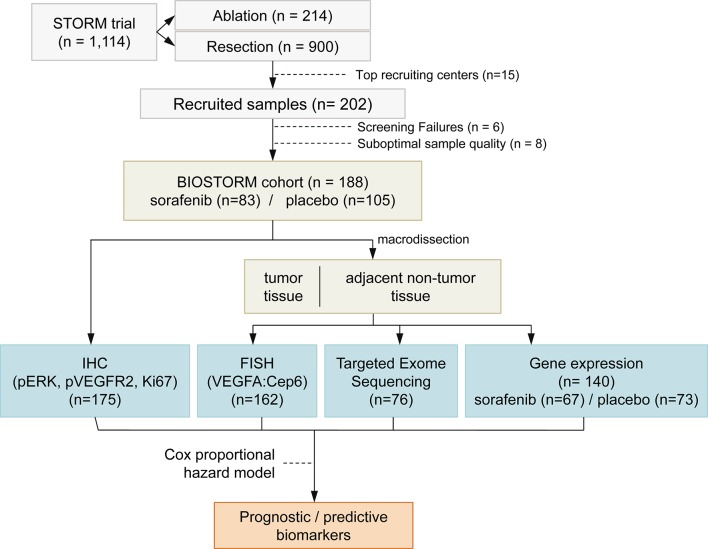
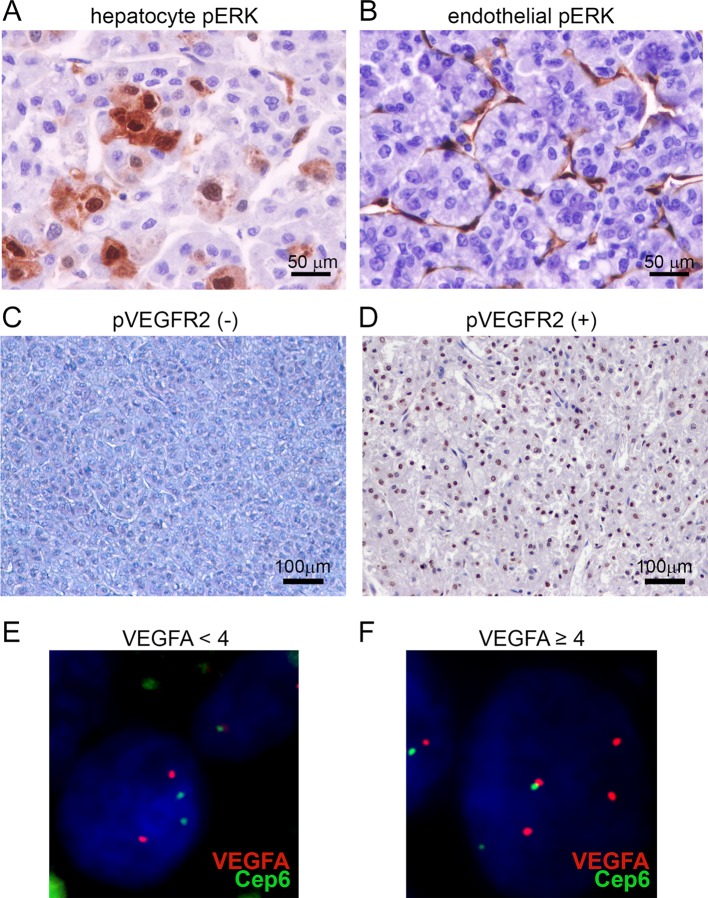
Tumour tissue from 188 patients randomised to receive sorafenib (83) or placebo (105) in the STORM trial was collected. Analyses included gene expression profiling, targeted exome sequencing (19 known oncodrivers), immunohistochemistry (pERK, pVEGFR2, Ki67), fluorescence in situ hybridisation (VEGFA) and immunome. A gene signature capturing improved RFS in sorafenib-treated patients was generated. All 70 RFS events were recurrences, thus time to recurrence equalled RFS. Predictive and prognostic value was assessed using Cox regression models and interaction test.
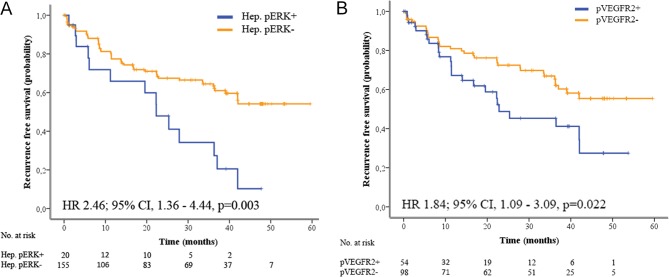
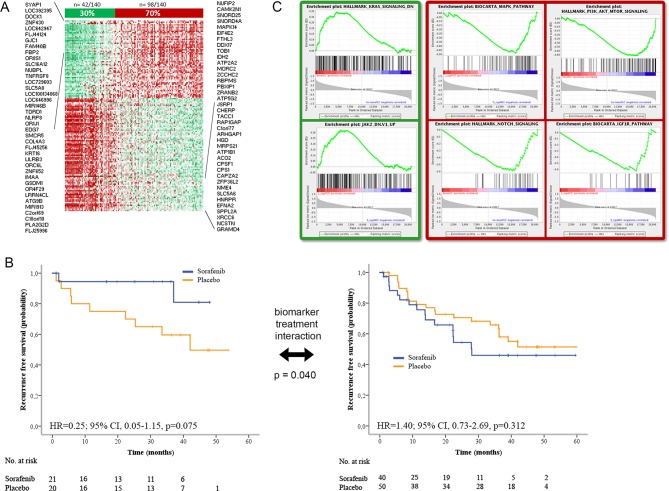
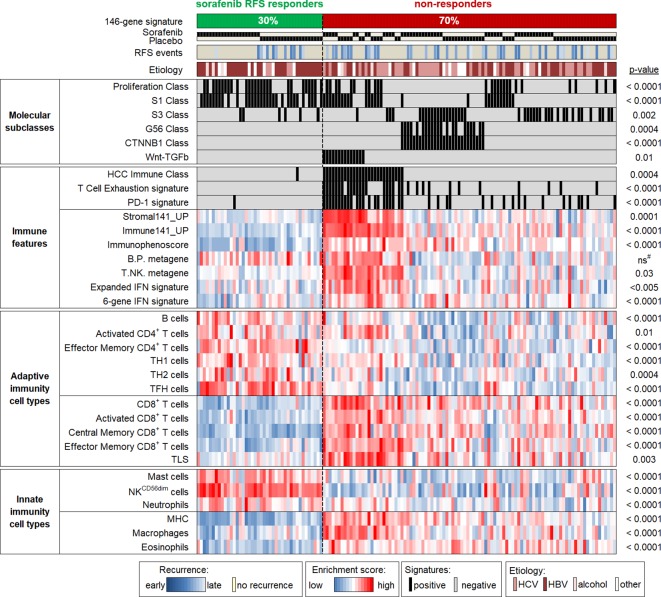
BIOSTORM recapitulates clinicopathological characteristics of STORM. None of the biomarkers tested (related to angiogenesis and proliferation) or previously proposed gene signatures, or mutations predicted sorafenib benefit or recurrence. A newly generated 146-gene signature identifying 30% of patients captured benefit to sorafenib in terms of RFS (p of interaction=0.04). These were significantly enriched in CD4 T, B and cytolytic natural killer cells, and lacked activated adaptive immune components. Hepatocytic pERK (HR=2.41; p=0.012) and microvascular invasion (HR=2.09; p=0.017) were independent prognostic factors.
In BIOSTORM, only hepatocytic pERK and microvascular invasion predicted poor RFS. No mutation, gene amplification or previously proposed gene signatures predicted sorafenib benefit. A newly generated multigene signature associated with improved RFS on sorafenib warrants further validation.
NCT00692770.
索拉非尼是晚期肝细胞癌(HCC)的标准系统治疗方法。早期 HCC 患者接受手术切除/局部消融治疗可获得生存获益,但 70%的患者在 5 年内会复发。III 期 STORM 试验比较了索拉非尼与安慰剂作为辅助治疗,未能达到改善无复发生存(RFS)的主要终点。伴随的生物标志物研究 BIOSTORM 的目的是确定(A)索拉非尼预防复发的预测因素,以及(B)具有 B 级证据水平的预后因素。
收集了来自随机接受索拉非尼(83 例)或安慰剂(105 例)治疗的 STORM 试验的 188 例患者的肿瘤组织。分析包括基因表达谱分析、靶向外显子测序(19 个已知的致癌驱动基因)、免疫组化(pERK、pVEGFR2、Ki67)、荧光原位杂交(VEGFA)和免疫组。生成了一个捕获索拉非尼治疗患者改善 RFS 的基因特征。所有 70 例 RFS 事件均为复发,因此复发时间等于 RFS。使用 Cox 回归模型和交互检验评估预测和预后价值。
BIOSTORM 再现了 STORM 的临床病理特征。未检测到任何生物标志物(与血管生成和增殖相关)或以前提出的基因特征,或突变预测索拉非尼的获益或复发。一个新生成的 146 基因特征确定了 30%的患者,这些患者在 RFS 方面从索拉非尼治疗中获益(交互检验的 p 值=0.04)。这些患者富含 CD4 T、B 和细胞毒性自然杀伤细胞,缺乏激活的适应性免疫成分。肝细胞质 pERK(HR=2.41;p=0.012)和微血管侵犯(HR=2.09;p=0.017)是独立的预后因素。
在 BIOSTORM 中,只有肝细胞质 pERK 和微血管侵犯预测 RFS 不良。没有突变、基因扩增或以前提出的基因特征预测索拉非尼的获益。与索拉非尼改善 RFS 相关的新生成的多基因特征需要进一步验证。
NCT00692770。