Division of Microbiology, National Center for Toxicological Research, U.S. Food and Drug Administration, Jefferson, Arkansas, USA.
Division of Biochemical Toxicology, National Center for Toxicological Research, U.S. Food and Drug Administration, Jefferson, Arkansas, USA.
mBio. 2018 Aug 14;9(4):e01418-18. doi: 10.1128/mBio.01418-18.
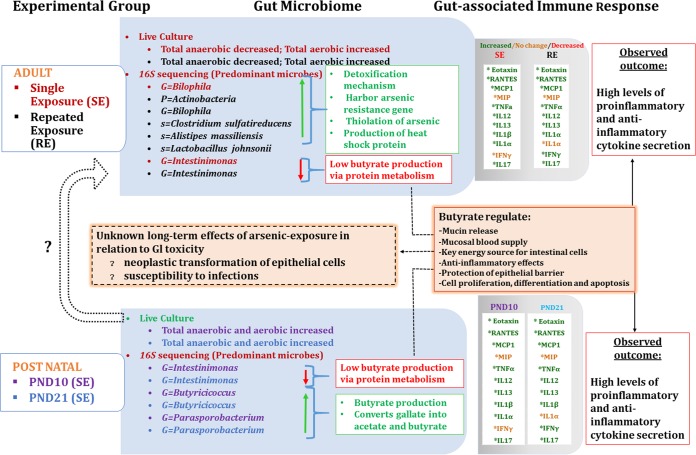
Intestinal microbiota composition and gut-associated immune response can contribute to the toxicity of arsenic. We investigated the potential toxicity of short-term arsenic exposure on gut microbiome composition, intestinal immune status, microbial arsenic resistance gene, and arsenic metabolic profiles in adult and developmental stages of CD-1 mice. The potential toxicity of arsenite [As(III)] was determined for two life stages: (i) adult animals at 24 or 48 h after single gavage (0.05 mg/kg body weight [b.w.] [low dose], 0.1 mg/kg b.w. [medium dose], and 0.2 mg/kg b.w. [high dose]) and repeated exposure at 1 mg/liter for 8 days and (ii) postnatal day 10 (PND10) and PND21 after single gavage (0.05 mg/kg b.w.). Dose- and time-dependent responses in bacterial recovery/microbial composition were observed in adults after a single gavage. Repeated exposure caused a transient decrease in the recovery of intestinal bacteria, a shift in the bacterial population with abundance of arsenic resistance genes, and evidence for host metabolism of arsenite into less-reactive trivalent methylated species. Arsenic exposure in adult animals induced high levels of CC chemokines and of proinflammatory and anti-inflammatory cytokine secretion in intestine. Arsenic exposure at PND21 resulted in the development of distinct bacterial populations. Results of this study highlight significant changes in the intestinal microbiome and gut-associated immune status during a single or repeated exposure to arsenic in juvenile and adult animals. The data warrant investigation of the long-term effects of oral arsenic exposure on the microbiome and of immune system development and responses. Transformation of organic arsenic to toxic inorganic arsenic (iAs) is likely carried out by intestinal bacteria, and iAs may alter the viability of certain microbial populations. This study addressed the impact of arsenic exposure on intestinal microbiota diversity and host gut-associated immune mediators during early development or adulthood using scenarios of acute or repeated doses. During acute arsenic exposure, animals developed defense functions characterized by higher abundances of bacteria that are involved in arsenic resistance or detoxification mechanisms. Arsenite had a negative effect on the abundance of bacterial species that are involved in the conversion of protein to butyrate, which is an alternative energy source in the intestine. The intestinal mucosal immune cytokine profile reflected a mechanism of protection from arsenic toxicity.
肠道微生物组成和肠道相关免疫反应可能导致砷的毒性。我们研究了短期砷暴露对成年和发育阶段 CD-1 小鼠肠道微生物组组成、肠道免疫状态、微生物砷抗性基因和砷代谢谱的潜在毒性。我们确定了亚砷酸盐 [As(III)] 的潜在毒性,研究了两个生命阶段:(i)成年动物在单次灌胃后 24 或 48 小时(0.05mg/kg 体重 [bw] [低剂量]、0.1mg/kg bw [中剂量] 和 0.2mg/kg bw [高剂量])和重复暴露于 1mg/L 8 天,以及(ii)出生后第 10 天(PND10)和第 21 天(PND21)单次灌胃(0.05mg/kg bw)。在成年动物单次灌胃后,观察到细菌回收/微生物组成的剂量和时间依赖性反应。重复暴露导致肠道细菌回收短暂减少,细菌种群发生变化,砷抗性基因丰度增加,宿主将亚砷酸盐代谢为反应性较低的三价甲基化物种的证据。成年动物砷暴露诱导肠道中 CC 趋化因子和促炎及抗炎细胞因子的高水平分泌。PND21 时的砷暴露导致了独特的细菌种群的发展。本研究强调了在幼年和成年动物单次或重复接触砷时,肠道微生物组和肠道相关免疫状态的显著变化。这些数据需要进一步研究口服砷暴露对微生物组和免疫系统发育和反应的长期影响。有机砷向有毒无机砷(iAs)的转化很可能是由肠道细菌完成的,而 iAs 可能会改变某些微生物种群的生存能力。本研究使用急性或重复剂量的场景,研究了砷暴露对早期发育或成年期肠道微生物多样性和宿主肠道相关免疫介质的影响。在急性砷暴露期间,动物发展出防御功能,表现为参与砷抗性或解毒机制的细菌丰度增加。亚砷酸盐对参与将蛋白质转化为丁酸盐的细菌种类的丰度产生负面影响,丁酸盐是肠道中的替代能源。肠道黏膜免疫细胞因子谱反映了一种对抗砷毒性的保护机制。