Zhu Qinheng, Chen Boyan, Zhang Fu, Zhang Baodan, Guo Yujie, Pang Mengtao, Huang Liang, Wang Tianjiao
Department of Personnel Management, Zhejiang Center for Disease Control and Prevention, Hangzhou, China.
Front Nutr. 2024 Jul 29;11:1448388. doi: 10.3389/fnut.2024.1448388. eCollection 2024.
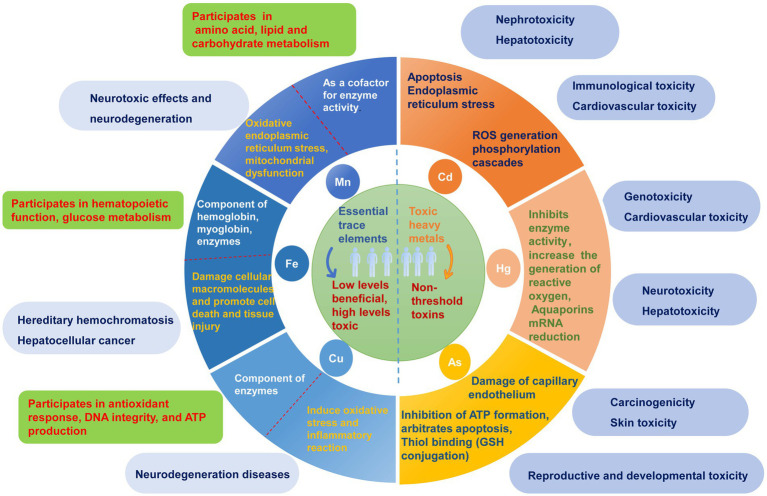
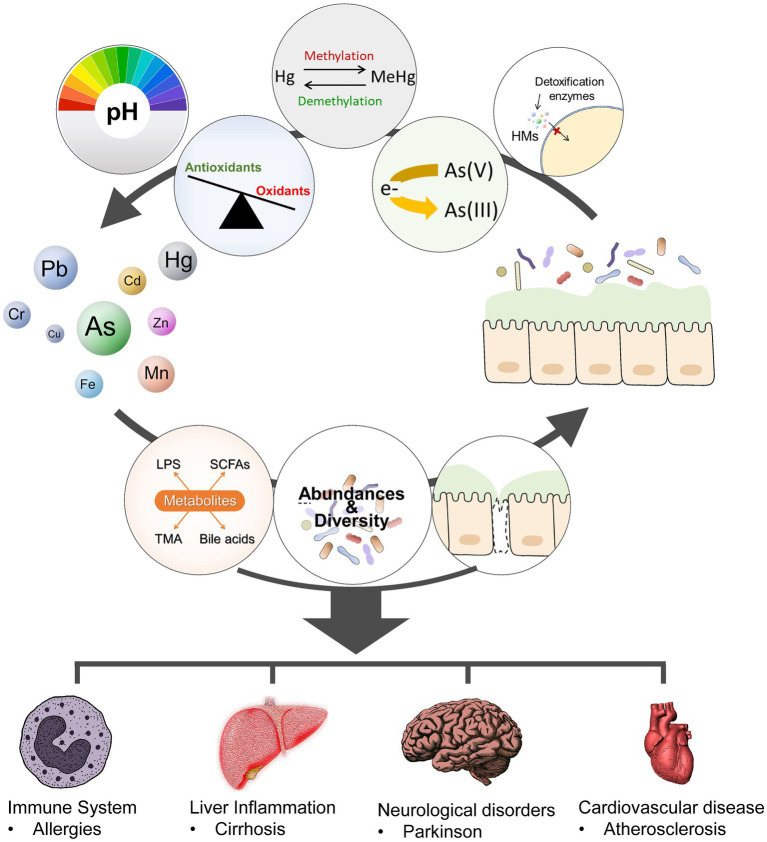
Human exposure to heavy metals, which encompasses both essential and toxic varieties, is widespread. The intestine functions as a critical organ for absorption and metabolism of heavy metals. Gut microbiota plays a crucial role in heavy metal absorption, metabolism, and related processes. Toxic heavy metals (THMs), such as arsenic (As), mercury (Hg), lead (Pb), and cadmium (Cd), can cause damage to multiple organs even at low levels of exposure, and it is crucial to emphasize their potential high toxicity. Nevertheless, certain essential trace elements, including iron (Fe), copper (Cu), and manganese (Mn), play vital roles in the biochemical and physiological functions of organisms at low concentrations but can exert toxic effects on the gut microbiota at higher levels. Some potentially essential micronutrients, such as chromium (Cr), silicon (Si), and nickel (Ni), which were considered to be intermediate in terms of their essentiality and toxicity, had different effects on the gut microbiota and their metabolites. Bidirectional relationships between heavy metals and gut microbiota have been found. Heavy metal exposure disrupts gut microbiota and influences its metabolism and physiological functions, potentially contributing to metabolic and other disorders. Furthermore, gut microbiota influences the absorption and metabolism of heavy metals by serving as a physical barrier against heavy metal absorption and modulating the pH, oxidative balance, and concentrations of detoxification enzymes or proteins involved in heavy metal metabolism. The interactions between heavy metals and gut microbiota might be positive or negative according to different valence states, concentrations, and forms of the same heavy metal. This paper reviews the metabolic interactions of 10 common heavy metals with the gut microbiota and their health implications. This collated information could provide novel insights into the disruption of the intestinal microbiota caused by heavy metals as a potential contributing factor to human diseases.
人类接触重金属的情况很普遍,其中既包括必需的重金属种类,也包括有毒的重金属种类。肠道是重金属吸收和代谢的关键器官。肠道微生物群在重金属的吸收、代谢及相关过程中起着至关重要的作用。有毒重金属(THMs),如砷(As)、汞(Hg)、铅(Pb)和镉(Cd),即使在低暴露水平下也会对多个器官造成损害,强调它们潜在的高毒性至关重要。然而,某些必需微量元素,包括铁(Fe)、铜(Cu)和锰(Mn),在低浓度时对生物体的生化和生理功能起着至关重要的作用,但在较高水平时会对肠道微生物群产生毒性作用。一些潜在的必需微量营养素,如铬(Cr)、硅(Si)和镍(Ni),在其必需性和毒性方面被认为处于中间状态,它们对肠道微生物群及其代谢产物有不同的影响。已发现重金属与肠道微生物群之间存在双向关系。重金属暴露会破坏肠道微生物群,影响其代谢和生理功能,可能导致代谢紊乱和其他疾病。此外,肠道微生物群通过作为重金属吸收的物理屏障以及调节参与重金属代谢的解毒酶或蛋白质的pH值、氧化平衡和浓度,来影响重金属的吸收和代谢。根据同一重金属的不同价态、浓度和形式,重金属与肠道微生物群之间的相互作用可能是正向的,也可能是负向的。本文综述了10种常见重金属与肠道微生物群的代谢相互作用及其对健康的影响。这些整理后的信息可以为重金属导致肠道微生物群紊乱作为人类疾病潜在促成因素提供新的见解。