Department of Biological Sciences, Vanderbilt University, Nashville, TN, 37235, USA.
Department of Physics, College of Science and Engineering, Kanazawa University, Kanazawa, 920-1192, Japan.
Nat Commun. 2018 Aug 14;9(1):3245. doi: 10.1038/s41467-018-05438-4.
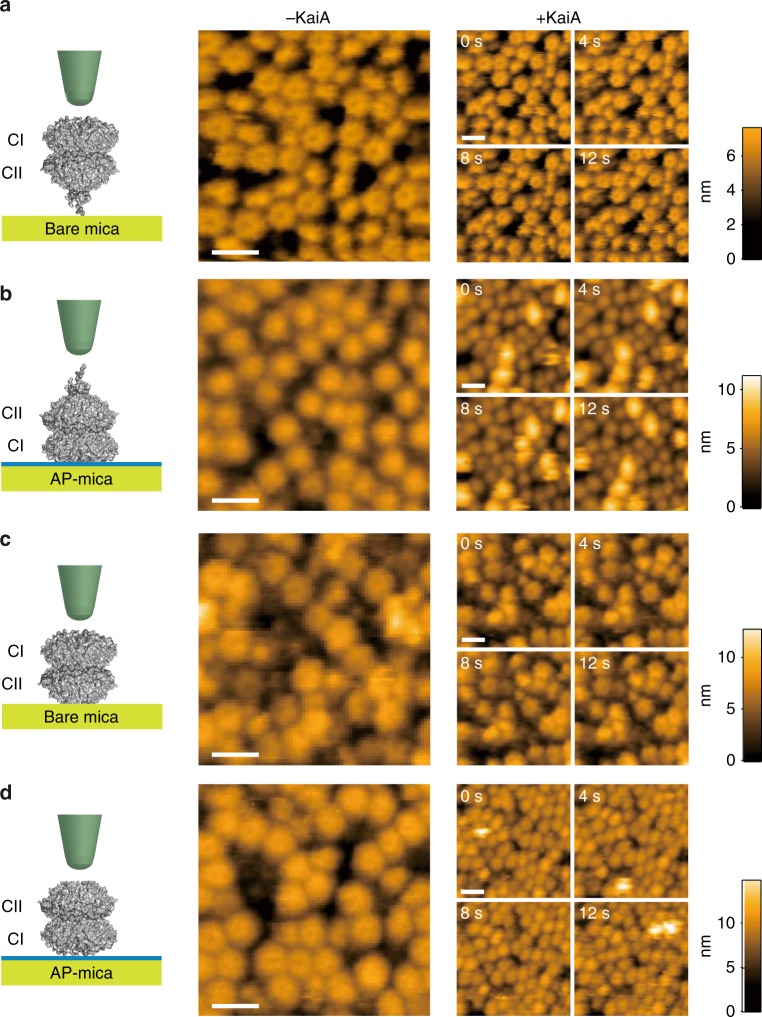
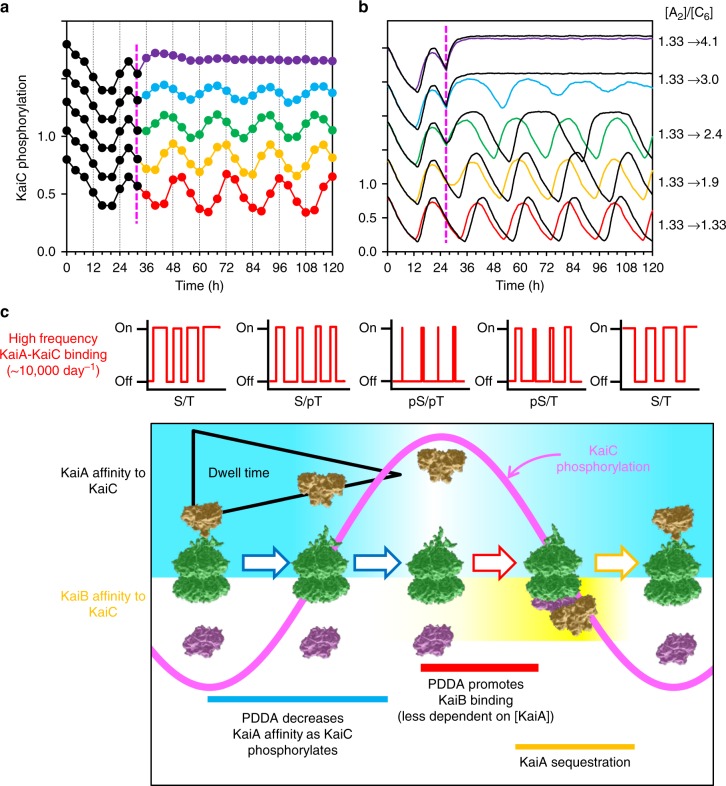
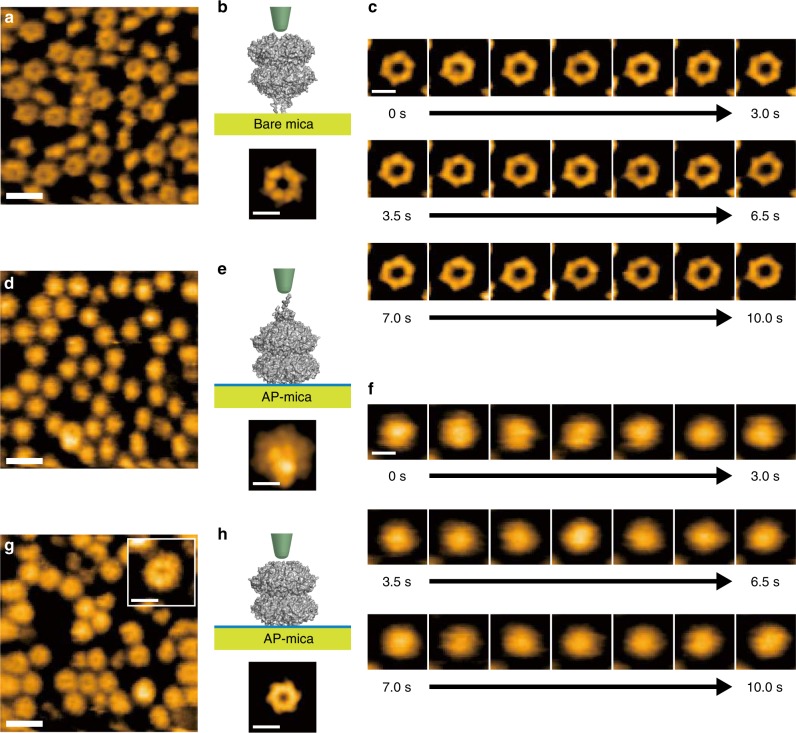
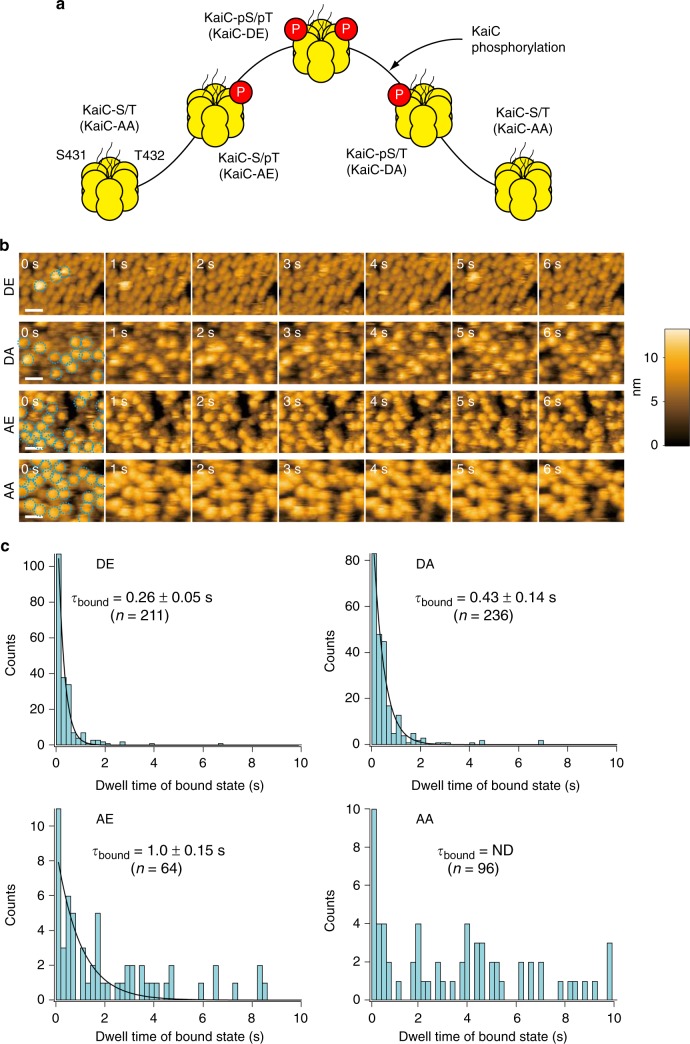
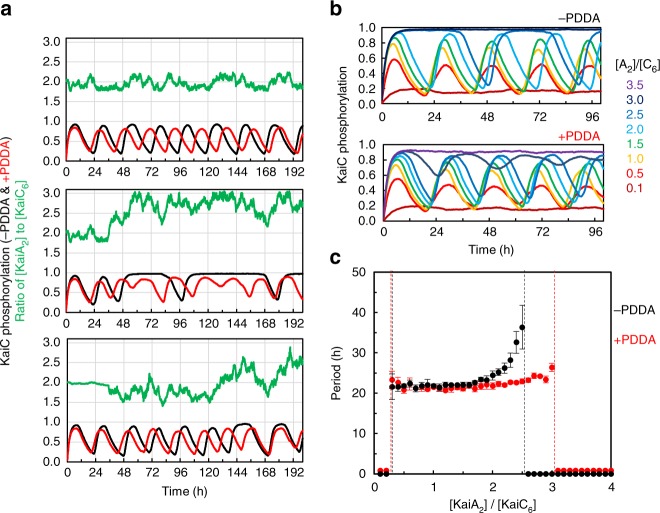
The circadian clock proteins KaiA, KaiB, and KaiC reconstitute a remarkable circa-24 h oscillation of KaiC phosphorylation that persists for many days in vitro. Here we use high-speed atomic force microscopy (HS-AFM) to visualize in real time and quantify the dynamic interactions of KaiA with KaiC on sub-second timescales. KaiA transiently interacts with KaiC, thereby stimulating KaiC autokinase activity. As KaiC becomes progressively more phosphorylated, KaiA's affinity for KaiC weakens, revealing a feedback of KaiC phosphostatus back onto the KaiA-binding events. These non-equilibrium interactions integrate high-frequency binding and unbinding events, thereby refining the period of the longer term oscillations. Moreover, this differential affinity phenomenon broadens the range of Kai protein stoichiometries that allow rhythmicity, explaining how the oscillation is resilient in an in vivo milieu that includes noise. Therefore, robustness of rhythmicity on a 24-h scale is explainable by molecular events occurring on a scale of sub-seconds.
生物钟蛋白 KaiA、KaiB 和 KaiC 重新构成了一个显著的约 24 小时的 KaiC 磷酸化振荡,这种振荡在体外可以持续数天。在这里,我们使用高速原子力显微镜 (HS-AFM) 实时可视化和定量测定 KaiA 与 KaiC 之间的动态相互作用,时间尺度在亚秒级。KaiA 与 KaiC 短暂相互作用,从而刺激 KaiC 自激酶活性。随着 KaiC 逐渐被磷酸化,KaiA 与 KaiC 的亲和力减弱,揭示了 KaiC 磷酸化状态对 KaiA 结合事件的反馈。这些非平衡相互作用整合了高频结合和解离事件,从而细化了较长时间振荡的周期。此外,这种差异亲和力现象拓宽了允许节律性的 Kai 蛋白化学计量比的范围,解释了为什么在包括噪声的体内环境中,振荡具有弹性。因此,在 24 小时尺度上的节律性的稳健性可以用亚秒级发生的分子事件来解释。