• 文献检索
  • 文档翻译
  • 深度研究
  • 学术资讯
  • Suppr Zotero 插件Zotero 插件
  • 邀请有礼
  • 套餐&价格
  • 历史记录
应用&插件
Suppr Zotero 插件Zotero 插件浏览器插件Mac 客户端Windows 客户端微信小程序
定价
高级版会员购买积分包购买API积分包
服务
文献检索文档翻译深度研究API 文档MCP 服务
关于我们
关于 Suppr公司介绍联系我们用户协议隐私条款
关注我们

Suppr 超能文献

核心技术专利:CN118964589B侵权必究
粤ICP备2023148730 号-1Suppr @ 2026

文献检索

告别复杂PubMed语法,用中文像聊天一样搜索,搜遍4000万医学文献。AI智能推荐,让科研检索更轻松。

立即免费搜索

文件翻译

保留排版,准确专业,支持PDF/Word/PPT等文件格式,支持 12+语言互译。

免费翻译文档

深度研究

AI帮你快速写综述,25分钟生成高质量综述,智能提取关键信息,辅助科研写作。

立即免费体验

整体加工需要一个大的大脑吗?来自蜜蜂和黄蜂在精细视觉识别任务中的见解。

Does Holistic Processing Require a Large Brain? Insights From Honeybees and Wasps in Fine Visual Recognition Tasks.

作者信息

Avarguès-Weber Aurore, d'Amaro Daniele, Metzler Marita, Finke Valerie, Baracchi David, Dyer Adrian G

机构信息

Centre de Recherches sur la Cognition Animale, Centre de Biologie Intégrative (CBI), Université de Toulouse, CNRS, UPS, Toulouse, France.

Institut für Zoologie III (Neurobiologie), Johannes Gutenberg Universität Mainz, Mainz, Germany.

出版信息

Front Psychol. 2018 Jul 31;9:1313. doi: 10.3389/fpsyg.2018.01313. eCollection 2018.

DOI:10.3389/fpsyg.2018.01313
PMID:30108535
原文链接:https://pmc.ncbi.nlm.nih.gov/articles/PMC6079261/
Abstract

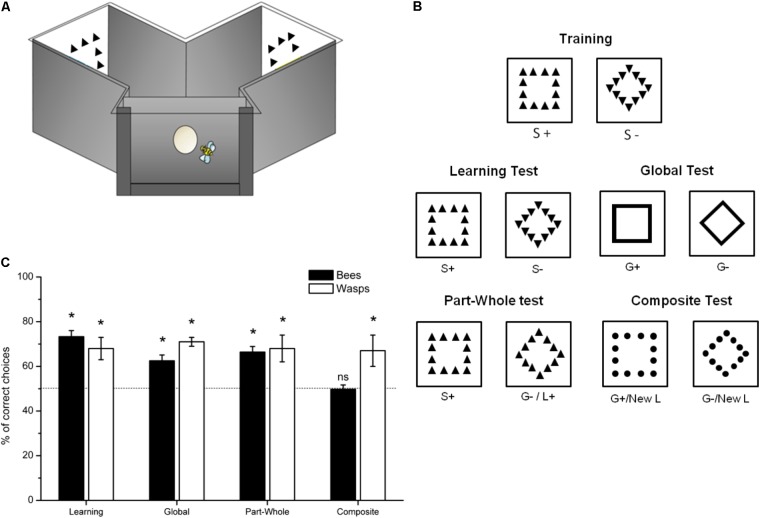
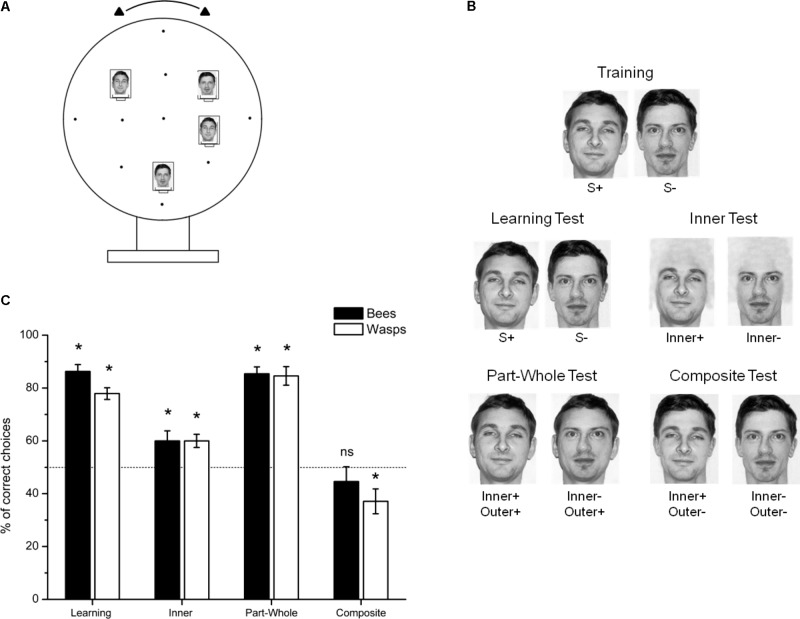
The expertise of humans for recognizing faces is largely based on holistic processing mechanism, a sophisticated cognitive process that develops with visual experience. The various visual features of a face are thus glued together and treated by the brain as a unique stimulus, facilitating robust recognition. Holistic processing is known to facilitate fine discrimination of highly similar visual stimuli, and involves specialized brain areas in humans and other primates. Although holistic processing is most typically employed with face stimuli, subjects can also learn to apply similar image analysis mechanisms when gaining expertise in discriminating novel visual objects, like becoming experts in recognizing birds or cars. Here, we ask if holistic processing with expertise might be a mechanism employed by the comparatively miniature brains of insects. We thus test whether honeybees () and/or wasps () can use holistic-like processing with experience to recognize images of human faces, or Navon-like parameterized-stimuli. These insect species are excellent visual learners and have previously shown ability to discriminate human face stimuli using configural type processing. Freely flying bees and wasps were consequently confronted with classical tests for holistic processing, the part-whole effect and the composite-face effect. Both species could learn similar faces from a standard face recognition test used for humans, and their performance in transfer tests was consistent with holistic processing as defined for studies on humans. Tests with parameterized stimuli also revealed a capacity of honeybees, but not wasps, to process complex visual information in a holistic way, suggesting that such sophisticated visual processing may be far more spread within the animal kingdom than previously thought, although may depend on ecological constraints.

摘要

人类识别面孔的专业能力很大程度上基于整体加工机制,这是一种随着视觉经验发展而来的复杂认知过程。因此,面孔的各种视觉特征被整合在一起,大脑将其视为一种独特的刺激,从而便于进行可靠的识别。众所周知,整体加工有助于对高度相似的视觉刺激进行精细辨别,并且涉及人类和其他灵长类动物的特定脑区。尽管整体加工最典型地用于面孔刺激,但当受试者在辨别新的视觉对象(如成为识别鸟类或汽车的专家)方面获得专业技能时,他们也可以学习应用类似的图像分析机制。在这里,我们要问,具有专业技能的整体加工是否可能是昆虫相对较小的大脑所采用的一种机制。因此,我们测试蜜蜂( )和/或黄蜂( )是否可以通过经验使用类似整体的加工来识别人类面孔图像或类纳冯参数化刺激。这些昆虫物种是优秀的视觉学习者,此前已显示出使用构型类型加工来辨别人类面孔刺激的能力。因此,自由飞行的蜜蜂和黄蜂面临着整体加工的经典测试,即部分 - 整体效应和合成面孔效应。这两个物种都可以从用于人类的标准人脸识别测试中学习相似的面孔,并且它们在迁移测试中的表现与针对人类研究所定义的整体加工一致。对参数化刺激的测试还揭示了蜜蜂(而非黄蜂)以整体方式处理复杂视觉信息的能力,这表明这种复杂的视觉加工在动物界的分布可能比以前认为的要广泛得多,尽管可能取决于生态限制。
https://cdn.ncbi.nlm.nih.gov/pmc/blobs/d1c3/6079261/174ae28fde97/fpsyg-09-01313-g002.jpg
https://cdn.ncbi.nlm.nih.gov/pmc/blobs/d1c3/6079261/7419e3ebba49/fpsyg-09-01313-g001.jpg
https://cdn.ncbi.nlm.nih.gov/pmc/blobs/d1c3/6079261/174ae28fde97/fpsyg-09-01313-g002.jpg
https://cdn.ncbi.nlm.nih.gov/pmc/blobs/d1c3/6079261/7419e3ebba49/fpsyg-09-01313-g001.jpg
https://cdn.ncbi.nlm.nih.gov/pmc/blobs/d1c3/6079261/174ae28fde97/fpsyg-09-01313-g002.jpg

相似文献

1
Does Holistic Processing Require a Large Brain? Insights From Honeybees and Wasps in Fine Visual Recognition Tasks.整体加工需要一个大的大脑吗?来自蜜蜂和黄蜂在精细视觉识别任务中的见解。
Front Psychol. 2018 Jul 31;9:1313. doi: 10.3389/fpsyg.2018.01313. eCollection 2018.
2
Individual recognition is associated with holistic face processing in paper wasps in a species-specific way.个体识别与整体面孔加工有关,而这种关系在纸黄蜂中具有物种特异性。
Proc Biol Sci. 2021 Jan 27;288(1943):20203010. doi: 10.1098/rspb.2020.3010. Epub 2021 Jan 20.
3
Honeybee (Apis mellifera) vision can discriminate between and recognise images of human faces.蜜蜂(西方蜜蜂)的视觉能够区分并识别人类面部图像。
J Exp Biol. 2005 Dec;208(Pt 24):4709-14. doi: 10.1242/jeb.01929.
4
Social experience drives the development of holistic face processing in paper wasps.社会经验驱动纸巢螟整体面孔加工能力的发展。
Anim Cogn. 2023 Mar;26(2):465-476. doi: 10.1007/s10071-022-01666-w. Epub 2022 Sep 6.
5
Configural processing enables discrimination and categorization of face-like stimuli in honeybees.形态加工使蜜蜂能够区分和分类类似面部的刺激。
J Exp Biol. 2010 Feb 15;213(4):593-601. doi: 10.1242/jeb.039263.
6
Multiple paths to holistic processing: Holistic processing of Gestalt stimuli do not overlap with holistic face processing in the same manner as do objects of expertise.通往整体加工的多种路径:格式塔刺激的整体加工与整体面部加工的重叠方式不同于专业对象。
Atten Percept Psychophys. 2019 Apr;81(3):716-726. doi: 10.3758/s13414-018-01643-x.
7
Behind the face of holistic perception: Holistic processing of Gestalt stimuli and faces recruit overlapping perceptual mechanisms.整体感知表象背后:格式塔刺激和面孔的整体加工调用重叠的感知机制。
Atten Percept Psychophys. 2019 Nov;81(8):2873-2880. doi: 10.3758/s13414-019-01749-w.
8
Can holistic processing be learned for inverted faces?对于倒置的面孔,整体加工能够被习得吗?
Cognition. 2003 May;88(1):79-107. doi: 10.1016/s0010-0277(03)00020-9.
9
The forest or the trees: preference for global over local image processing is reversed by prior experience in honeybees.森林还是树木:蜜蜂的先前经验会逆转其对整体而非局部图像处理的偏好。
Proc Biol Sci. 2015 Jan 22;282(1799):20142384. doi: 10.1098/rspb.2014.2384.
10
Inversion Impairs Expert Budgerigar Identity Recognition: A Face-Like Effect for a Nonface Object of Expertise.倒置会损害虎皮鹦鹉专家的身份识别:对专业领域的非面部物体产生类似面部的效应。
Perception. 2018 Jun;47(6):647-659. doi: 10.1177/0301006618771806. Epub 2018 Apr 24.

引用本文的文献

1
Examining Honeybee () Dominance Patterns Within Urban Bee Communities Worldwide.研究全球城市蜜蜂群落中的蜜蜂优势模式。
Ecol Evol. 2025 Aug 13;15(8):e71979. doi: 10.1002/ece3.71979. eCollection 2025 Aug.
2
The ability of teleost fishes to recognize individual faces suggests an early evolutionary origin in vertebrates.硬骨鱼识别个体面孔的能力表明其在脊椎动物中有着早期的进化起源。
Front Psychol. 2024 Nov 27;15:1497386. doi: 10.3389/fpsyg.2024.1497386. eCollection 2024.
3
Face processing in animal models: implications for autism spectrum disorder.

本文引用的文献

1
Sheep recognize familiar and unfamiliar human faces from two-dimensional images.绵羊能够从二维图像中识别出熟悉和不熟悉的人类面孔。
R Soc Open Sci. 2017 Nov 8;4(11):171228. doi: 10.1098/rsos.171228. eCollection 2017 Nov.
2
Are We Face Experts?我们是面部识别专家吗?
Trends Cogn Sci. 2018 Feb;22(2):100-110. doi: 10.1016/j.tics.2017.11.007. Epub 2017 Dec 15.
3
Perception of contextual size illusions by honeybees in restricted and unrestricted viewing conditions.在受限和非受限观察条件下,蜜蜂对环境大小错觉的感知。
动物模型中的面部处理:对自闭症谱系障碍的启示
Front Neurosci. 2024 Aug 9;18:1462272. doi: 10.3389/fnins.2024.1462272. eCollection 2024.
4
Quantity misperception by hymenopteran insects observing the solitaire illusion.膜翅目昆虫观察孤立错觉时的数量误判。
iScience. 2023 Dec 8;27(2):108697. doi: 10.1016/j.isci.2023.108697. eCollection 2024 Feb 16.
5
Social experience drives the development of holistic face processing in paper wasps.社会经验驱动纸巢螟整体面孔加工能力的发展。
Anim Cogn. 2023 Mar;26(2):465-476. doi: 10.1007/s10071-022-01666-w. Epub 2022 Sep 6.
6
Visual Perception of Photographs of Rotated 3D Objects in Goldfish ().金鱼对旋转三维物体照片的视觉感知()。
Animals (Basel). 2022 Jul 13;12(14):1797. doi: 10.3390/ani12141797.
7
Illusional Perspective across Humans and Bees.人类与蜜蜂之间的错觉视角。
Vision (Basel). 2022 May 31;6(2):28. doi: 10.3390/vision6020028.
8
Wild non-eusocial bees learn a colour discrimination task in response to simulated predation events.野生非社会性蜜蜂通过模拟捕食事件学会了颜色辨别任务。
Naturwissenschaften. 2021 Jun 21;108(4):28. doi: 10.1007/s00114-021-01739-9.
9
Einstein, von Frisch and the honeybee: a historical letter comes to light.爱因斯坦、冯·弗里希与蜜蜂:一封历史信件公诸于世。
J Comp Physiol A Neuroethol Sens Neural Behav Physiol. 2021 Jul;207(4):449-456. doi: 10.1007/s00359-021-01490-6. Epub 2021 May 10.
10
Individual recognition is associated with holistic face processing in paper wasps in a species-specific way.个体识别与整体面孔加工有关,而这种关系在纸黄蜂中具有物种特异性。
Proc Biol Sci. 2021 Jan 27;288(1943):20203010. doi: 10.1098/rspb.2020.3010. Epub 2021 Jan 20.
Proc Biol Sci. 2017 Nov 29;284(1867). doi: 10.1098/rspb.2017.2278.
4
Individual recognition and the 'face inversion effect' in medaka fish ().青鳉鱼的个体识别与“面孔倒置效应”
Elife. 2017 Jul 11;6:e24728. doi: 10.7554/eLife.24728.
5
Global/local processing of hierarchical visual stimuli in a conflict-choice task by capuchin monkeys (Sapajus spp.).卷尾猴(僧面猴属)在冲突选择任务中对分层视觉刺激的全局/局部处理
Anim Cogn. 2017 Mar;20(2):347-357. doi: 10.1007/s10071-016-1057-3. Epub 2016 Nov 17.
6
Facial patterns in a tropical social wasp correlate with colony membership.一种热带群居黄蜂的面部图案与群体成员身份相关。
Naturwissenschaften. 2016 Oct;103(9-10):80. doi: 10.1007/s00114-016-1406-8. Epub 2016 Sep 17.
7
Discrimination of human faces by archerfish (Toxotes chatareus).射水鱼(Toxotes chatareus)对人类面孔的辨别。
Sci Rep. 2016 Jun 7;6:27523. doi: 10.1038/srep27523.
8
Neural substrate for higher-order learning in an insect: Mushroom bodies are necessary for configural discriminations.昆虫高阶学习的神经基础:蘑菇体对于构型辨别是必需的。
Proc Natl Acad Sci U S A. 2015 Oct 27;112(43):E5854-62. doi: 10.1073/pnas.1508422112. Epub 2015 Oct 12.
9
Speed and accuracy in nest-mate recognition: a hover wasp prioritizes face recognition over colony odour cues to minimize intrusion by outsiders.巢穴伙伴识别中的速度与准确性:一种食蚜蝇优先通过面部识别而非群体气味线索来减少外来者的侵扰。
Proc Biol Sci. 2015 Mar 7;282(1802). doi: 10.1098/rspb.2014.2750.
10
The forest or the trees: preference for global over local image processing is reversed by prior experience in honeybees.森林还是树木:蜜蜂的先前经验会逆转其对整体而非局部图像处理的偏好。
Proc Biol Sci. 2015 Jan 22;282(1799):20142384. doi: 10.1098/rspb.2014.2384.