Centro de Investigaciones en Microbiología y Parasitología Tropical (CIMPAT), Facultad de Ciencias, Universidad de Los Andes, Bogotá, Colombia.
Laboratorio de Investigación en Parasitología Tropical, Facultad de Ciencias, Universidad del Tolima, Ibagué, Colombia.
PLoS Negl Trop Dis. 2018 Aug 15;12(8):e0006735. doi: 10.1371/journal.pntd.0006735. eCollection 2018 Aug.
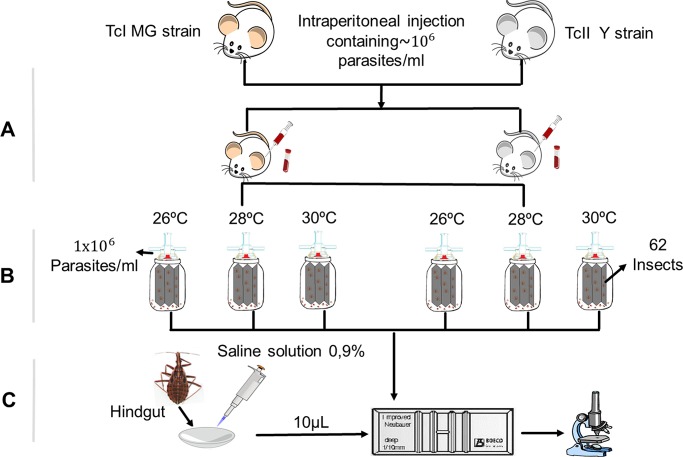
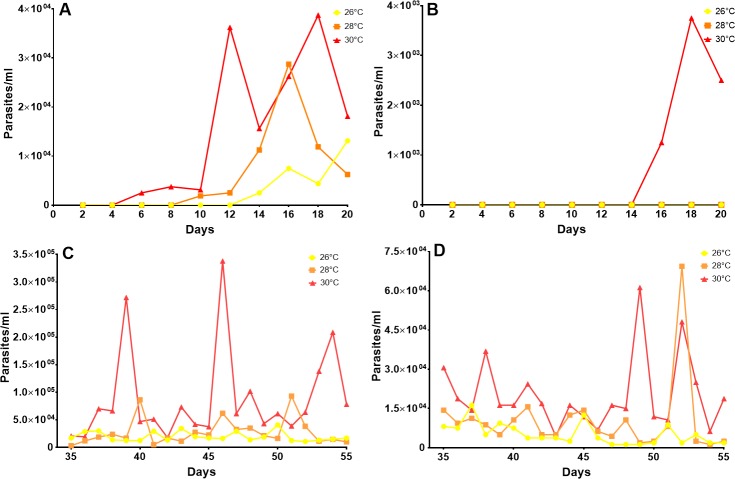
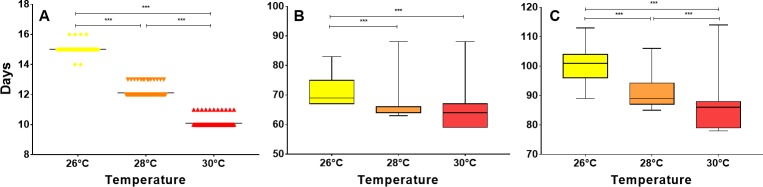
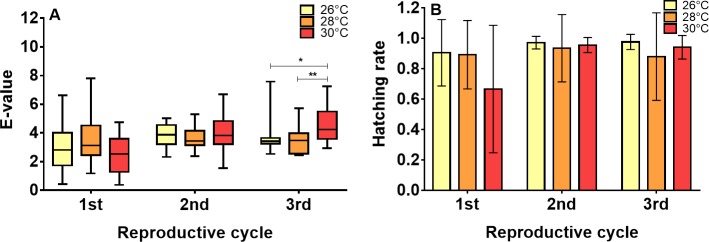
The increase in the global land temperature, expected under predictions of climate change, can directly affect the transmission of some infectious diseases, including Chagas disease, an anthropozoonosis caused by Trypanosoma cruzi and transmitted by arthropod vectors of the subfamily Triatominae. This work seeks to study the effects of temperature on the development of the life cycle, fertility and fecundity of the insect vector Rhodnius prolixus and on the metacyclogenesis of T. cruzi. All of the variables were subjected to 3 temperatures: 26°C, 28°C and 30°C. Hatching time was evaluated, along with time to fifth instar, time to adult, fecundity studied using the e-value, and egg viability during the first 3 reproductive cycles. In addition, the amounts of metacyclic trypomastigotes of the TcI and TcII DTUs in R. prolixus were evaluated from days 2 to 20 at two-day intervals and from weeks 6 to 8 post-infection. Decreases were observed in time to hatching (15-10 days on average) and in time to fifth instar (70-60 days on average) and transition to adult (100-85 days on average). No significant differences in egg viability were observed in any of the reproductive cycles evaluated, but an increase in fecundity was observed at 30°C during the third reproductive cycle. At 30°C, there was also an increase in the number of infective forms and a decrease in the time at which metacyclic trypomastigotes were detected in the rectal ampulla of the insects for both TcI and TcII. According to these results, the expected temperature increase under climate change would cause an increase in the number of insects and a greater probability of infection of the parasite, which affects the transmission of Chagas disease.
全球气温升高,预计气候变化的预测会对一些传染病的传播产生直接影响,包括恰加斯病,这是一种由克氏锥虫引起的人兽共患病,由三锥虫亚科的节肢动物媒介传播。这项工作旨在研究温度对昆虫媒介 Rhodnius prolixus 的生命周期发育、生育力和繁殖力以及克氏锥虫的循环生成的影响。所有变量都在 3 个温度下进行:26°C、28°C 和 30°C。评估了孵化时间,以及第五龄期、成虫期的时间、使用 e 值研究的生育力,以及前 3 个繁殖周期的卵活力。此外,还评估了 TcI 和 TcII DTU 的循环生成的 Rhodnius prolixus 中的循环生成的 Trypomastigotes 的量,从感染后第 2 天到第 20 天,每隔两天评估一次,从第 6 周到第 8 周评估一次。孵化时间(平均减少 15-10 天)和第五龄期(平均减少 70-60 天)以及成虫期过渡时间(平均减少 100-85 天)均缩短。在任何评估的繁殖周期中,卵活力均未观察到显著差异,但在第三个繁殖周期中在 30°C 时观察到生育力增加。在 30°C 时,在昆虫的直肠囊内也检测到感染性形式的数量增加,并且检测到循环生成的锥虫的时间减少,无论是 TcI 还是 TcII。根据这些结果,气候变化下预计的温度升高将导致昆虫数量增加,寄生虫感染的可能性增加,从而影响恰加斯病的传播。