Department of Obstetrics and Gynecology, College of Medicine, The Catholic University of Korea, Seoul, Republic of Korea.
Department of Biostatistics, College of Medicine, The Catholic University of Korea, Seoul, Republic of Korea.
PLoS One. 2018 Aug 15;13(8):e0202318. doi: 10.1371/journal.pone.0202318. eCollection 2018.
This study was conducted to analyze recent trends of multiple birth rates (MBR) and fetal/neonatal/infant mortalities according to the number of gestations in Korea.
Data from 2009 to 2015 of live births, infant deaths and stillbirths were obtained from the Korean Vital Statistics. Neonatal mortality rate (NMR), infant mortality rate (IMR), and fetal mortality rate (FMR) in singleton, twin and triplet pregnancies were analyzed according to gestational period (GP; ≤ 23, 24-27, 28-31, and 32-36 weeks).
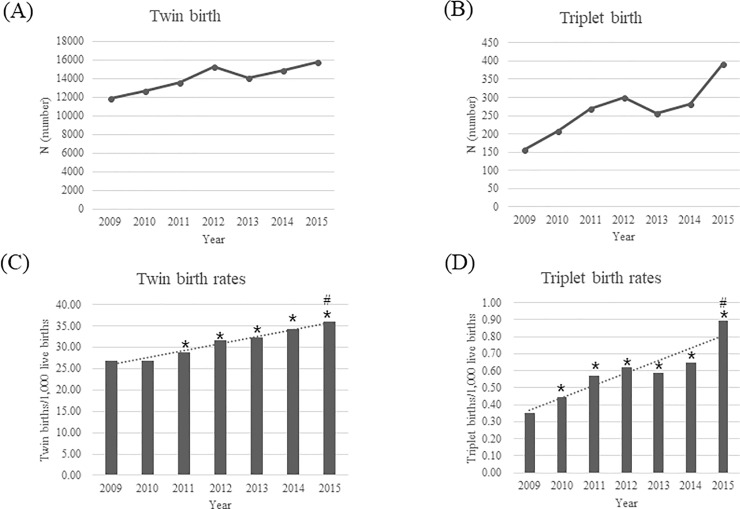
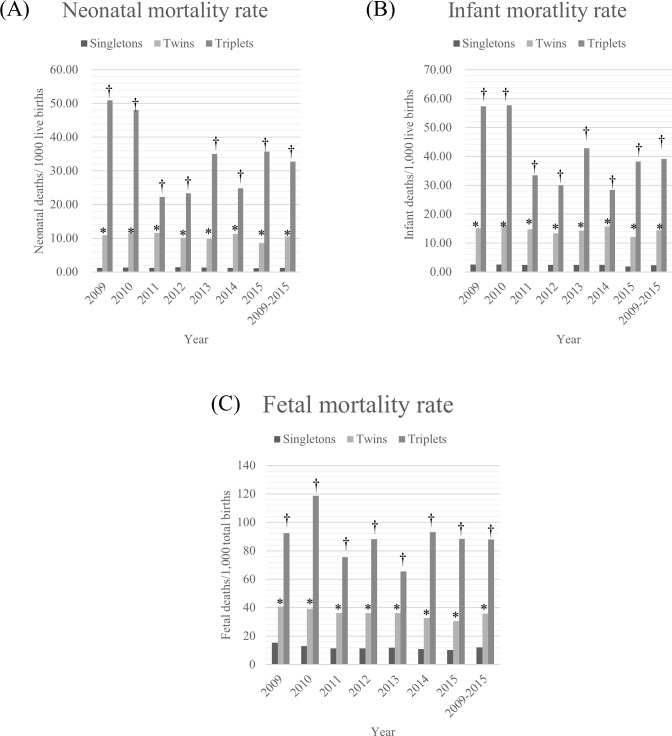
From 2009 to 2015, twin and triplet birth rates increased 34.5% and 154.3%, respectively. In twin births, NMR and FMR have been decreased significantly (from 10.92 to 8.62, p = 0.034 and from 41.00 to 30.55, p< 0.001, respectively), but IMR did not show significant decrease. There was no significant change of NMR, IMR, and FMR, in triplet births. Overall, in singleton, twin, and triplet births, NMR was 1.26 ± 0.09, 10.6 ± 1.12, and 34.32 ± 11.72, respectively, and IMR was 2.38 ± 0.26, 14.52 ± 1.38, and 41.13 ± 12.2, respectively. FMRs were 12 ± 1.73, 35.99 ± 3.55, and 88.85 ± 16.55, respectively, in singleton, twin, and triplet pregnancies. In spite of decreasing trends in overall mortalities, the odds ratios of NMRs and IMRs in 2015 were approximately 9-fold and 6-fold higher, respectively, in twin births, and approximately 37-fold and 20-fold higher, respectively, in triplet births, than those in singleton births. There were no significant differences in odds ratios of NMRs and IMRs at GP 32-36 among single, twin, and triplet births, although the odds ratios of FMR at GP 32-36 in triplet gestation was significantly higher than those in singleton and twin gestation.
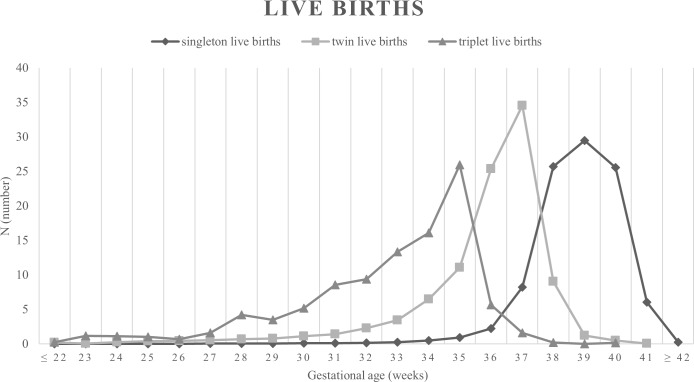
Neonatal/infant mortality in multiple births is still significantly high, which is mainly related with preterm birth. Close fetal monitoring is needed to prevent fetal death in triplet pregnancies, after 32 gestational weeks.
本研究旨在分析韩国不同孕周多胎妊娠的出生率(MBR)和胎儿/新生儿/婴儿死亡率的变化趋势。
本研究数据来源于韩国生命统计数据库 2009 年至 2015 年的活产儿、婴儿死亡和死胎数据。分析单胎、双胎和三胎妊娠的围产儿(23 周之前、24-27 周、28-31 周和 32-36 周)的新生儿死亡率(NMR)、婴儿死亡率(IMR)和胎儿死亡率(FMR)。
2009 年至 2015 年,双胎和三胎出生率分别增长了 34.5%和 154.3%。双胎妊娠的 NMR 和 FMR 显著下降(分别从 10.92 降至 8.62,p=0.034 和从 41.00 降至 30.55,p<0.001),但 IMR 没有显著下降。三胎妊娠的 NMR、IMR 和 FMR 没有显著变化。总体而言,在单胎、双胎和三胎妊娠中,NMR 分别为 1.26±0.09、10.6±1.12 和 34.32±11.72,IMR 分别为 2.38±0.26、14.52±1.38 和 41.13±12.2,FMR 分别为 12±1.73、35.99±3.55 和 88.85±16.55。尽管总体死亡率呈下降趋势,但与单胎妊娠相比,2015 年双胎妊娠的 NMR 和 IMR 比值分别约为 9 倍和 6 倍,三胎妊娠的 NMR 和 IMR 比值分别约为 37 倍和 20 倍。虽然三胎妊娠的 FMR 比值在 32-36 周的围产儿中明显高于单胎和双胎妊娠,但单胎、双胎和三胎妊娠的 32-36 周围产儿的 NMR 和 IMR 比值差异无统计学意义。
多胎妊娠的新生儿/婴儿死亡率仍然很高,主要与早产有关。三胎妊娠需要密切监测胎儿,以防止在 32 孕周后发生胎儿死亡。