Department of Otolaryngology-Head and Neck Surgery, Stanford University School of Medicine, Palo Alto, CA, USA, 94305.
Department of Structural Biology, Stanford University, Palo Alto, CA, USA, 94305.
Nucleic Acids Res. 2018 Oct 12;46(18):9793-9804. doi: 10.1093/nar/gky693.
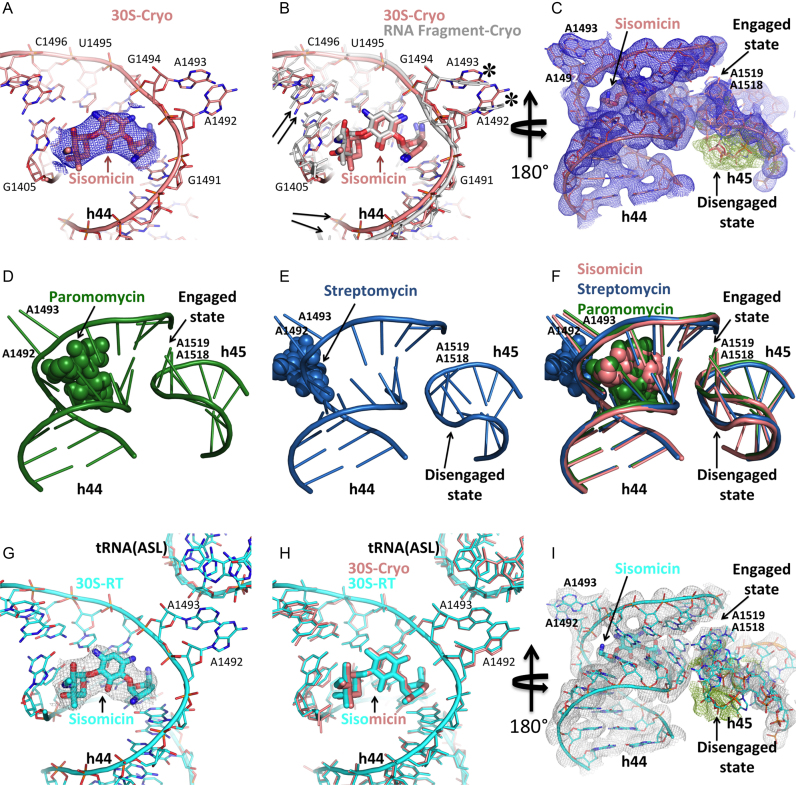
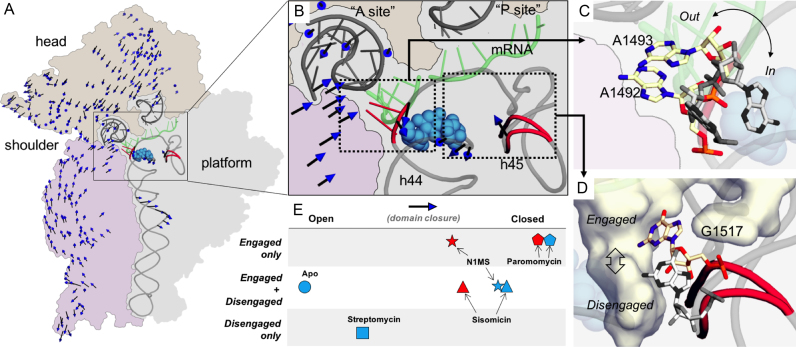
The bacterial 30S ribosomal subunit is a primary antibiotic target. Despite decades of discovery, the mechanisms by which antibiotic binding induces ribosomal dysfunction are not fully understood. Ambient temperature crystallographic techniques allow more biologically relevant investigation of how local antibiotic binding site interactions trigger global subunit rearrangements that perturb protein synthesis. Here, the structural effects of 2-deoxystreptamine (paromomycin and sisomicin), a novel sisomicin derivative, N1-methyl sulfonyl sisomicin (N1MS) and the non-deoxystreptamine (streptomycin) aminoglycosides on the ribosome at ambient and cryogenic temperatures were examined. Comparative studies led to three main observations. First, individual aminoglycoside-ribosome interactions in the decoding center were similar for cryogenic versus ambient temperature structures. Second, analysis of a highly conserved GGAA tetraloop of h45 revealed aminoglycoside-specific conformational changes, which are affected by temperature only for N1MS. We report the h44-h45 interface in varying states, i.e. engaged, disengaged and in equilibrium. Third, we observe aminoglycoside-induced effects on 30S domain closure, including a novel intermediary closure state, which is also sensitive to temperature. Analysis of three ambient and five cryogenic crystallography datasets reveal a correlation between h44-h45 engagement and domain closure. These observations illustrate the role of ambient temperature crystallography in identifying dynamic mechanisms of ribosomal dysfunction induced by local drug-binding site interactions. Together, these data identify tertiary ribosomal structural changes induced by aminoglycoside binding that provides functional insight and targets for drug design.
细菌 30S 核糖体亚基是主要的抗生素靶标。尽管经过了几十年的发现,但抗生素结合如何诱导核糖体功能障碍的机制仍未完全了解。环境温度晶体学技术允许更深入地研究局部抗生素结合位点相互作用如何引发全局亚基重排,从而扰乱蛋白质合成。在这里,研究了 2-脱氧链霉胺(巴龙霉素和西索米星)、新型西索米星衍生物 N1-甲基磺酰基西索米星(N1MS)和非脱氧链霉胺(链霉素)氨基糖苷类抗生素在环境温度和低温下对核糖体的结构影响。比较研究得出了三个主要观察结果。首先,低温与环境温度结构相比,在解码中心的单个氨基糖苷-核糖体相互作用相似。其次,对高度保守的 h45 GGAA 四链体的分析揭示了氨基糖苷特异性构象变化,而 N1MS 仅受温度影响。我们报告了 h44-h45 界面处于不同状态,即结合、脱离和平衡。第三,我们观察到氨基糖苷诱导的 30S 结构域闭合效应,包括一种新的中间闭合状态,这种状态也对温度敏感。对三个环境温度和五个低温晶体学数据集的分析表明,h44-h45 结合与结构域闭合之间存在相关性。这些观察结果说明了环境温度晶体学在确定局部药物结合位点相互作用诱导的核糖体功能障碍的动态机制中的作用。总之,这些数据确定了由氨基糖苷结合诱导的核糖体的三级结构变化,为药物设计提供了功能见解和靶标。