Zhou Chaomin, Peng Hongying, Yuan Jing, Lin Xin, Zha Yan, Chen Hui
Renal Division, Department of Medicine, Guizhou Provincial People's Hospital, Guizhou Provincial Institute of Nephritic and Urinary Disease, Guiyang, 550002, Guizhou, China.
Renal Division, Department of Medicine, Baiyun Hospital Affiliated to Guizhou Medical University, Guiyang, 550002, Guizhou, China.
BMC Nephrol. 2018 Aug 16;19(1):206. doi: 10.1186/s12882-018-0996-0.
Obesity is a well-established risk factor for atherosclerosis. However, it is unknown which measure of adiposity best relates to atherosclerosis in relatively lean maintenance hemodialysis (MHD) patients. We aimed to explore and compare the associations between different adiposity indices reflecting general, abdominal, visceral adiposity and arteriosclerosis risk with atherogenic index of plasma(AIP) in relatively lean MHD patients.
We conducted a multicenter, cross-sectional study in Guizhou Province, Southwest China. General/abdominal adiposity indices like body mass index (BMI), waist circumference(WC), waist-height ratio(WHtR), conicity index (Ci) and visceral obesity indices including visceral adiposity index (VAI), lipid accumulation product (LAP) and the hypertriglyceridemic waist phenotype (HW phenotype) were recorded. Univariate and multivariate linear regression models were used.
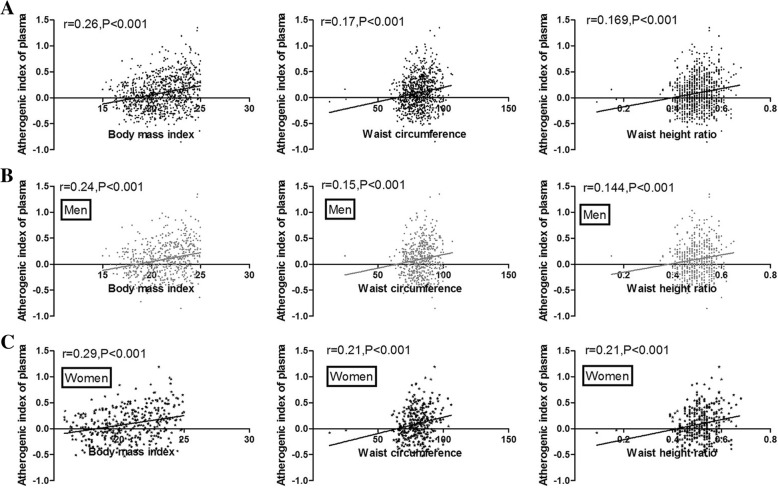
All adiposity indices correlated positively with AIP in univariate analysis both in men and women except for Ci. After adjustment for age and traditional atherosclerosis risk factors, BMI, WC, WHtR, VAI and LAP still had associations with AIP both in men (β = 0.265, 0.153, 0.16, 0.788 and 0.74, respectively, all P < 0.001) and women (β = 0.34,0.199, 0.21, 0.83 and 0.74, respectively, all P < 0.001). After further adjustment for BMI, associations between AIP and VAI, LAP remained significant, but associations between WC, WHtR and AIP disappeared.
The HW phenotype, VAI, and LAP, validated and convenient markers of visceral obesity, were superior to classical anthropometric general/ abdominal adiposity indices for atherosclerosis risk assessment, especially in relatively lean MHD patients aged 40 years or older.
肥胖是动脉粥样硬化公认的危险因素。然而,在相对瘦的维持性血液透析(MHD)患者中,哪种肥胖指标与动脉粥样硬化的关系最为密切尚不清楚。我们旨在探讨并比较反映全身、腹部、内脏肥胖的不同肥胖指数与相对瘦的MHD患者血浆致动脉粥样硬化指数(AIP)之间的关联。
我们在中国西南部的贵州省进行了一项多中心横断面研究。记录了体重指数(BMI)、腰围(WC)、腰高比(WHtR)、锥度指数(Ci)等全身/腹部肥胖指数,以及内脏肥胖指数,包括内脏脂肪指数(VAI)、脂质蓄积产物(LAP)和高甘油三酯血症腰围表型(HW表型)。使用单变量和多变量线性回归模型。
在单变量分析中,除Ci外,所有肥胖指数在男性和女性中均与AIP呈正相关。在调整年龄和传统动脉粥样硬化危险因素后,BMI、WC、WHtR、VAI和LAP在男性(β分别为0.265、0.153、0.16、0.788和0.74,均P<0.001)和女性(β分别为0.34、0.199、0.21、0.83和0.74,均P<0.001)中仍与AIP相关。在进一步调整BMI后,AIP与VAI、LAP之间的关联仍然显著,但WC、WHtR与AIP之间的关联消失。
HW表型、VAI和LAP是经过验证的方便的内脏肥胖标志物,在动脉粥样硬化风险评估方面优于经典的人体测量全身/腹部肥胖指数,尤其是在40岁及以上相对瘦的MHD患者中。