Department of Cardiovascular Medicine, the Second Affiliated Hospital of Nanchang University, No. 1 Minde Road, Nanchang of Jiangxi, 330006, China.
School of Medical Science and Engineering, Beihang University, Beijing, China.
BMC Cardiovasc Disord. 2020 Mar 5;20(1):115. doi: 10.1186/s12872-020-01388-2.
To date, the best adiposity index that predicts or associates strongly with hypertension remains controversial. Therefore, we aimed to compare the performance of different adiposity indices [BMI (body mass index), WC (waist circumference), WHtR (waist-to-height ratio), ABSI (a body shape index), VAI (visceral adipose index), BFP (body fat percentage)] as associates and potential predictors of risk of hypertension among Chinese population.
A cross-sectional survey was conducted in Jiangxi province, China from 2013 to 2014. A total of 14,573 participants were included in the study. The physical measurements included body height, weight, WC, BFP and VAI. Multivariate logistic regression analysis was performed to assess the associations between different adiposity indices and the prevalence of hypertension. Receiver operating characteristic (ROC) analysis was also performed.
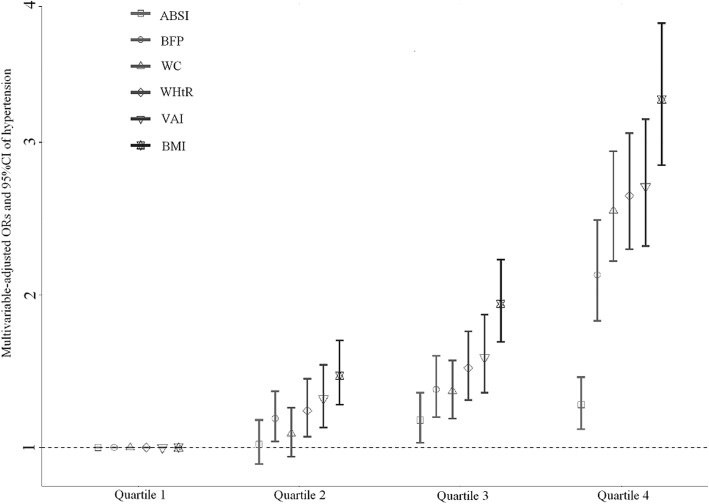
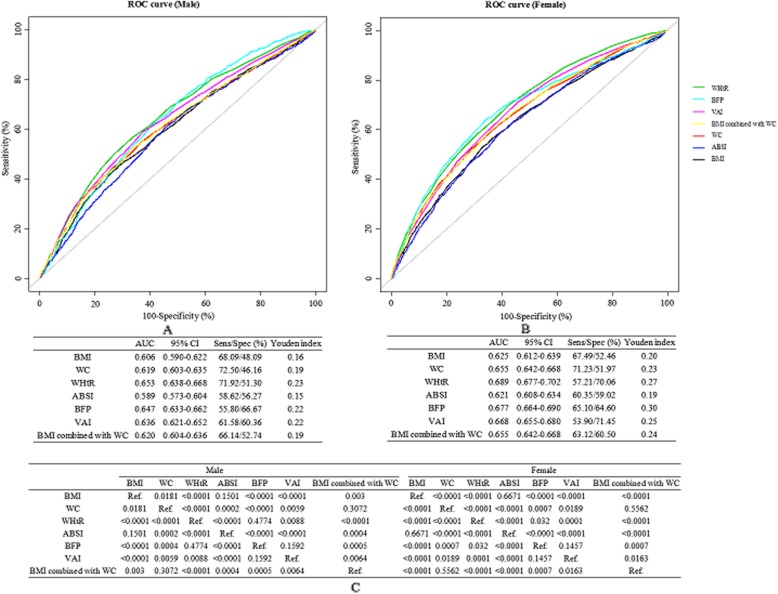
All adiposity indices were independently and positively associated with the prevalence of hypertension in a dose response fashion. The area under the curves (AUCs) for WHtR, BFP and VAI were significantly larger than those for other adiposity indices in both males and females (all P < 0.01). For males, no statistically significant difference was found in AUCs among WHtR and BFP (0.653 vs. 0.647, P = 0.4774). The AUC of WHtR was significantly higher than VAI (0.653 vs. 0.636, P < 0.01). For females, the AUCs demonstrated that WHtR was significantly more powerful than BFP and VAI (both P < 0.05) for predicting hypertension [WHtR, 0.689 (0.677-0.702); BFP, 0.677 (0.664-0.690); VAI, 0.668 (0.655-0.680)]. Whereas no significant differences were found in AUCs for hypertension among BFP and VAI in both sexes (all P > 0.1). The AUCs for hypertension associated with each adiposity index declined with age in both males and females. For subjects aged < 65 years, WHtR still had the largest AUC. However, for participants aged ≥65 years, BMI had the largest AUC.
The findings indicated that WHtR was the best for predicting hypertension, followed by BFP and VAI, especially in younger population.
迄今为止,能够准确预测或关联高血压的最佳肥胖指数仍存在争议。因此,我们旨在比较不同肥胖指数(BMI、WC、WHtR、ABSI、VAI、BFP)作为中国人群高血压风险的关联因素和潜在预测因素的表现。
本横断面研究于 2013 年至 2014 年在中国江西省进行。共纳入 14573 名参与者。身体测量包括身高、体重、WC、BFP 和 VAI。采用多变量 logistic 回归分析评估不同肥胖指数与高血压患病率之间的关系。还进行了受试者工作特征(ROC)分析。
所有肥胖指数均与高血压患病率呈剂量反应关系独立正相关。在男性和女性中,WHtR、BFP 和 VAI 的曲线下面积(AUCs)均显著大于其他肥胖指数(均 P<0.01)。对于男性,WHtR 和 BFP 的 AUC 之间没有统计学差异(0.653 比 0.647,P=0.4774)。WHtR 的 AUC 显著高于 VAI(0.653 比 0.636,P<0.01)。对于女性,WHtR 的 AUC 显著大于 BFP 和 VAI(均 P<0.05),用于预测高血压[WHtR,0.689(0.677-0.702);BFP,0.677(0.664-0.690);VAI,0.668(0.655-0.680)]。而在两性中,BFP 和 VAI 的 AUC 之间在高血压方面没有显著差异(均 P>0.1)。在男性和女性中,每个肥胖指数与高血压相关的 AUC 随年龄增长而下降。对于年龄<65 岁的受试者,WHtR 仍具有最大 AUC。然而,对于年龄≥65 岁的参与者,BMI 具有最大 AUC。
研究结果表明,WHtR 是预测高血压的最佳指标,其次是 BFP 和 VAI,尤其是在年轻人群中。