Matsuhisa Takaharu, Takahashi Noriyuki, Aomatsu Muneyoshi, Takahashi Kunihiko, Nishino Jo, Ban Nobutaro, Mercer Stewart W
Department of General Medicine/Family & Community Medicine Nagoya University Graduate School of Medicine, 65 Turumai-cho, Showa-ku, Nagoya, 466-8560, Japan.
Department of Education for Community-Oriented Medicine, Nagoya University Graduate School of Medicine, 65 Turumai-cho, Showa-ku, Nagoya, Japan.
BMC Fam Pract. 2018 Aug 16;19(1):138. doi: 10.1186/s12875-018-0826-2.
Empathy is widely regarded as being key to effective consultation in general practice. The Consultation and Relational Empathy (CARE) Measure is a widely used and well-validated patient-rated measure in English. A Japanese version of the CARE Measure has undergone preliminary validation, but its ability to differentiate between individual doctors has not been established. The current study sought to investigate the reliability of the Japanese version of the CARE Measure in terms of discrimination between doctors.
We conducted secondary analysis of a dataset involving 252 patients assessed by nine attending General Practitioners. The intra-cluster correlation coefficient was evaluated as an index of the reliability of the Japanese version of the CARE Measure for discriminating between doctors. With a criterion of intra-cluster correlation coefficient = 0.8, we conducted a decision (D) study using generalizability theory to determine the required number of patients for reliable CARE Measure estimates.
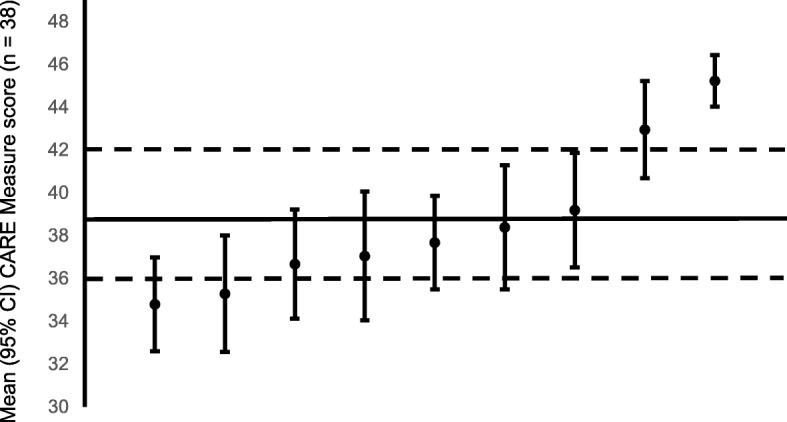
The ability of the CARE Measure to discriminate between doctors increased with the number of patients assessed per doctor. A sample size of 38 or more patients provided an average intra-cluster correlation coefficient of 0.8.
The Japanese CARE Measure appears to reliably discriminate between doctors with a feasible number of patient-ratings per doctor. Further studies involving larger numbers of doctors with a multicenter analysis are required to confirm the results of the current study, which was conducted at a single institution.
同理心被广泛认为是全科医疗中有效会诊的关键。会诊与关系同理心(CARE)量表是一种在英语环境中广泛使用且经过充分验证的患者自评量表。CARE量表的日语版本已经过初步验证,但其区分个体医生的能力尚未得到证实。本研究旨在探讨CARE量表日语版在区分医生方面的可靠性。
我们对一个数据集进行了二次分析,该数据集包含由9名全科主治医师评估的252名患者。组内相关系数被评估为CARE量表日语版区分医生可靠性的指标。以组内相关系数=0.8为标准,我们使用概化理论进行决策(D)研究,以确定可靠的CARE量表估计所需的患者数量。
CARE量表区分医生的能力随着每位医生评估的患者数量增加而提高。38名或更多患者的样本量提供了平均0.8的组内相关系数。
CARE量表日语版似乎能够通过每位医生可行数量的患者评分可靠地区分医生。需要进行涉及更多医生的多中心分析的进一步研究,以证实本在单一机构进行的研究结果。