Tea Research Institute, Chinese Academy of Agricultural Sciences, Hangzhou 310008, China.
Tea Research Institute, College of Horticulture, Nanjing Agricultural University, Nanjing 210095, China.
Int J Mol Sci. 2018 Aug 16;19(8):2414. doi: 10.3390/ijms19082414.
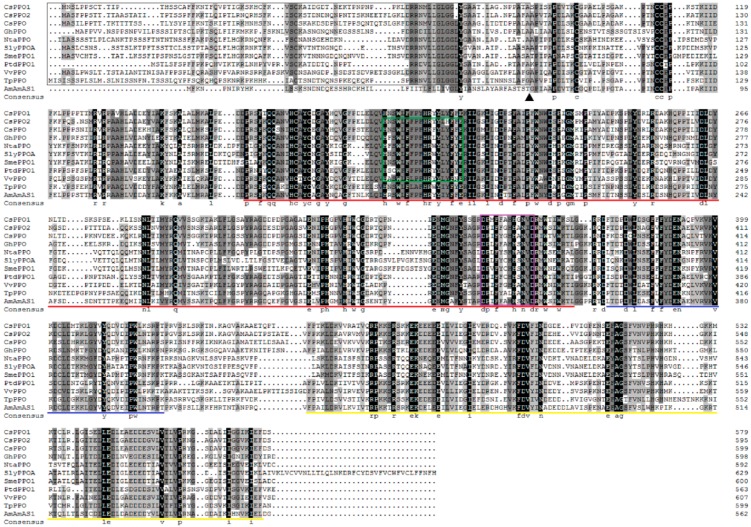
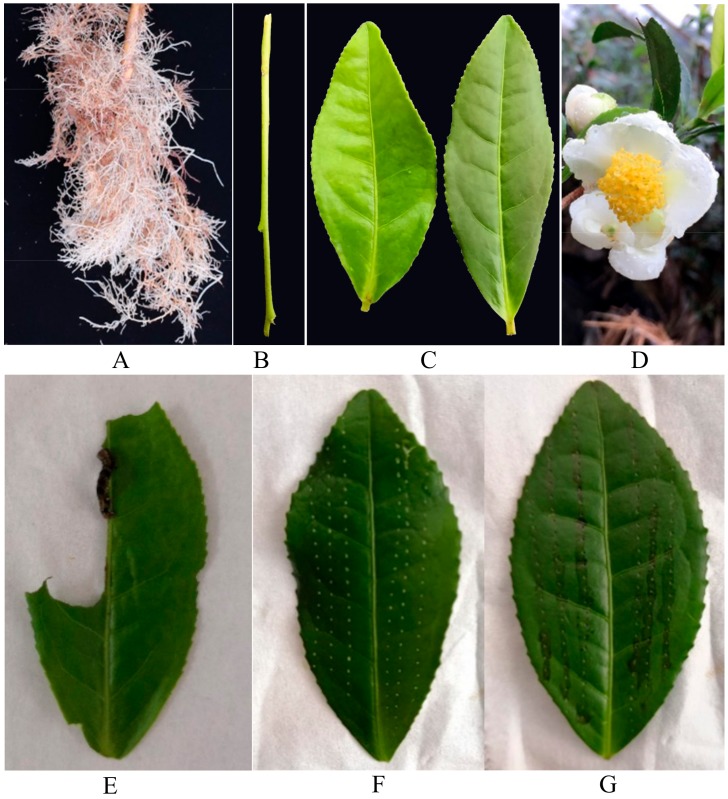
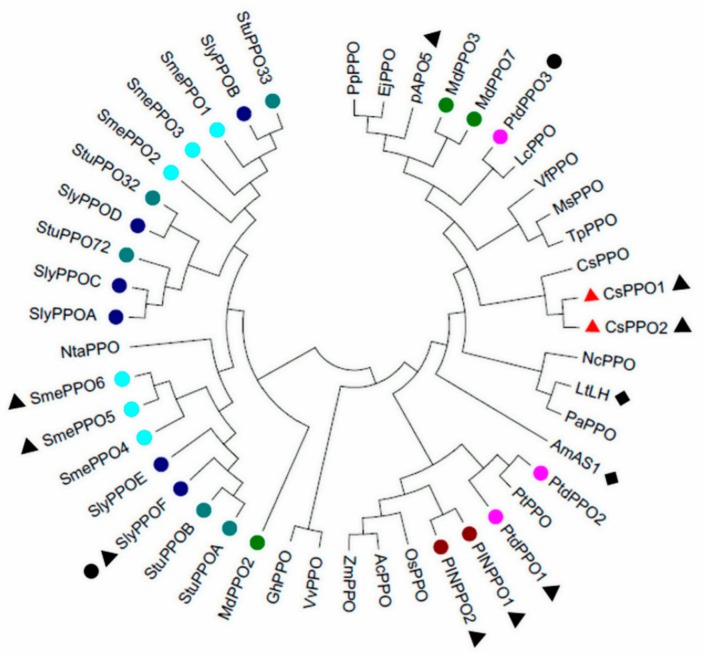
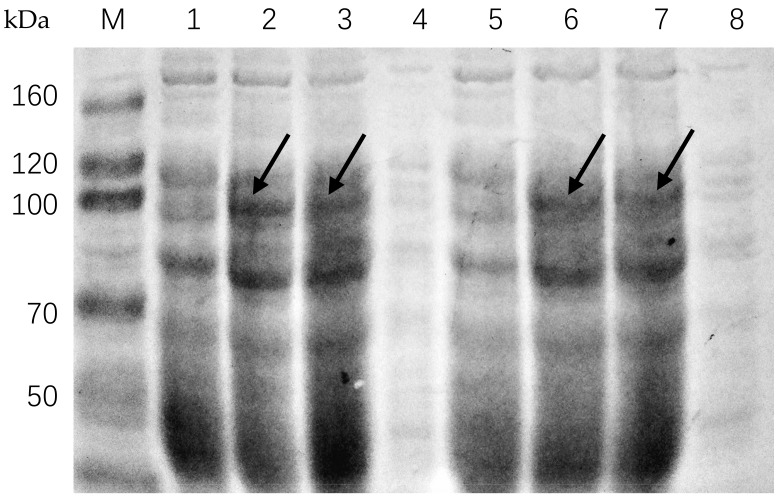
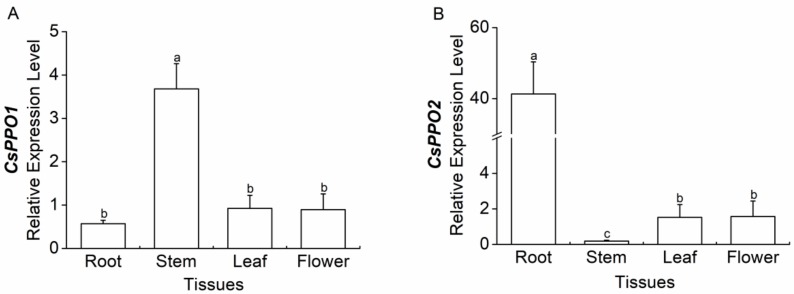
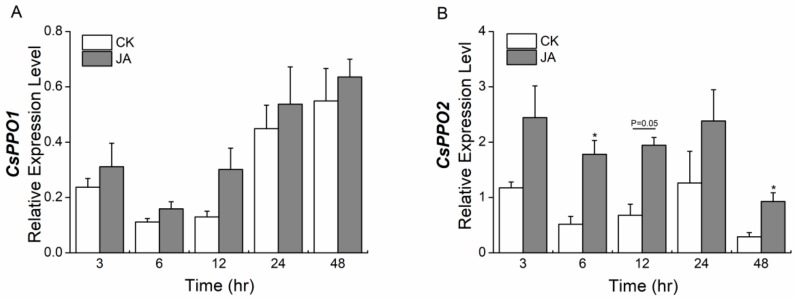
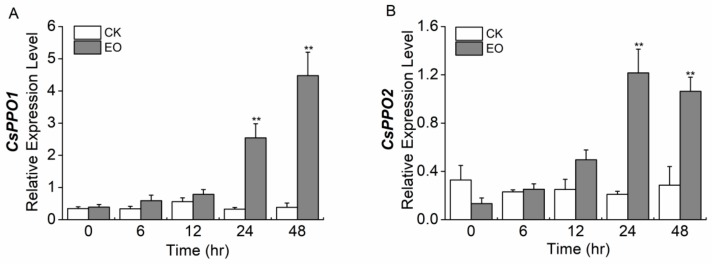
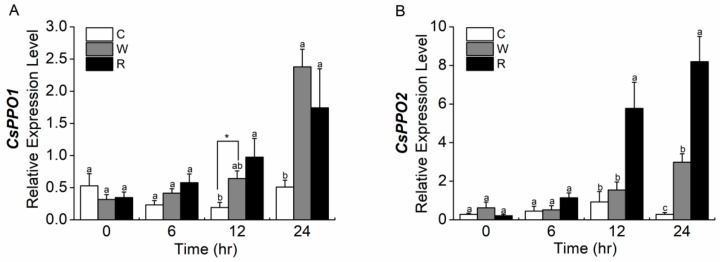
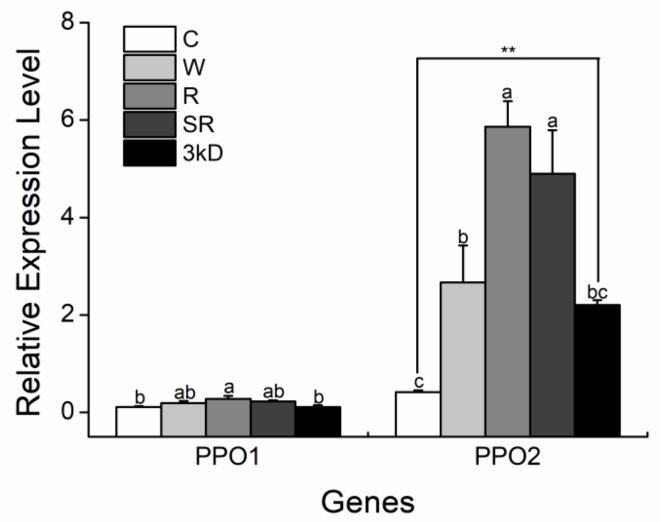
Polyphenol oxidases (PPOs) have been reported to play an important role in protecting plants from attacks by herbivores. Though PPO genes in other plants have been extensively studied, research on PPO genes in the tea plant () is lacking. In particular, which members of the PPO gene family elicit the defense response of the tea plant are as yet unknown. Here, two new PPO genes, and , both of which had high identity with PPOs from other plants, were obtained from tea leaves. The full length of contained an open reading frame (ORF) of 1740 bp that encoded a protein of 579 amino acids, while contained an ORF of 1788 bp that encoded a protein of 595 amino acids. The deduced CsPPO1 and CsPPO2 proteins had calculated molecular masses of 64.6 and 65.9 kDa; the isoelectric points were 6.94 and 6.48, respectively. The expression products of recombinant CsPPO1 and CsPPO2 in were about 91 and 92 kDa, respectively, but the recombinant proteins existed in the form of an inclusion body. Whereas is highly expressed in stems, is highly expressed in roots. Further results showed that the expression of and was wound- and -induced, and that regurgitant, unlike treatment with wounding plus deionized water, significantly upregulated the transcriptional expression of but not of . The difference between regurgitant and wounding indicates that may play a more meaningful defensive role against than . Meanwhile, we found the active component(s) of the regurgitant elicited by the expression of may contain small molecules (under 3-kDa molecular weight). These conclusions advance the understanding of the biological function of two new PPO genes and show that one of these, , may be a promising gene for engineering tea plants that are resistant to .
多酚氧化酶(PPO)已被报道在保护植物免受草食动物侵害方面发挥着重要作用。虽然其他植物中的 PPO 基因已得到广泛研究,但茶树()中的 PPO 基因研究却很缺乏。特别是,PPO 基因家族的哪些成员会引起茶树的防御反应尚不清楚。在这里,从茶叶中获得了两个新的 PPO 基因和,它们与其他植物的 PPO 具有高度的同源性。全长的包含一个开放阅读框(ORF),长 1740bp,编码一个 579 个氨基酸的蛋白质,而则包含一个长 1788bp 的 ORF,编码一个 595 个氨基酸的蛋白质。推导的 CsPPO1 和 CsPPO2 蛋白的计算分子量分别为 64.6 和 65.9 kDa;等电点分别为 6.94 和 6.48。在中表达的重组 CsPPO1 和 CsPPO2 的表达产物分别约为 91 和 92 kDa,但重组蛋白以包涵体的形式存在。而在茎中高度表达,在根中高度表达。进一步的结果表明,和的表达受到伤害和茉莉酸甲酯的诱导,而不同于处理伤害加去离子水,吐液显著上调了的转录表达,但不影响的表达。吐液与伤害之间的差异表明,可能比更有意义地发挥针对的防御作用。同时,我们发现由表达引起的吐液的活性成分(s)可能包含小分子(分子量低于 3 kDa)。这些结论推进了对两个新 PPO 基因的生物学功能的理解,并表明其中之一,可能是工程茶树抵抗的有前途的基因。