Yatsugi Aya, Morishita Takashi, Fukuda Hiroyuki, Kotani Naoya, Yagi Kenji, Abe Hiroshi, Shiota Etsuji, Inoue Tooru
Department of Neurological Surgery, Fukuoka University Faculty of Medicine, Fukuoka, Japan.
Department of Rehabilitation Medicine, Fukuoka University Hospital, Fukuoka, Japan.
Appl Bionics Biomech. 2018 Jul 10;2018:7435746. doi: 10.1155/2018/7435746. eCollection 2018.
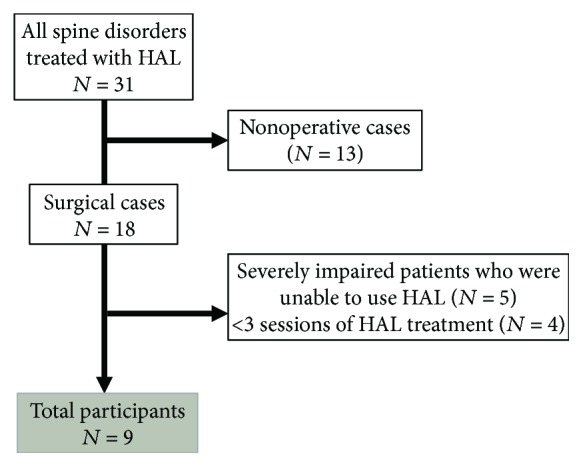
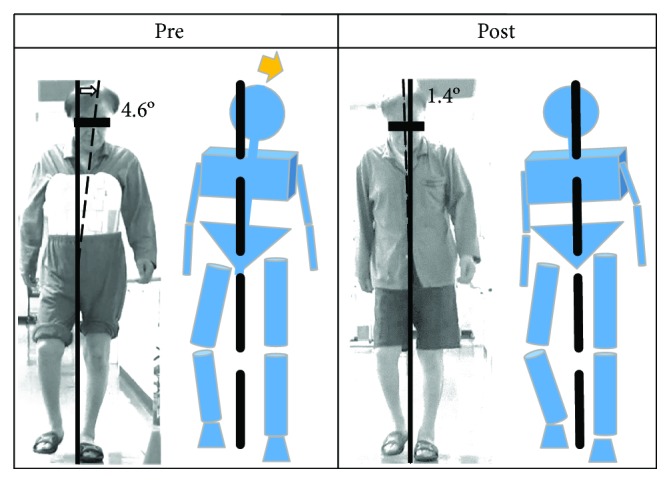
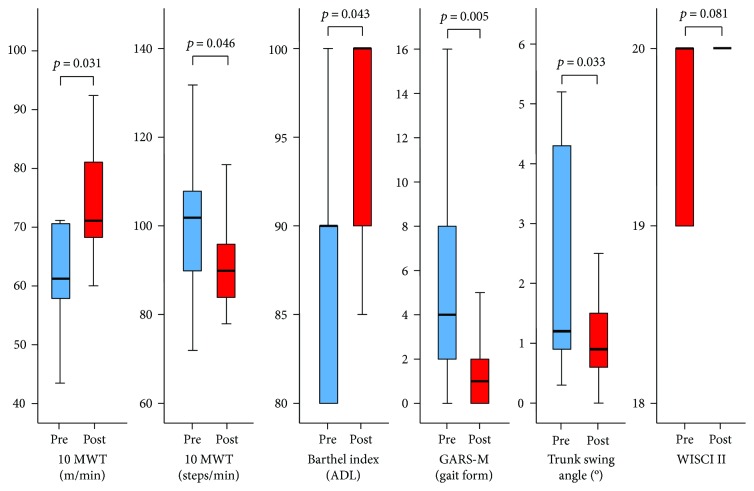
Recent studies of robotic rehabilitation have demonstrated its efficacy for neurological disorders. However, few studies have used the Hybrid Assistive Limb (HAL) during the early postoperative stage of spine disorders. We aimed to evaluate the safety and efficacy of HAL treatment during the early postoperative period for spine disorder patients. We retrospectively identified patients who underwent spine surgery and who could complete HAL treatment. We evaluated the 10-m walking test (10MWT), the modified Gait Abnormality Rating Scale (GARS-M), Barthel Index (BI), and the walking index for spinal cord injury II (WISCI II) score results before and after robotic rehabilitation. Clinical outcomes were compared after treatment. We included nine patients with various spine problems. After HAL treatment, the speed during the 10MWT significantly improved from 64.1 ± 16.0 to 74.8 ± 10.8 m/min, and the walking cadence decreased from 102.7 ± 17.6 to 92.7 ± 10.9 steps/min. The BI score also improved from 83.3 ± 16.0 to 95.6 ± 5.8, and the WISCI II score improved from 19.7 ± 0.5 to 20.0 ± 0.0. Furthermore, the total GARS-M score improved from 6.0 ± 5.7 to 2.3 ± 3.3. The maximum angles of the trunk swing were improved from 2.2 ± 1.9 to 1.2 ± 0.9 degrees. Neurorehabilitation therapy using HAL for spinal surgery patients was considered feasible following spine surgery.
近期关于机器人康复的研究已证明其对神经系统疾病的疗效。然而,很少有研究在脊柱疾病术后早期使用混合辅助肢体(HAL)。我们旨在评估HAL治疗在脊柱疾病患者术后早期的安全性和疗效。我们回顾性地确定了接受脊柱手术且能够完成HAL治疗的患者。我们评估了机器人康复前后的10米步行测试(10MWT)、改良步态异常评分量表(GARS-M)、Barthel指数(BI)以及脊髓损伤步行指数II(WISCI II)评分结果。治疗后比较临床结果。我们纳入了9例患有各种脊柱问题的患者。经过HAL治疗后,10MWT期间的速度从64.1±16.0显著提高到74.8±10.8米/分钟,步行节奏从102.7±17.6降至92.7±10.9步/分钟。BI评分也从83.3±16.0提高到95.6±5.8,WISCI II评分从19.7±0.5提高到20.0±0.0。此外,GARS-M总分从6.0±5.7提高到2.3±3.3。躯干摆动的最大角度从2.2±1.9改善到1.2±0.9度。对脊柱手术患者使用HAL进行神经康复治疗被认为在脊柱手术后是可行的。