Liu Feng, Zhang Jing, Qian Jianmin, Wu Gang, Ma Zhenyu
Department of Integrative Medicine, Huashan Hospital, Fudan University, Shanghai 200040, P.R. China.
Nursing Center, Huashan Hospital, Fudan University, Shanghai 200040, P.R. China.
Exp Ther Med. 2018 Aug;16(2):657-664. doi: 10.3892/etm.2018.6284. Epub 2018 Jun 8.
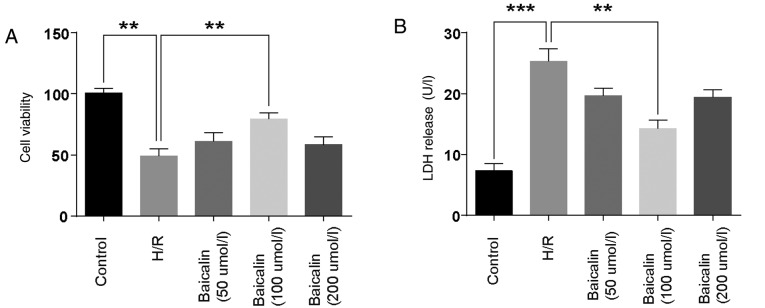
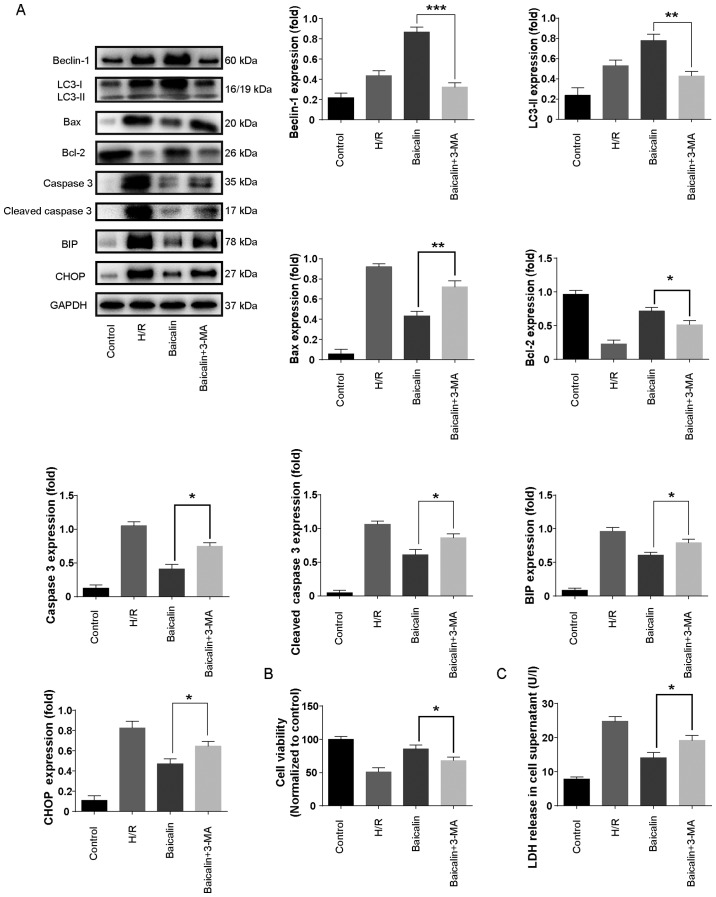
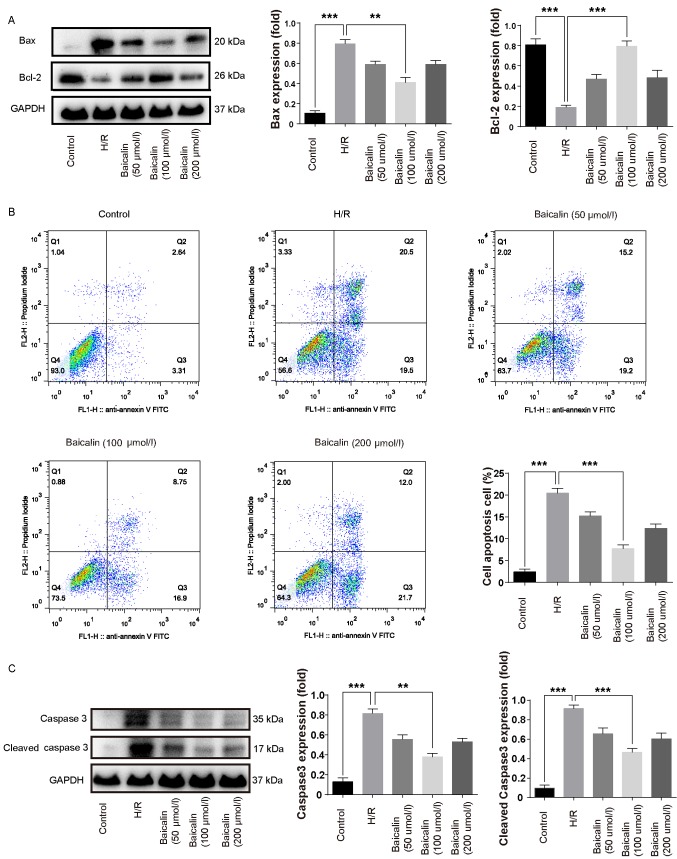
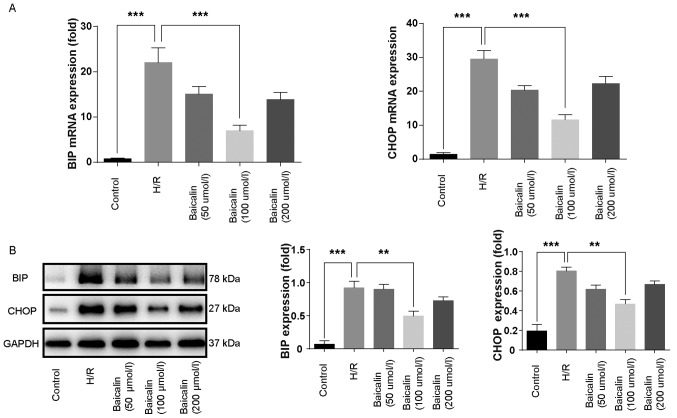
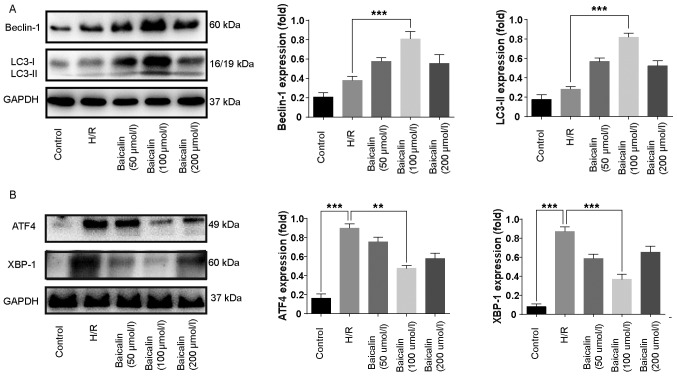
The aim of the present study was to explore the effect of baicalin on liver hypoxia/reoxygenation (H/R) injury and the possible mechanism involved. A cellular H/R model was established and cells were treated with 50, 100 and 200 µmol/l baicalin. Following reoxygenation for 6 h, cell viability, lactate dehydrogenase (LDH), B-cell lymphoma 2 (Bcl-2), Bcl-2-associated X protein (Bax), caspase 3 and cleaved caspase 3 were assessed. Furthermore, levels of endoplasmic reticulum stress markers binding of immunoglobulin protein (BIP) and CCAAT/enhancer-binding protein homologous protein (CHOP) and autophagy markers microtubule-associated proteins 1A/1B light chain 3B (LC3) and beclin 1 were measured. To confirm the involvement of autophagy in baicalin-mediated attenuation of H/R injury, the autophagy inhibitor 3-methyladenine (3-MA) was administered. The results revealed that baicalin administration increased cell viability and decreased LDH levels, most notably at a dosage of 100 µmol/l. Baicalin pretreatment also downregulated the expression of caspase 3, cleaved caspase 3 and Bax, while upregulating the expression of Bcl-2. Furthermore, BIP and CHOP were decreased while LC3 and beclin-1 were significantly increased by baicalin pretreatment. Inhibiting autophagy using 3-MA, resulted in a significant decrease in LC3-II, beclin-1 and LDH, as well as increase in the expression of BIP, CHOP, caspase 3, cleaved caspase 3 and Bax. Bcl-2 and cell viability were also decreased. In conclusion, the results of the present study indicate that baicalin exerts a protective effect on liver H/R injury and this may be achieved via the induction of autophagy.
本研究的目的是探讨黄芩苷对肝脏缺氧/复氧(H/R)损伤的影响及其可能的作用机制。建立细胞H/R模型,并用50、100和200μmol/L的黄芩苷处理细胞。复氧6小时后,评估细胞活力、乳酸脱氢酶(LDH)、B细胞淋巴瘤2(Bcl-2)、Bcl-2相关X蛋白(Bax)、半胱天冬酶3(caspase 3)和裂解的半胱天冬酶3。此外,还测量了内质网应激标志物免疫球蛋白结合蛋白(BIP)和CCAAT/增强子结合蛋白同源蛋白(CHOP)的水平以及自噬标志物微管相关蛋白1A/1B轻链3B(LC3)和贝克林1的水平。为了证实自噬参与黄芩苷介导的H/R损伤减轻,给予自噬抑制剂3-甲基腺嘌呤(3-MA)。结果显示,给予黄芩苷可提高细胞活力并降低LDH水平,最显著的是在100μmol/L的剂量下。黄芩苷预处理还下调了caspase 3、裂解的caspase 3和Bax的表达,同时上调了Bcl-2的表达。此外,黄芩苷预处理使BIP和CHOP降低,而LC3和贝克林-1显著增加。使用3-MA抑制自噬导致LC3-II、贝克林-1和LDH显著降低,以及BIP、CHOP、caspase 3、裂解的caspase 3和Bax的表达增加。Bcl-2和细胞活力也降低。总之,本研究结果表明黄芩苷对肝脏H/R损伤具有保护作用,这可能是通过诱导自噬实现的。