Key Laboratory for Arteriosclerology of Hunan Province, Institute of Cardiovascular Disease, University of South China, Hengyang, Hunan 421001, P.R. China.
Department of Clinical Laboratory, Nanhua Hospital, University of South China, Hengyang, Hunan 421001, P.R. China.
Int J Mol Med. 2019 Mar;43(3):1321-1330. doi: 10.3892/ijmm.2019.4071. Epub 2019 Jan 21.
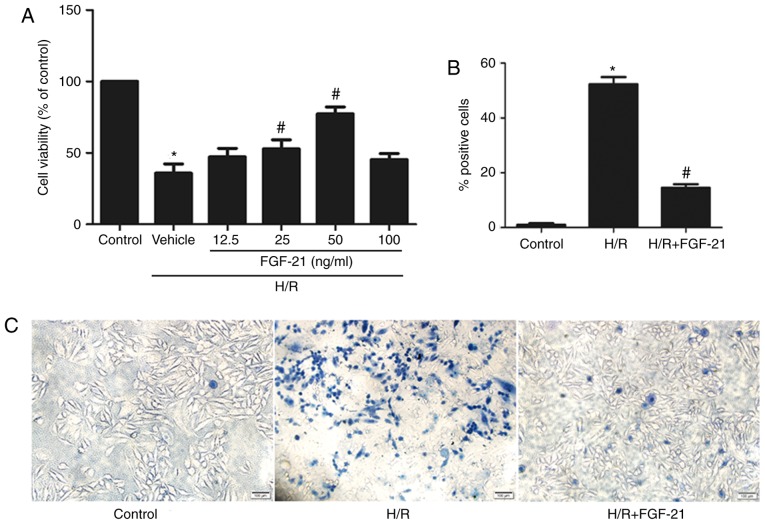
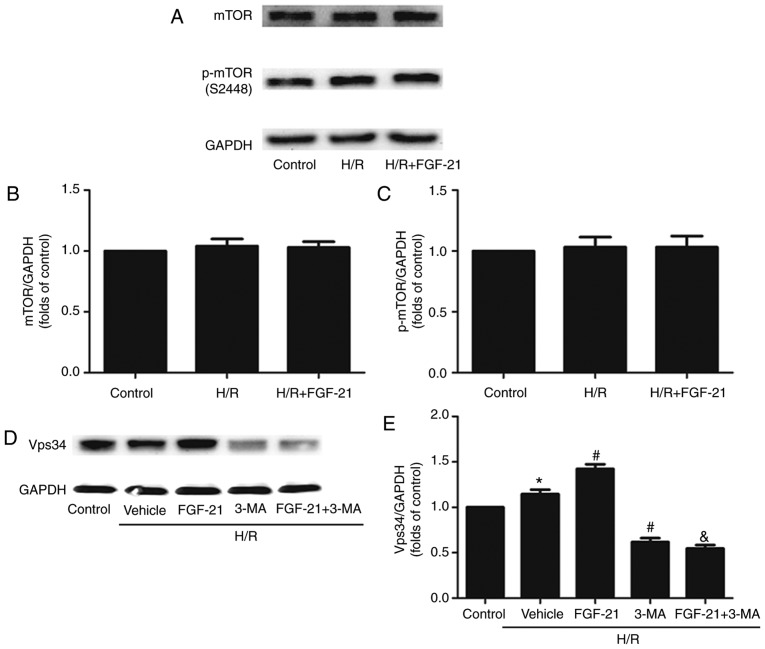
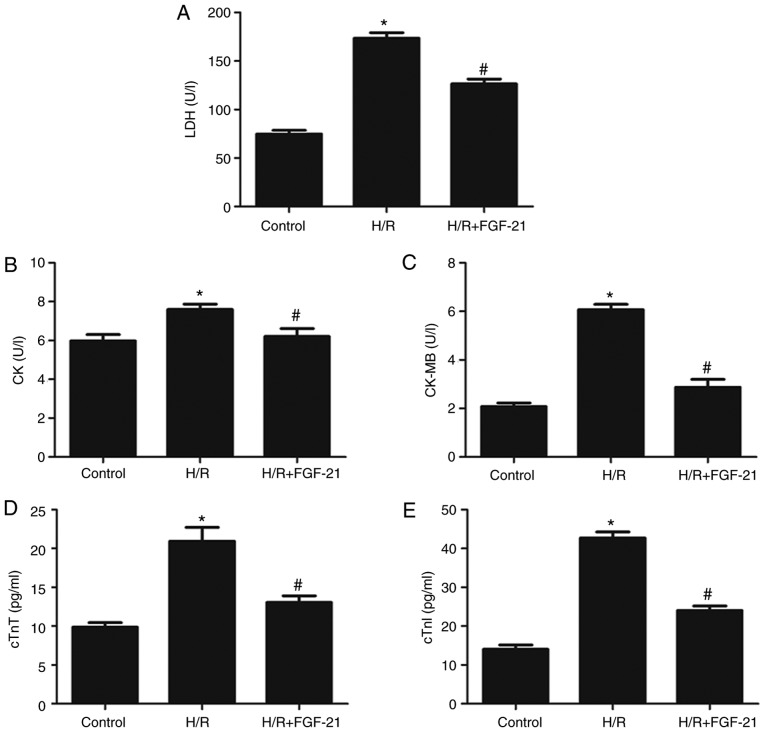
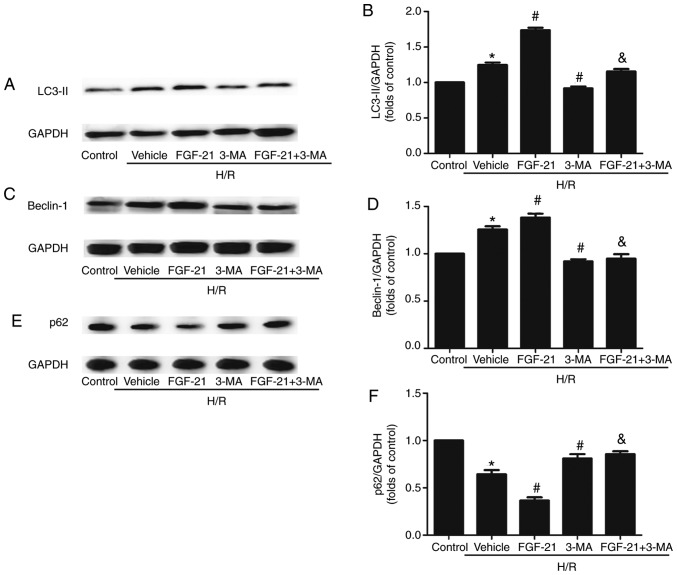
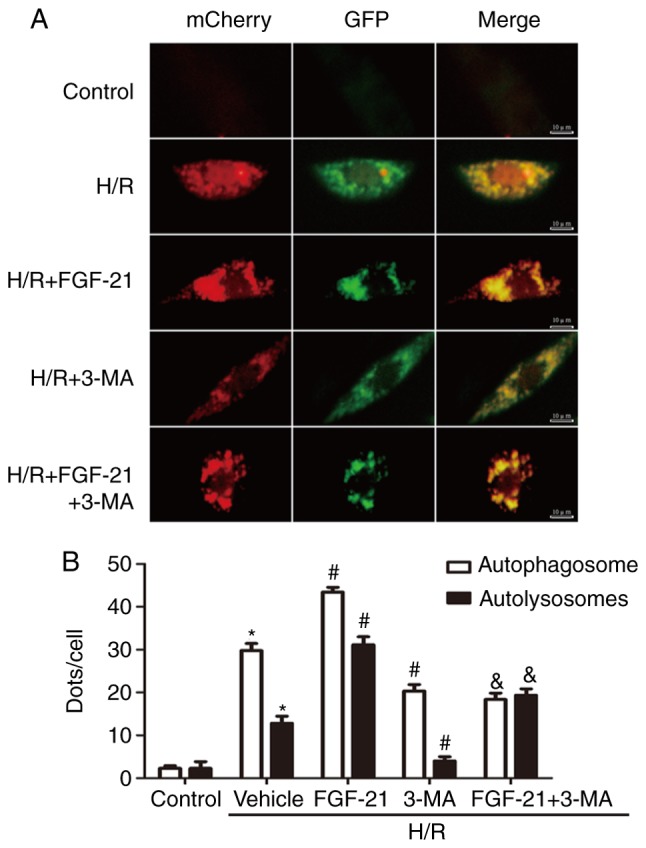
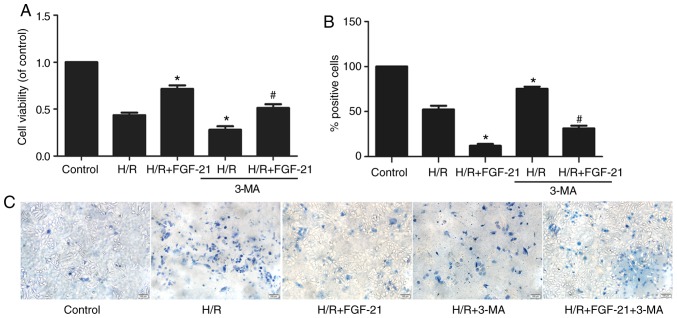
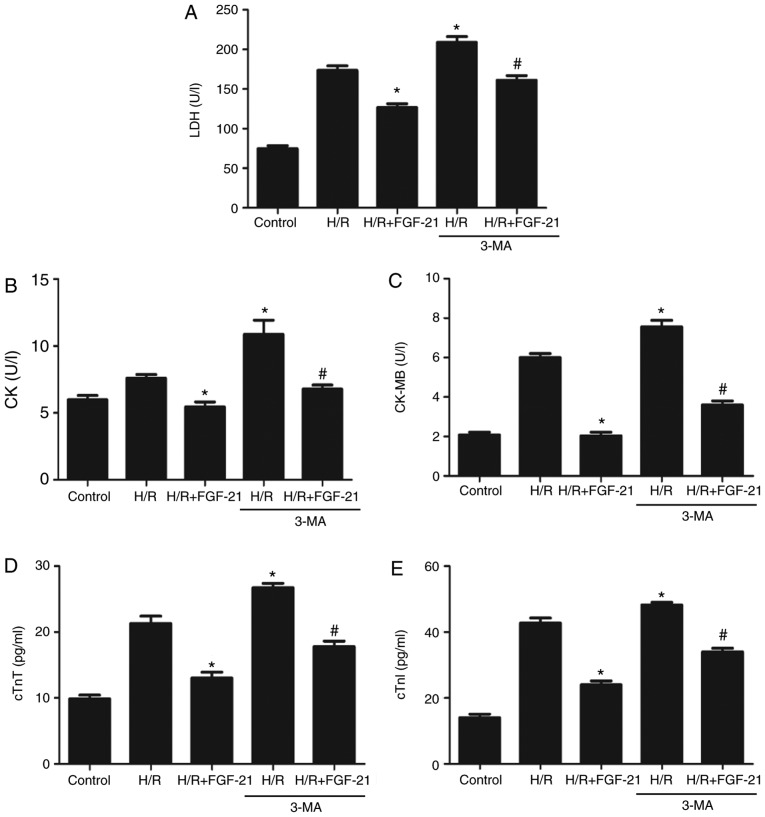
Fibroblast growth factor (FGF)‑21, a member of the family of FGFs, exhibits protective effects against myocardial ischemia and ischemia/reperfusion injury; it is also an enhancer of autophagy. However, the mechanisms underlying the protective role of FGF‑21 against cardiomyocyte hypoxia/reoxygenation (H/R) injury remain unclear. The present study aimed to investigate the effect of FGF‑21 on H9c2 cardiomyocyte injury induced by H/R and the mechanism associated with changes in autophagy. Cultured H9c2 cardiomyocytes subjected to hypoxia were treated with a vehicle or FGF‑21 during reoxygenation. The viability of H9c2 rat cardiomyocytes was measured using Cell Counting Kit‑8 and trypan blue exclusion assays. The contents of creatine kinase (CK) and creatine kinase isoenzymes (CK‑MB), cardiac troponin I (cTnT), cardiac troponin T (cTnI) and lactate dehydrogenase (LDH) in culture medium were detected with a CK, CK‑MB, cTnT, cTnI and LDH assay kits. The protein levels were examined by western blot analysis. Autophagic flux was detected by Ad‑mCherry‑GFP‑LC3B autophagy fluorescent adenovirus reagent. The results indicated that FGF‑21 alleviated H/R‑induced H9c2 myocardial cell injury and enhanced autophagic flux during H/R, and that this effect was antagonized by co‑treatment with 3‑methyladenine, an autophagy inhibitor. Furthermore, FGF‑21 increased the expression levels of Beclin‑1 and Vps34 proteins, but not of mechanistic target of rapamycin. These data indicate that FGF‑21 treatment limited H/R injury in H9c2 cardiomyocytes by promoting autophagic flux through upregulation of the expression levels of Beclin‑1 and Vps34 proteins.
成纤维细胞生长因子 21(FGF-21)是成纤维细胞因子家族的一员,对心肌缺血和缺血/再灌注损伤具有保护作用;它也是自噬的增强剂。然而,FGF-21 对抗心肌细胞缺氧/复氧(H/R)损伤的保护作用的机制尚不清楚。本研究旨在探讨 FGF-21 对 H/R 诱导的 H9c2 心肌细胞损伤的影响及其与自噬变化相关的机制。培养的 H9c2 心肌细胞在缺氧后用载体或 FGF-21 进行复氧处理。采用细胞计数试剂盒-8 和台盼蓝排除试验测定 H9c2 大鼠心肌细胞的活力。采用 CK、CK-MB、cTnT、cTnI 和 LDH 检测试剂盒检测培养上清液中肌酸激酶(CK)和肌酸激酶同工酶(CK-MB)、心肌肌钙蛋白 I(cTnT)、心肌肌钙蛋白 T(cTnI)和乳酸脱氢酶(LDH)的含量。采用 Western blot 分析检测蛋白水平。采用 Ad-mCherry-GFP-LC3B 自噬荧光腺病毒试剂检测自噬流。结果表明,FGF-21 减轻了 H/R 诱导的 H9c2 心肌细胞损伤,并增强了 H/R 期间的自噬流,而自噬抑制剂 3-甲基腺嘌呤可拮抗这种作用。此外,FGF-21 增加了 Beclin-1 和 Vps34 蛋白的表达水平,但不增加雷帕霉素的靶蛋白。这些数据表明,FGF-21 通过上调 Beclin-1 和 Vps34 蛋白的表达水平来促进自噬流,从而限制 H9c2 心肌细胞的 H/R 损伤。