Wang Dan, Jiang Xinhao, Lu Aiqing, Tu Min, Huang Wei, Huang Ping
Department of Orthopedics, Jinmen No. 2 People's Hospital, Jingmen, Hubei 448000, P.R. China.
Department of Orthopedics, Jingchu Center Hospital Affiliated to The Institute of Technology, Jingmen, Hubei 448000, P.R. China.
Exp Ther Med. 2018 Aug;16(2):1165-1174. doi: 10.3892/etm.2018.6293. Epub 2018 Jun 12.
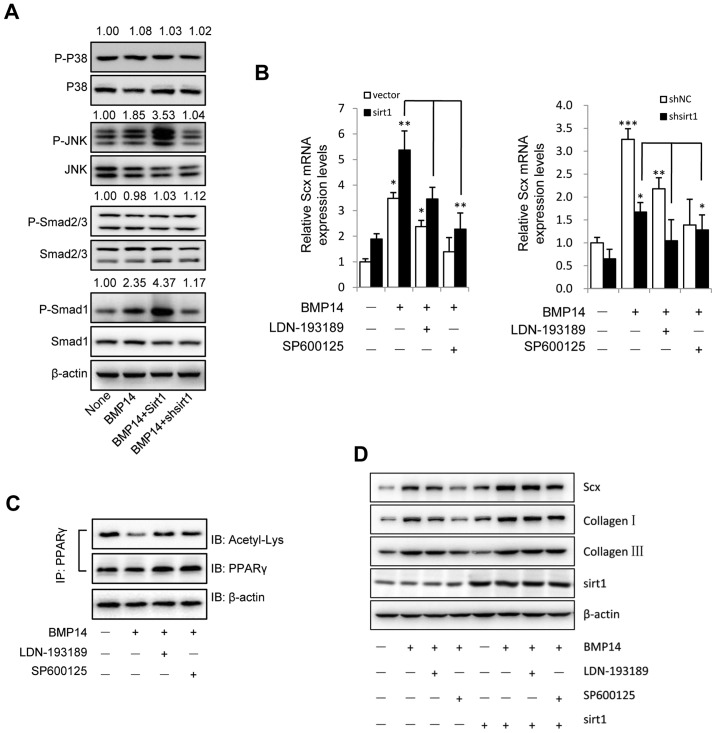
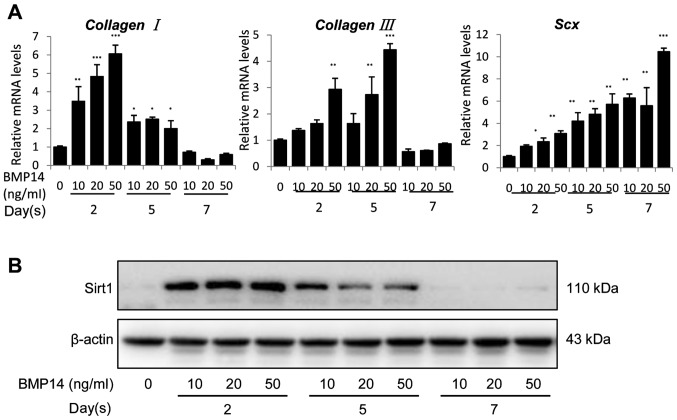
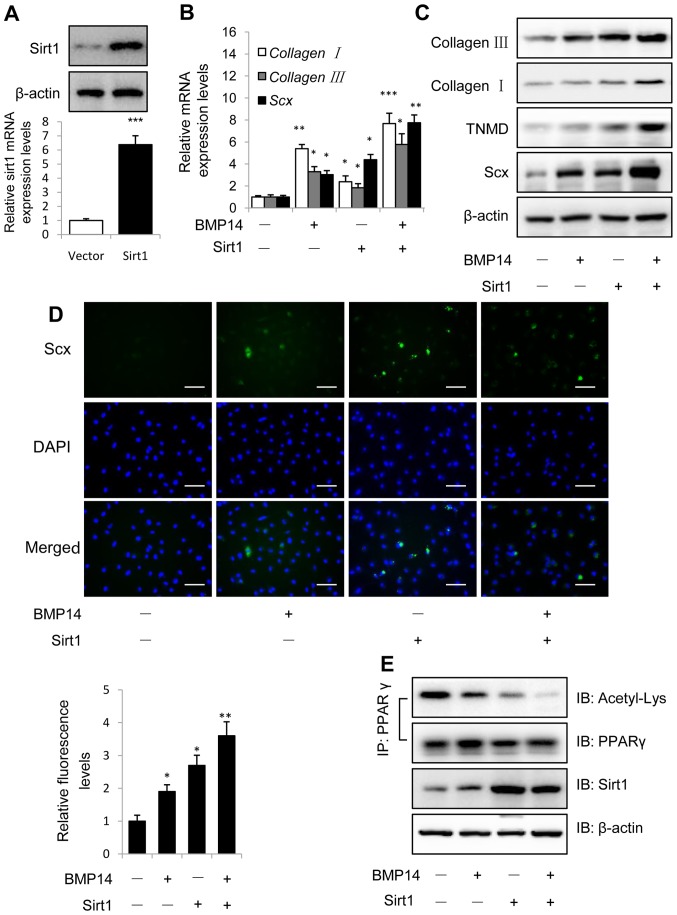
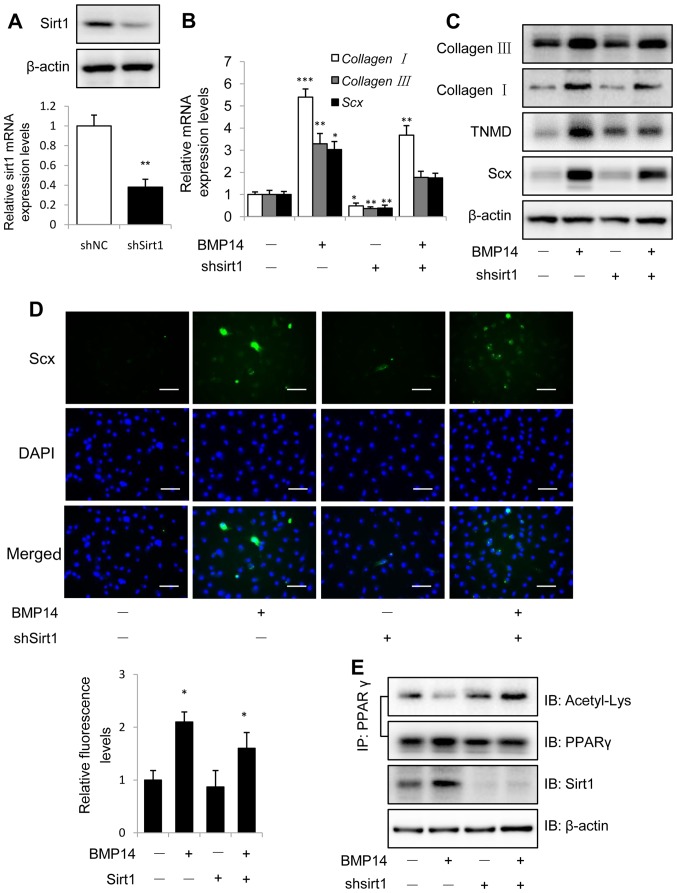
Bone marrow mesenchymal stem cells (BMSCs) are pluripotent cells, which have the capacity to differentiate into various types of mesenchymal cell phenotypes, including osteoblasts, chondroblasts, myoblasts and tendon fibroblasts (TFs). The molecular mechanism for tenogenic differentiation of BMSCs is still unknown. The present study investigated the effects of bone morphogenetic protein (BMP) 14 on BMSC differentiation . It was revealed that BMP14 significantly increased the expression of tendon markers (scleraxis and tenomodulin) at the mRNA and protein level, which led to the upregulation of sirtuin 1 (Sirt1) expression. The gain or loss of Sirt1 function may promote or inhibit tenogenic differentiation by deacetylating the peroxisome proliferator-activated receptor (PPAR)-γ. BMP14 also triggered the phosphorylation of c-Jun N-terminal kinase (JNK) and Smad1; overexpression of Sirt1 significantly increased the phosphorylation and knockdown of Sirt1 significantly decreased the phosphorylation. The inhibition of JNK and Smad significantly increased the acetylation of PPARγ and inhibited the expression of tenogenic differentiation markers. These results suggest that BMP14 may induce the tenogenic differentiation of BMSCs via the Sirt1-JNK/Smad1-PPARγ signaling pathway. The present study provided a cellular and molecular basis for the development of novel therapeutic strategies for tendon healing.
骨髓间充质干细胞(BMSCs)是多能细胞,具有分化为多种间充质细胞表型的能力,包括成骨细胞、成软骨细胞、成肌细胞和肌腱成纤维细胞(TFs)。BMSCs向肌腱分化的分子机制尚不清楚。本研究调查了骨形态发生蛋白(BMP)14对BMSC分化的影响。结果显示,BMP14在mRNA和蛋白质水平上显著增加了肌腱标志物(硬骨素和肌腱调节蛋白)的表达,这导致沉默调节蛋白1(Sirt1)表达上调。Sirt1功能的获得或丧失可能通过使过氧化物酶体增殖物激活受体(PPAR)-γ去乙酰化来促进或抑制肌腱分化。BMP14还引发了c-Jun氨基末端激酶(JNK)和Smad1的磷酸化;Sirt1的过表达显著增加了磷酸化,而Sirt1的敲低显著降低了磷酸化。抑制JNK和Smad显著增加了PPARγ的乙酰化,并抑制了肌腱分化标志物的表达。这些结果表明,BMP14可能通过Sirt1-JNK/Smad1-PPARγ信号通路诱导BMSCs向肌腱分化。本研究为开发肌腱愈合的新型治疗策略提供了细胞和分子基础。