Cespedes Michelle S, Kang Minhee, Kojic Erna Milunka, Umbleja Triin, Godfrey Catherine, Webster-Cyriaque Jennifer Y, Masih Reena, Firnhaber Cynthia, Grinsztejn Beatriz, Saah Alfred, Cu-Uvin Susan, Aberg Judith A
Division of Infectious Disease, Icahn School of Medicine at Mount Sinai, New York, NY, United States.
Center for Biostatistics in AIDS Research, Harvard T.H. Chan School of Public Health, Boston, MA, United States.
Papillomavirus Res. 2018 Dec;6:15-21. doi: 10.1016/j.pvr.2018.08.002. Epub 2018 Aug 16.
People living with HIV have increased Human Papillomavirus (HPV) related lesions and malignancies. We describe HPV DNA recovered from the cervix and anal canal, explore the effect of vaccination on HPV detection, and examine the durability of vaccine titers in women living with HIV-1 who were vaccinated with the quadrivalent HPV vaccine.
AIDS Clinical Trials Group A5240 was a prospective study of the quadrivalent HPV (qHPV) vaccine in 315 HIV-1 infected women in three CD4 strata (A: >350, B; 201-350, C: ≤200 cells/mm). Vaccine was administered at entry, week 8 and week 24. Cervical and anal HPV DNA specimens were collected at baseline, weeks 28 and 52; serum for antibody testing was obtained at baseline, weeks 28 and 72.
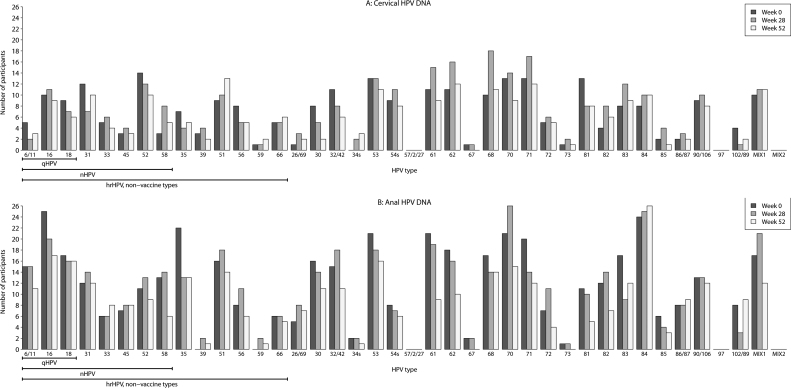
Vaccine antibody titers decreased across all four HPV types at week 72 compared to week 28. Lower proportions of sustained seropositivity were observed in women with lower CD4 counts for all four vaccine types, with the lowest titers for HPV 18. Despite the decrease, the geometric mean titer levels were above the seroconversion cut-off levels for all types except HPV 18 in the lowest CD4 stratum. Of the 174 participants who had a negative baseline HPV 16 antibody and developed antibody response at week 28, 95%, 88%, and 86% retained seropositivity at week 72 in strata A, B, and C respectively. Lower antibody retention was observed in women with CD4 < 200 compared to CD4 > 350 (p = 0.016). Anal HPV detection was more prevalent compared to cervical detection at all visits. Among high risk types, type 52, 31, 16, 18 and 51 were the most common in the cervical compartment, while types 16, 35, 18, and 51 were the most prevalent in the anal canal at baseline (listed in the order of prevalence). Later detection of HPV not present at baseline was uncommon in either compartment. Serial recovery of HPV over time was more commonly observed in the anal canal.
The qHPV vaccine elicits durable titer response above the seroconversion cut-off levels in HIV-infected women. However, the titer levels were substantially lower by Week 72, most noticeably in type 18. HPV DNA was detected more frequently in the anal canal. Detection of non-vaccine high risk HPV suggests a role for the nonavalent vaccine.
感染人类免疫缺陷病毒(HIV)的人群发生人乳头瘤病毒(HPV)相关病变和恶性肿瘤的风险增加。我们描述了从子宫颈和肛管中回收的HPV DNA,探讨了疫苗接种对HPV检测的影响,并研究了接种四价HPV疫苗的HIV-1感染女性体内疫苗滴度的持久性。
艾滋病临床试验组A5240是一项针对315名HIV-1感染女性的前瞻性研究,她们被分为三个CD4细胞分层(A:>350个细胞/mm³,B:201-350个细胞/mm³,C:≤200个细胞/mm³)。在入组时、第8周和第24周接种疫苗。在基线、第28周和第52周收集子宫颈和肛管HPV DNA样本;在基线、第28周和第72周采集血清进行抗体检测。
与第28周相比,第72周时所有四种HPV类型的疫苗抗体滴度均下降。对于所有四种疫苗类型,CD4细胞计数较低的女性中持续血清阳性的比例较低,HPV 18的滴度最低。尽管抗体滴度下降,但在最低CD4细胞分层中,除HPV 18外,所有类型的几何平均滴度水平均高于血清转化临界水平。在174名基线时HPV 16抗体阴性且在第28周产生抗体反应的参与者中,A、B和C分层中分别有95%、88%和86%在第72周时保持血清阳性。与CD4细胞计数>350的女性相比,CD4细胞计数<200的女性抗体保留率较低(p = 0.016)。在所有访视中,肛管HPV检测比子宫颈检测更普遍。在高危类型中,52型、31型、16型、18型和51型在子宫颈部位最常见,而在基线时,16型、35型、18型和51型在肛管中最普遍(按流行率顺序列出)。在两个部位,后期检测到基线时不存在的HPV均不常见。随着时间的推移,HPV在肛管中更常出现连续回收情况。
四价HPV疫苗在HIV感染女性中可引发高于血清转化临界水平的持久滴度反应。然而,到第72周时滴度水平大幅下降,最明显的是18型。肛管中HPV DNA检测更频繁。非疫苗高危HPV的检测表明九价疫苗可能发挥作用。