Kanaji Nobuhiro, Mizoguchi Hitoshi, Inoue Takuya, Tadokoro Akira, Watanabe Naoki, Ishii Tomoya, Tojo Yasunori, Yamaguchi Masahiro, Kadowaki Norimitsu
Department of Internal Medicine, Division of Hematology, Rheumatology and Respiratory Medicine, Faculty of Medicine, Kagawa University,
Department of Respiratory Medicine, National Hospital Organization Takamatsu Medical Center.
Ther Clin Risk Manag. 2018 Aug 1;14:1361-1368. doi: 10.2147/TCRM.S164700. eCollection 2018.
Thromboembolism (TE) and disseminated intravascular coagulation (DIC) are often present concomitantly. This study aimed to investigate the clinical features of patients with lung cancer and TE and/or DIC.
Data on 716 patients with pathologically confirmed diagnoses of lung cancer were retrospectively analyzed for TE/DIC.
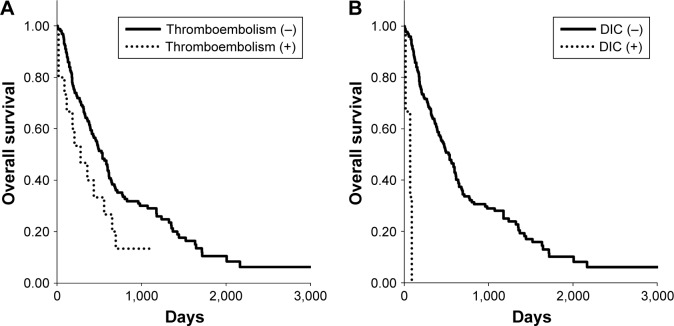
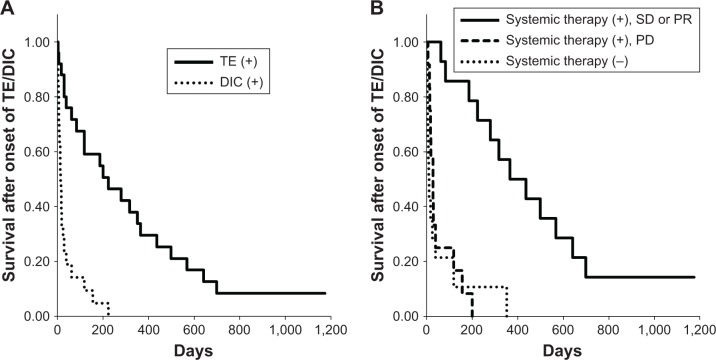
TE was identified in 16 patients (2.2%) and DIC was identified in 5 (0.7%) during the diagnosis of cancer. TE was more often observed in adenocarcinoma (4.0%). Both TE and DIC were more often observed in stage IV (4.7% and 1.5%, respectively). In patients with stage IV adenocarcinoma who received some systemic treatment, overall survival (OS) was significantly shorter in patients with TE (median 280 days) and with DIC (72 days) than in non-TE/DIC patients (538 days). Multivariate analysis showed that older age, poor performance status, greater number of metastatic organs, no mutation/ fusion, presence of interstitial lung disease, and DIC were poor prognostic factors for OS. In 339 patients in stage IV, 25 (7.4%) and 21 (6.2%) patients had TE and DIC, respectively, during the course. Six patients exhibited both TE and DIC. TE was more often observed in adenocarcinoma (20 of 196 patients; 10.2%). Patients with DIC had extremely shorter survival (median 13 days) after onset. Cancer control by systemic therapy, such as chemotherapy and molecular-targeted therapy, contributed to long survival.
Patients with TE/DIC had shorter OS than patients without TE/DIC. Control of lung cancer by systemic therapy was important for longer survival after the onset of events.
血栓栓塞(TE)和弥散性血管内凝血(DIC)常同时存在。本研究旨在调查肺癌合并TE和/或DIC患者的临床特征。
回顾性分析716例经病理确诊为肺癌患者的TE/DIC数据。
在癌症诊断期间,16例患者(2.2%)被诊断为TE,5例患者(0.7%)被诊断为DIC。TE在腺癌中更常见(4.0%)。TE和DIC在IV期患者中更常见(分别为4.7%和1.5%)。在接受过一些全身治疗的IV期腺癌患者中,合并TE(中位生存期280天)和DIC(72天)的患者总生存期(OS)显著短于未合并TE/DIC的患者(538天)。多因素分析显示,年龄较大、体能状态较差、转移器官数量较多、无突变/融合、存在间质性肺病和DIC是OS的不良预后因素。在339例IV期患者中,分别有25例(7.4%)和21例(6.2%)在病程中发生TE和DIC。6例患者同时出现TE和DIC。TE在腺癌中更常见(196例患者中的20例;10.2%)。发生DIC的患者发病后的生存期极短(中位生存期13天)。化疗和分子靶向治疗等全身治疗对癌症的控制有助于延长生存期。
合并TE/DIC的患者OS短于未合并TE/DIC的患者。全身治疗控制肺癌对事件发生后的长期生存很重要。