Jin Shi, Cao Shoubo, Li Jianhua, Meng Qingwei, Wang Chunyan, Yao Lei, Lang Yaoguo, Cao Jingyan, Shen Jing, Pan Bo, Hu Jing, Yu Yan
Department of Medical Oncology, Harbin Medical University Cancer Hospital, Harbin, China,
Department of Medical Oncology, Linyi People's Hospital, Linyi, China.
Onco Targets Ther. 2018 Aug 1;11:4491-4499. doi: 10.2147/OTT.S159491. eCollection 2018.
Increasing evidence shows cancer/testis antigens (CTAs) play a key role in oncogenesis. Our pre-study finds that , , , , and / have high expression frequencies at the protein level. We aim to explore their prognostic role and correlations with clinical characteristics in resected lung cancer at the mRNA level.
Thirty-eight surgical lung cancer samples were included. Validation study was performed based on The Cancer Genome Atlas database. The prognostic roles of CTAs were evaluated by Kaplan-Meier and multivariate analysis.
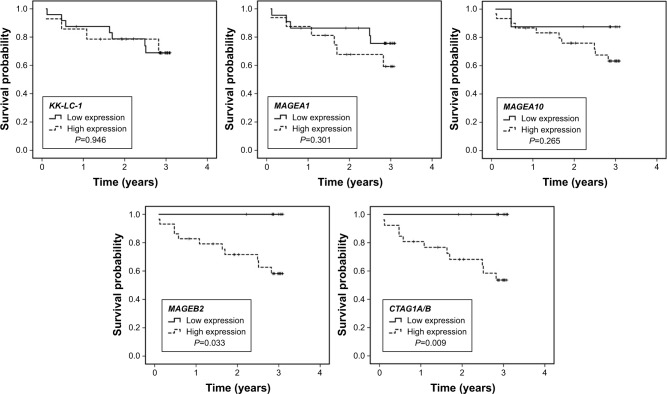
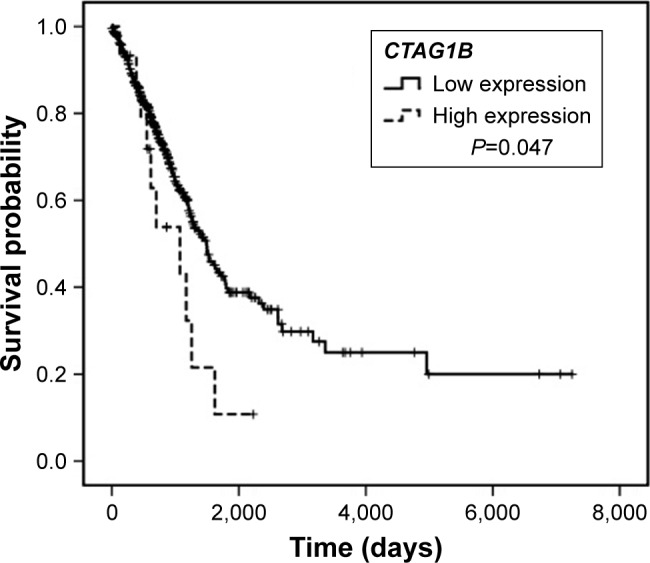
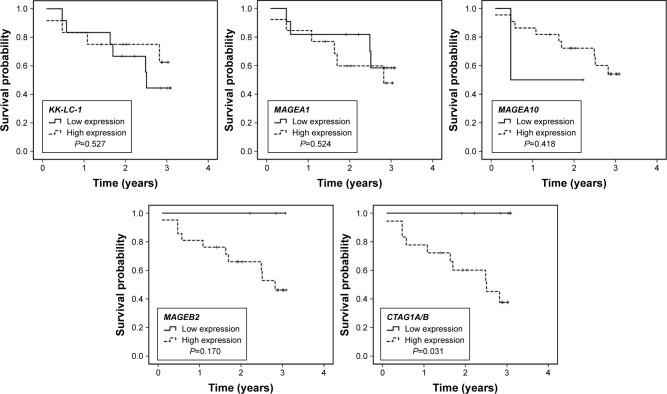
High expression of (16.7% vs 65.0%, =0.004), (61.1% vs 95.0%, =0.016), (55.6% vs 95.0%, =0.007), and (16.7% vs 55.0%, =0.020) was closely correlated with lymph node metastasis at diagnosis. Patients with TNM stage II or III had a higher expression of (57.1% vs 91.7%, =0.034) and (14.3% vs 50.0%, =0.039) compared with patients in TNM stage I. High / expression showed unfavorable prognosis in all cases (<0.05). Subgroup analysis showed high / expression was a negative prognostic factor of survival (=0.031) in patients with TNM stage II or III. Although no statistical significance was reached, high / also showed a similar prognostic trend in lung adenocarcinoma (ADC) and squamous cell carcinoma. The Cancer Genome Atlas database showed the negative prognostic role of / was mainly induced by (, =0.047) and high expression (hazard ratio =2.733, 95% CI: 1.348-5.541, =0.005) was an independent negative prognostic factor of lung ADC.
CTAs represent potential candidate targets for immunotherapy and their expression was closely correlated with tumor stage. High expression was an independent negative prognostic factor of lung ADC.
越来越多的证据表明癌胚抗原(CTAs)在肿瘤发生中起关键作用。我们的前期研究发现, 、 、 、 和 / 在蛋白水平具有高表达频率。我们旨在探讨它们在切除的肺癌中mRNA水平的预后作用及其与临床特征的相关性。
纳入38例手术切除的肺癌样本。基于癌症基因组图谱数据库进行验证研究。通过Kaplan-Meier法和多因素分析评估CTAs的预后作用。
高表达(16.7% 对 65.0%, =0.004)、 (61.1% 对 95.0%, =0.016)、 (55.6% 对 95.0%, =0.007)以及 (16.7% 对 55.0%, =0.020)与诊断时的淋巴结转移密切相关。与TNM I期患者相比,TNM II期或III期患者的 (57.1% 对 91.7%, =0.034)和 (14.3% 对 50.0%, =0.039)表达更高。高 / 表达在所有病例中均显示预后不良(<0.05)。亚组分析显示,高 / 表达是TNM II期或III期患者生存的负性预后因素( =0.031)。尽管未达到统计学意义,但高 / 在肺腺癌(ADC)和鳞状细胞癌中也显示出类似的预后趋势。癌症基因组图谱数据库显示, / 的负性预后作用主要由 ( , =0.047)引起,高 表达(风险比=2.733,95% CI:1.348 - 5.541, =0.005)是肺ADC的独立负性预后因素。
CTAs是免疫治疗的潜在候选靶点,其表达与肿瘤分期密切相关。高 表达是肺ADC的独立负性预后因素。