Steeb Brenda, García-Cordero Indira, Huizing Marjolein C, Collazo Lucas, Borovinsky Geraldine, Ferrari Jesica, Cuitiño Macarena M, Ibáñez Agustín, Sedeño Lucas, García Adolfo M
Laboratory of Language Research (LILEN), Institute of Cognitive and Translational Neuroscience (INCYT), INECO Foundation, Favaloro University, Buenos Aires, Argentina.
Laboratory of Experimental Psychology and Neuroscience (LPEN), Institute of Cognitive and Translational Neuroscience (INCYT), INECO Foundation, Favaloro University, Buenos Aires, Argentina.
Front Psychol. 2018 Aug 3;9:1345. doi: 10.3389/fpsyg.2018.01345. eCollection 2018.
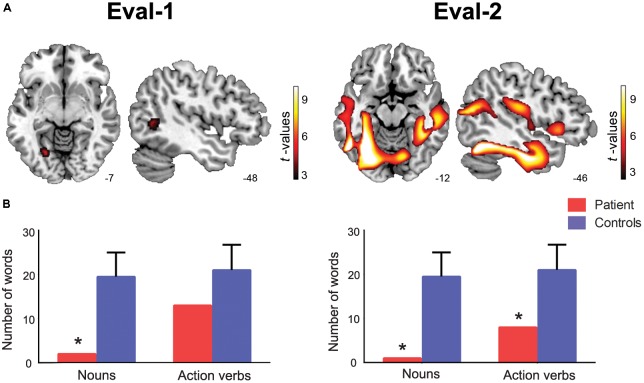
Processing of nouns and action verbs can be differentially compromised following lesions to posterior and anterior/motor brain regions, respectively. However, little is known about how these deficits in the course of neurodegeneration. To address this issue, we assessed productive lexical skills in a patient with posterior cortical atrophy (PCA) at two different stages of his pathology. On both occasions, he underwent a structural brain imaging protocol and completed semantic fluency tasks requiring retrieval of animals (nouns) and actions (verbs). Imaging results were compared with those of controls via voxel-based morphometry (VBM), whereas fluency performance was compared to age-matched norms through Crawford's -tests. In the first assessment, the patient exhibited atrophy of more posterior regions supporting multimodal semantics (medial temporal and lingual gyri), together with a selective deficit in noun fluency. Then, by the second assessment, the patient's atrophy had progressed mainly toward fronto-motor regions (rolandic operculum, inferior and superior frontal gyri) and subcortical motor hubs (cerebellum, thalamus), and his fluency impairments had extended to action verbs. These results offer unprecedented evidence of the specificity of the pathways related to noun and action-verb impairments in the course of neurodegeneration, highlighting the latter's critical dependence on damage to regions supporting motor functions, as opposed to multimodal semantic processes.
名词和行为动词的加工在分别损伤后脑区和前脑/运动脑区后可能会受到不同程度的损害。然而,对于神经退行性变过程中这些缺陷的情况却知之甚少。为了解决这个问题,我们在一名患有后皮质萎缩(PCA)的患者病程的两个不同阶段评估了其生成性词汇技能。在这两次评估中,他都接受了脑部结构成像检查,并完成了语义流畅性任务,这些任务要求提取动物(名词)和动作(动词)。通过基于体素的形态计量学(VBM)将成像结果与对照组进行比较,而流畅性表现则通过克劳福德检验与年龄匹配的常模进行比较。在首次评估中,患者表现出更多支持多模态语义的后脑区(内侧颞叶和舌回)萎缩,同时在名词流畅性方面存在选择性缺陷。然后,到第二次评估时,患者的萎缩主要发展到额前运动区(中央沟盖、额下回和额上回)和皮质下运动中枢(小脑、丘脑),并且他的流畅性损伤已扩展到行为动词。这些结果为神经退行性变过程中与名词和行为动词损伤相关的通路的特异性提供了前所未有的证据,突出了后者对支持运动功能的脑区损伤的关键依赖性,而不是对多模态语义过程的依赖性。