Wang I-Jen, Liang Wen-Miin, Wu Trong-Neng, Karmaus Wilfried J J, Hsu Jiin-Chyr
Department of Pediatrics, Taipei Hospital, Ministry of Health and Welfare, Taipei, Taiwan.
School of Medicine, National Yang-Ming University, Taipei, Taiwan.
Ann Thorac Med. 2018 Jul-Sep;13(3):156-162. doi: 10.4103/atm.ATM_367_17.
It is unclear whether inhaled corticosteroids (ICS) have chemopreventive effect on lung cancer (LC) development in humans. We investigated the association between the ICS use in asthma patients and the risk of LC.
We conducted a nationwide, population-based retrospective cohort study using the National Health Insurance database. We identified 4210 asthmatics who were initially free of LC and regularly used ICS between 2001 and 2005 and 37,228 asthmatics without regular ICS use. Patients with documented history of tobacco use were excluded from the analyses. Asthmatics were categorized into a mild and a severe asthma group. Each patient was tracked until the end of 2010 to identify incident cases of LC. Cox proportional hazards models were used to evaluate the effect of ICS on the risk of LC, further stratifying by asthma severity and comorbidities.
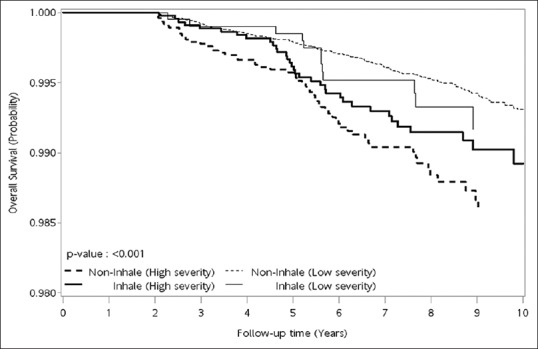
During follow-up, we identified 747 incident cases of LC diagnosed in the asthma cohort. Compared with severe asthmatics without regular ICS use, the risk of LC for those with mild asthma with regular ICS use was lower (adjusted hazard ratio = 0.42, 95% confidence interval = 0.31-0.56, < 0.0001). The risk of LC was calculated among the following rankings of risk severe asthma without regular ICS use, low severity without regular ICS, high severity with regular ICS, and low severity with regular ICS group showed a decreasing trend of LC incidence ( = 0.041). Analyses stratified by comorbidities revealed that the protective effect of ICS was assessed with better precision and more pronounced in those with renal diseases, stroke, and hyperlipidemia.
For patients with asthma, regular ICS use might have a protective effect against LC. Further studies are required to assess this potential association from both immunohistopathological and clinical aspects.
吸入性糖皮质激素(ICS)对人类肺癌(LC)发生是否具有化学预防作用尚不清楚。我们调查了哮喘患者使用ICS与LC风险之间的关联。
我们利用国民健康保险数据库进行了一项全国性的、基于人群的回顾性队列研究。我们确定了4210例在2001年至2005年间最初无LC且定期使用ICS的哮喘患者以及37228例未定期使用ICS的哮喘患者。有吸烟记录的患者被排除在分析之外。哮喘患者被分为轻度和重度哮喘组。对每位患者进行跟踪直至2010年底,以确定LC的发病病例。采用Cox比例风险模型评估ICS对LC风险的影响,并进一步按哮喘严重程度和合并症进行分层。
在随访期间,我们在哮喘队列中确定了747例LC发病病例。与未定期使用ICS的重度哮喘患者相比,定期使用ICS的轻度哮喘患者发生LC的风险较低(调整后风险比=0.42,95%置信区间=0.31-0.56,<0.0001)。在以下风险等级中计算LC风险:未定期使用ICS的重度哮喘、未定期使用ICS的低严重程度、定期使用ICS的高严重程度以及定期使用ICS的低严重程度组,LC发病率呈下降趋势(=0.041)。按合并症分层分析显示,ICS的保护作用在患有肾脏疾病、中风和高脂血症的患者中评估更为精确且更为明显。
对于哮喘患者,定期使用ICS可能对LC具有保护作用。需要进一步研究从免疫组织病理学和临床两个方面评估这种潜在关联。