Hinz Andreas, Geue Kristina, Zenger Markus, Wirtz Hubert, Bosse-Henck Andrea
Department of Medical Psychology and Medical Sociology, University of Leipzig, Leipzig, Germany.
Faculty of Applied Human Studies, University of Applied Sciences Magdeburg and Stendal, Stendal, Germany.
Can Respir J. 2018 Jul 10;2018:6853948. doi: 10.1155/2018/6853948. eCollection 2018.
The aim of this study was to analyze daytime sleepiness in a sample of patients diagnosed with sarcoidosis.
A sample of 1197 German sarcoidosis patients was examined with the Epworth Sleepiness Scale (ESS), the Fatigue Assessment Scale, the Hospital Anxiety and Depression Scale, the Pittsburgh Sleep Quality Index, and the Short-Form Health Survey (SF-8). The patients' ESS mean scores were compared with those obtained from a large general population sample.
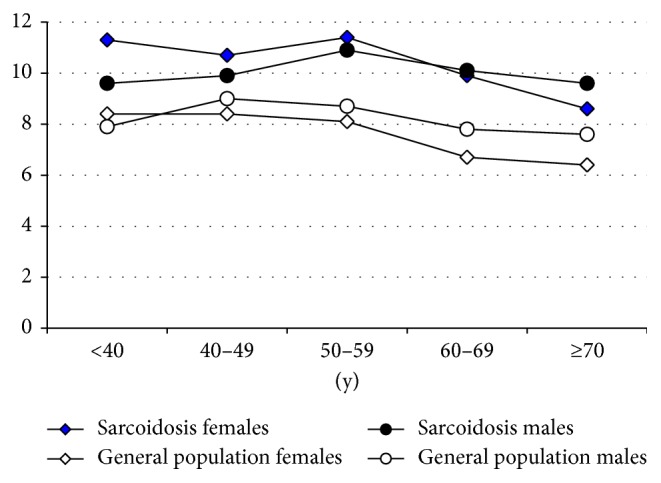
Exactly 50% of the patients reached the criterion (ESS > 10) for excessive daytime sleepiness, compared with only 22.1% in the general population. The effect size for the mean score difference between both samples was =0.62. The number of affected organs and the number of concomitant diseases proved to be significant independent predictors of daytime sleepiness. Sleepiness was associated with fatigue (=0.45), anxiety (=0.23), depression (=0.28), sleep problems (=0.23), and detriments in physical (=-0.29) and mental (=-0.28) quality of life.
The issue of excessive daytime sleepiness should be considered in the management of sarcoidosis.
本研究旨在分析被诊断为结节病的患者样本中的日间嗜睡情况。
采用爱泼沃斯思睡量表(ESS)、疲劳评估量表、医院焦虑抑郁量表、匹兹堡睡眠质量指数和简短健康调查问卷(SF - 8)对1197名德国结节病患者进行检查。将患者的ESS平均得分与从大量普通人群样本中获得的得分进行比较。
恰好50%的患者达到日间过度嗜睡的标准(ESS>10),而普通人群中只有22.1%达到该标准。两个样本之间平均得分差异的效应大小为=0.62。受累器官数量和伴随疾病数量被证明是日间嗜睡的显著独立预测因素。嗜睡与疲劳(=0.45)、焦虑(=0.23)、抑郁(=0.28)、睡眠问题(=0.23)以及身体(=-0.29)和精神(=-0.28)生活质量受损相关。
在结节病的管理中应考虑日间过度嗜睡问题。