Rogers James, Urbina Stacie L, Taylor Lem W, Wilborn Colin D, Purpura Martin, Jäger Ralf, Juturu Vijaya
Summit Analytical, LLC, 8354 Northfield Blvd., Building G, Suite 3700, Denver, CO 80238 USA.
2Human Performance Laboratory, University of Mary Hardin-Baylor, Belton, TX 76513 USA.
BMC Obes. 2018 Aug 13;5:22. doi: 10.1186/s40608-018-0197-1. eCollection 2018.
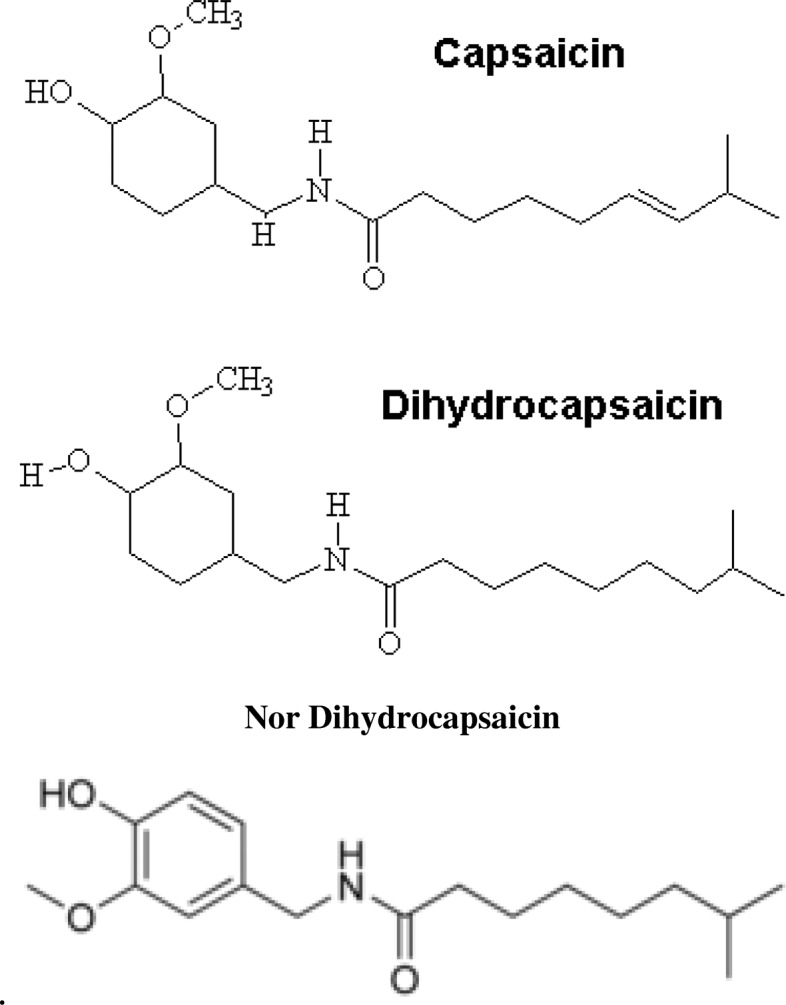
Capsaicinoids (CAPs) found in chili peppers and pepper extracts, are responsible for enhanced metabolism. The objective of the study was to evaluate the effects of CAPs on body fat and fat mass while considering interactions with body habitus, diet and metabolic propensity.
Seventy-five ( = 75) volunteer (male and female, age: 18 and 56 years) healthy subjects were recruited. This is a parallel group, randomized, double-blind, placebo controlled exploratory study. Subjects were randomly assigned to receive either placebo, 2 mg CAPs or 4 mg CAPs dosing for 12 weeks. After initial screening, subjects were evaluated with respect to fat mass and percent body fat at baseline and immediately following a 12-week treatment period. The current study evaluates two measures of fat loss while considering six baseline variables related to fat loss. Baseline measurements of importance in this paper are those used to evaluate body habitus, diet, and metabolic propensity. Lean mass and fat mass (body habitus); protein intake, fat intake and carbohydrate intake; and total serum cholesterol level (metabolic propensity) were assessed. Body fat and fat mass were respectively re-expressed as percent change in body fat and change in fat mass by application of formula outcome = (12-week value - baseline value) / baseline value) × 100. Thus, percent change in body fat and change in fat mass served as dependent variables in the evaluation of CAPs. Inferential statistical tests were derived from the model to compare low dose CAPs to placebo and high dose CAPs to placebo.
Percent change in body fat after 12 weeks of treatment was 5.91 percentage units lower in CAPs 4 mg subjects than placebo subjects after adjustment for covariates ( = 0.0402). Percent change in fat mass after 12 weeks of treatment was 6.68 percentage units lower in Caps 4 mg subjects than placebo subjects after adjustment for covariates ( = 0.0487).
These results suggest potential benefits of Capsaicinoids (CAPs) on body fat and fat mass in post hoc analysis. Further studies are required to explore pharmacological, physiological, and metabolic benefits of both chronic and acute Capsaicinoids consumption.
ISRCTN10458693 'retrospectively registered'.
辣椒和辣椒提取物中的辣椒素类物质(CAPs)可促进新陈代谢。本研究的目的是评估辣椒素类物质对体脂和脂肪量的影响,同时考虑其与身体形态、饮食和代谢倾向的相互作用。
招募了75名(n = 75)志愿者(男性和女性,年龄:18至56岁)健康受试者。这是一项平行组、随机、双盲、安慰剂对照的探索性研究。受试者被随机分配接受安慰剂、2毫克辣椒素类物质或4毫克辣椒素类物质给药,为期12周。在初始筛查后,在基线时以及12周治疗期结束后立即对受试者的脂肪量和体脂百分比进行评估。本研究在考虑与脂肪减少相关的六个基线变量的同时,评估了两种脂肪减少的指标。本文中重要的基线测量指标是用于评估身体形态、饮食和代谢倾向的指标。评估了瘦体重和脂肪量(身体形态);蛋白质摄入量、脂肪摄入量和碳水化合物摄入量;以及总血清胆固醇水平(代谢倾向)。通过应用公式结果=(12周值-基线值)/基线值)×100,将体脂和脂肪量分别重新表示为体脂百分比变化和脂肪量变化。因此,体脂百分比变化和脂肪量变化作为评估辣椒素类物质的因变量。从模型中得出推断性统计检验,以比较低剂量辣椒素类物质与安慰剂以及高剂量辣椒素类物质与安慰剂。
在调整协变量后,4毫克辣椒素类物质组受试者在治疗12周后的体脂百分比变化比安慰剂组受试者低5.91个百分点(P = 0.0402)。在调整协变量后,4毫克辣椒素类物质组受试者在治疗12周后的脂肪量百分比变化比安慰剂组受试者低6.68个百分点(P = 0.0487)。
这些结果表明,在事后分析中辣椒素类物质(CAPs)对体脂和脂肪量有潜在益处。需要进一步研究来探索长期和短期食用辣椒素类物质的药理学、生理学和代谢益处。
ISRCTN10458693“回顾性注册”