Steiner Peter M, Kim Yongnam
Department of Educational Psychology, University of Wisconsin, Madison, WI, USA.
J Causal Inference. 2016 Sep;4(2). doi: 10.1515/jci-2016-0009. Epub 2016 Nov 8.
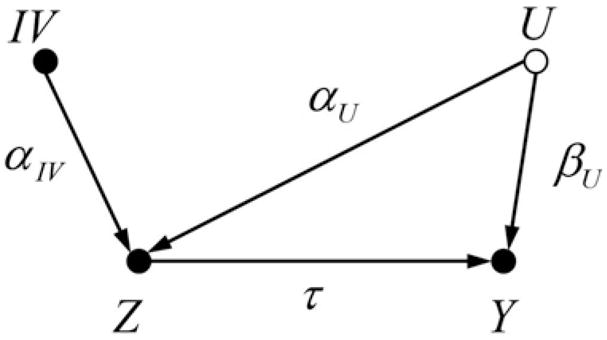
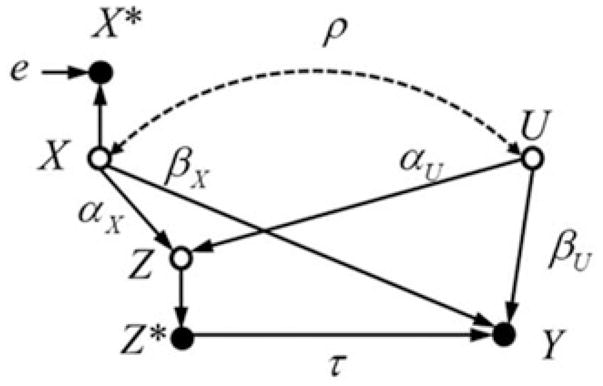
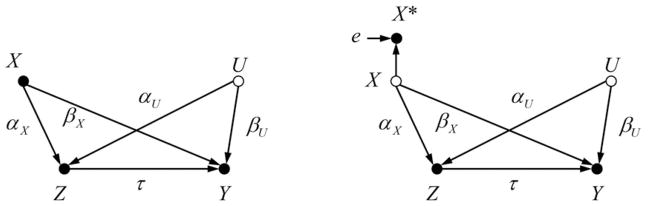
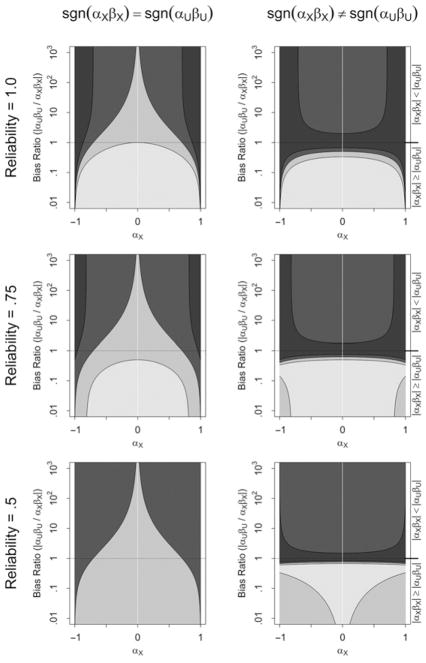
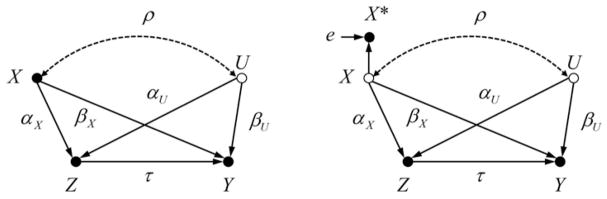
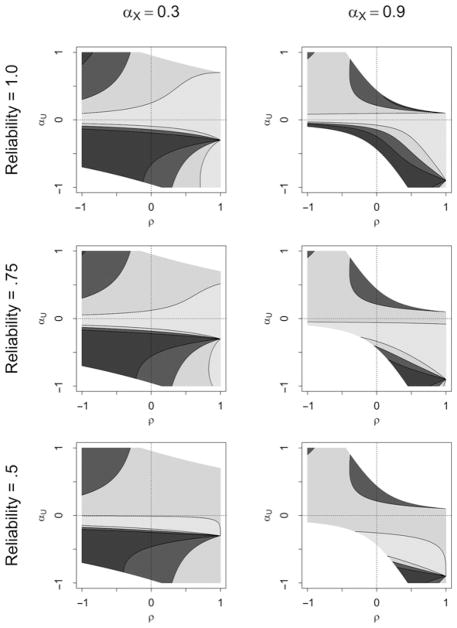
Causal inference with observational data frequently requires researchers to estimate treatment effects conditional on a set of observed covariates, hoping that they remove or at least reduce the confounding bias. Using a simple linear (regression) setting with two confounders - one observed (), the other unobserved () - we demonstrate that conditioning on the observed confounder does not necessarily imply that the confounding bias decreases, even if is highly correlated with . That is, adjusting for may increase instead of reduce the omitted variable bias (OVB). Two phenomena can cause an increasing OVB: (i) bias amplification and (ii) cancellation of offsetting biases. Bias amplification occurs because conditioning on amplifies any remaining bias due to the omitted confounder . Cancellation of offsetting biases is an issue whenever and induce biases in opposite directions such that they perfectly or partially offset each other, in which case adjusting for inadvertently cancels the bias-offsetting effect. In this article we discuss the conditions under which adjusting for increases OVB, and demonstrate that conditioning on increases the imbalance in , which turns into an even stronger confounder. We also show that conditioning on an unreliably measured confounder can remove more bias than the corresponding reliable measure. Practical implications for causal inference will be discussed.
利用观察性数据进行因果推断时,研究人员常常需要在一组观察到的协变量的条件下估计治疗效果,期望这些协变量能够消除或至少减少混杂偏倚。在一个具有两个混杂因素的简单线性(回归)模型中——一个是观察到的(),另一个是未观察到的()——我们证明,即使与高度相关,基于观察到的混杂因素进行条件设定并不一定意味着混杂偏倚会减小。也就是说,对进行调整可能会增加而不是减少遗漏变量偏倚(OVB)。有两种现象会导致OVB增加:(i)偏倚放大和(ii)抵消偏倚的抵消。偏倚放大的发生是因为基于进行条件设定会放大由于遗漏的混杂因素而产生的任何剩余偏倚。每当和导致的偏倚方向相反,从而使它们完全或部分相互抵消时,抵消偏倚的抵消就会成为一个问题,在这种情况下,对进行调整会无意中消除偏倚抵消效应。在本文中,我们讨论了对进行调整会增加OVB的条件,并证明基于进行条件设定会增加中的不平衡,这会使变成一个更强的混杂因素。我们还表明,基于测量不可靠的混杂因素进行条件设定可能比相应的可靠测量消除更多的偏倚。我们将讨论因果推断的实际意义。