Division of Infection and Immunity, School of Medicine, Cardiff University, Cardiff, UK.
Division of Dermatology, Department of Medicine, University of Toronto, Toronto, Ontario, Canada.
Cell Microbiol. 2018 Oct;20(10):e12944. doi: 10.1111/cmi.12944.
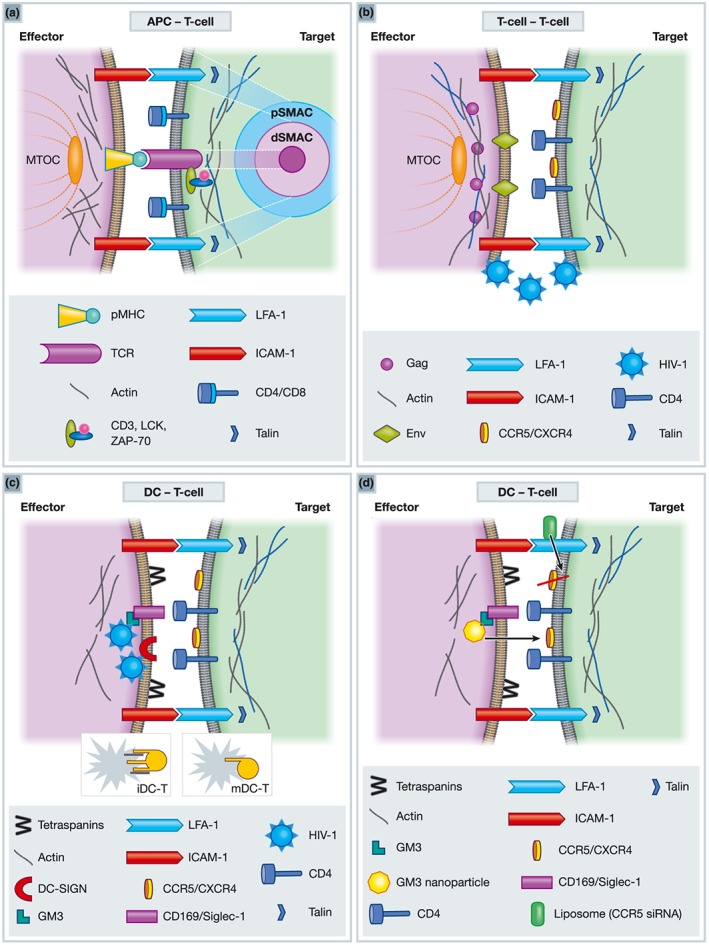
In order to thrive, viruses have evolved to manipulate host cell machinery for their own benefit. One major obstacle faced by pathogens is the immunological synapse. To enable efficient replication and latency in immune cells, viruses have developed a range of strategies to manipulate cellular processes involved in immunological synapse formation to evade immune detection and control T-cell activation. In vitro, viruses such as human immunodeficiency virus 1 and human T-lymphotropic virus type 1 utilise structures known as virological synapses to aid transmission of viral particles from cell to cell in a process termed trans-infection. The formation of the virological synapse provides a gateway for virus to be transferred between cells avoiding the extracellular space, preventing antibody neutralisation or recognition by complement. This review looks at how viruses are able to subvert intracellular signalling to modulate immune function to their advantage and explores the role synapse formation has in viral persistence and cell-to-cell transmission.
为了繁荣,病毒已经进化出操纵宿主细胞机制来为自己谋取利益。病原体面临的一个主要障碍是免疫突触。为了在免疫细胞中实现高效复制和潜伏,病毒已经开发了一系列策略来操纵涉及免疫突触形成的细胞过程,以逃避免疫检测和控制 T 细胞激活。在体外,人类免疫缺陷病毒 1 和人类 T 淋巴细胞性病毒 1 等病毒利用称为病毒突触的结构来辅助病毒颗粒从一个细胞传递到另一个细胞,这一过程称为转感染。病毒突触的形成提供了一个通道,使病毒能够在细胞间转移,从而避免了细胞外空间,防止了抗体中和或补体的识别。这篇综述探讨了病毒如何能够颠覆细胞内信号转导,从而调节免疫功能以利于自身,并探讨了突触形成在病毒持续存在和细胞间传播中的作用。