Charité -Universitätsmedizin Berlin, corporate member of Freie Universität Berlin, Humboldt-Universität zu Berlin, and Berlin Institute of Health, Center for Musculoskeletal Surgery (CMSC), Berlin, Germany.
Berlin-Brandenburg Center for Regenerative Therapies (BCRT), Berlin, Germany.
PLoS One. 2018 Aug 20;13(8):e0202639. doi: 10.1371/journal.pone.0202639. eCollection 2018.
The definition criteria and clinical characteristics of implant-associated infection (IAI) caused by Cutibacterium (formerly Propionibacterium) spp. are poorly known. We analyzed microbiologically proven Cutibacterium orthopedic IAI in a prospective cohort.
Patients with periprosthetic joint infections (PJI) and fixation device-associated infections (FDAI) caused by Cutibacterium spp. were prospectively included. IAI was defined by significant growth of Cutibacterium spp. and presence of at least one non-microbiological criterion for infection. The McNemar's chi-squared or binomial test was used to compare the performance of diagnostic tests.
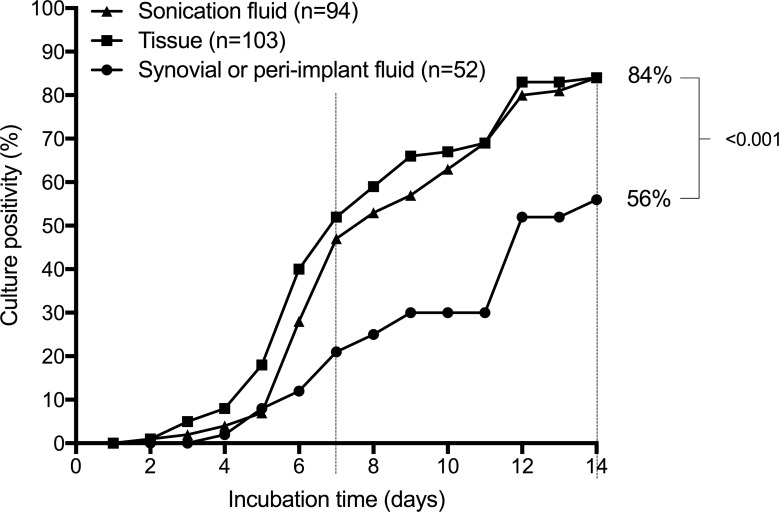
Of 121 patients with Cutibacterium IAI, 62 patients (51%) had PJI and 59 (49%) had FDAI. 109 infections (90%) were caused by C. acnes and 12 (10%) by C. avidum. The median time from implantation until diagnosis of infection was 15.7 months (interquartile range, 5-46.5 months). Clinical local signs were present in 30 patients (28%) and radiological implant loosening in 64 patients (63%). Culture sensitivity of sonication fluid was 84%, of peri-implant tissue 84% and of synovial or peri-implant fluid 56% after 14 days of incubation.
Cutibacterium IAI was diagnosed late in the disease course and presented with subtle signs. Prolonged culture incubation and implant sonication improved the poor performance of conventional microbiological tests. Due to lack of reliable diagnostic tests, Cutibacterium remains difficult to detect making the diagnosis challenging.
目前对于 痤疮丙酸杆菌(以前称为丙酸杆菌属)引起的植入物相关感染(IAI)的定义标准和临床特征知之甚少。我们分析了前瞻性队列中经微生物学证实的 痤疮丙酸杆菌骨科 IAI。
前瞻性纳入由 痤疮丙酸杆菌属引起的假体周围关节感染(PJI)和固定装置相关感染(FDAI)患者。IAI 通过显著生长的 痤疮丙酸杆菌属和至少存在一个感染的非微生物学标准来定义。采用 McNemar 的卡方检验或二项式检验比较诊断试验的性能。
在 121 例 痤疮丙酸杆菌感染患者中,62 例(51%)患有 PJI,59 例(49%)患有 FDAI。109 例感染(90%)由 C. acnes 引起,12 例(10%)由 C. avidum 引起。从植入到感染诊断的中位时间为 15.7 个月(四分位距,5-46.5 个月)。30 例(28%)存在临床局部体征,64 例(63%)存在影像学上的植入物松动。14 天孵育后,超声处理液的培养敏感性为 84%,植入物周围组织为 84%,滑膜或植入物周围液为 56%。
痤疮丙酸杆菌 IAI 诊断较晚,表现为轻微体征。延长培养孵育和植入物超声处理提高了常规微生物学检测的不良性能。由于缺乏可靠的诊断检测, 痤疮丙酸杆菌仍然难以检测,使诊断具有挑战性。