Gao Jie, Tang Chaoliang, Tai Lydia Wai, Ouyang Yeling, Li Na, Hu Zhiqiang, Chen Xiangdong
Department of Anesthesiology, The First Affiliated Hospital of Anhui Medical University, Hefei, 230022, Anhui Provence, China.
Department of Anesthesiology, Union Hospital, Tongji Medical College, Huazhong University of Science and Technology, Wuhan, 430022, Hubei Province, China,
J Pain Res. 2018 Aug 10;11:1511-1519. doi: 10.2147/JPR.S160779. eCollection 2018.
Pro-resolving mediators (PRMs) are considered as emerging analgesics for chronic pain. Maresin 1 (MaR1) is a newly identified member of PRMs, and recent studies implicate its potential role in some pain conditions. As the function of MaR1 in neuropathic pain remains unclear, we investigated the effects of MaR1 on pain hypersensitivity and the underlying mechanism using a rat spinal nerve ligation (SNL) model of neuropathic pain.
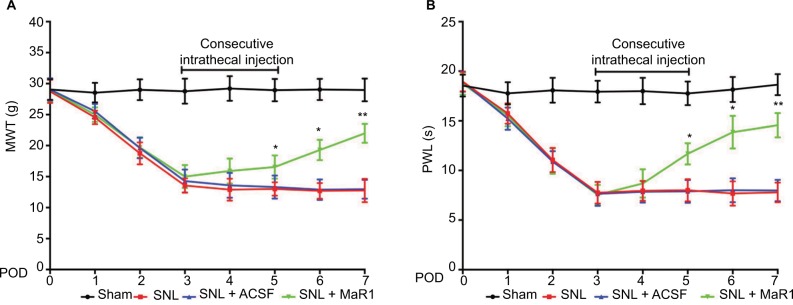
MaR1 (100 ng/10 μL) or commensurable artificial cerebrospinal fluid was delivered via intrathecal catheter from days 3 to 5 post-SNL followed by assessment of mechanical allodynia and thermal hyperalgesia. Ipsilateral L4-L5 spinal cord tissue was collected on day 7 post-SNL and assessed by Western blotting, enzyme-linked immunosorbent assay or immunohistochemistry.
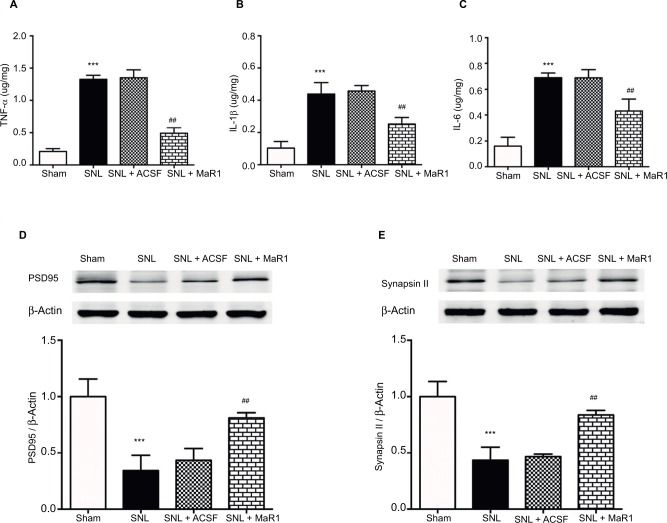
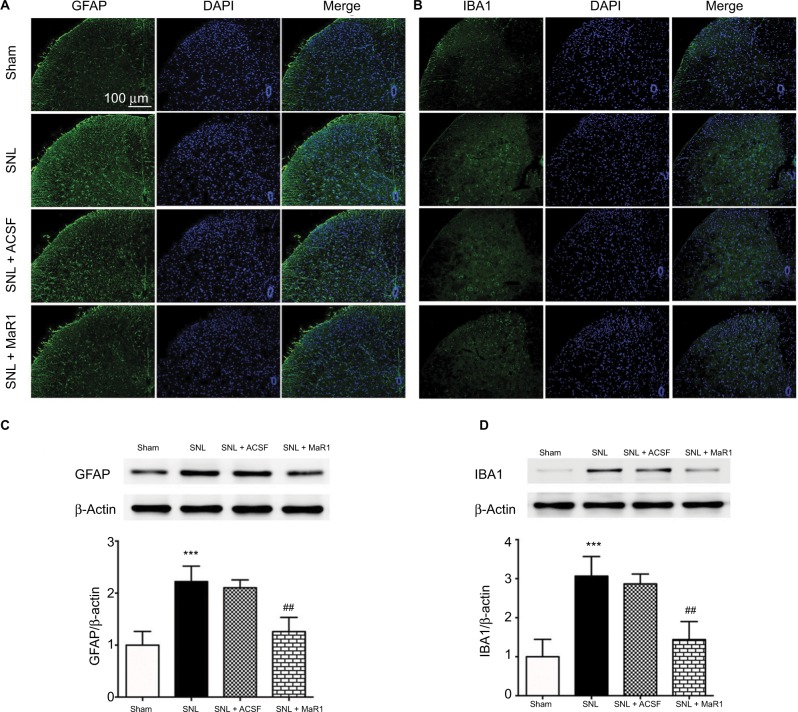
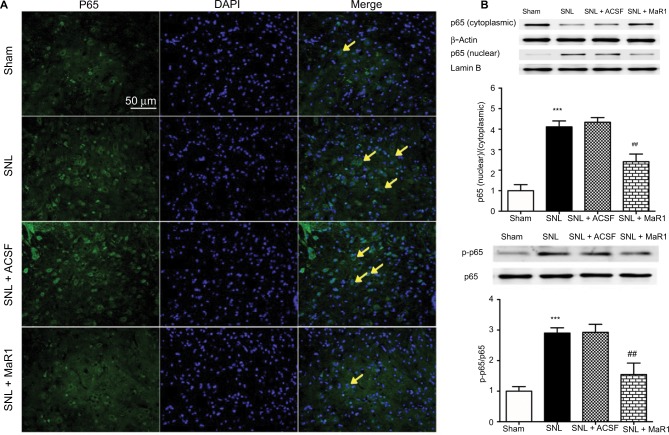
Intrathecal MaR1 significantly attenuated mechanical allodynia and thermal hyperalgesia from day 5 to day 7 post-SNL, which was associated with decreased spinal levels of glial markers, GFAP and IBA1. It was also found that intrathecal MaR1 downregulated phosphorylation levels of NF-κB p65 and its nuclear translocation, as well as decreased protein levels of pro-inflammatory cytokines, TNF-α, IL-1β and IL-6. Further, MaR1 treatment restored PSD95 and synapsin II levels, suggesting that MarR1 also protected synaptic integrity.
Our results indicate that MaR1 ameliorates the SNL-induced neuropathic pain by regulating glial activities and pro-inflammatory cytokines release. The present study offers insight into the potential of MaR1 as a novel intervention to ameliorate neuropathic pain.
促消退介质(PRMs)被认为是治疗慢性疼痛的新型镇痛药。maresin 1(MaR1)是PRMs新发现的成员,近期研究表明其在某些疼痛状态中具有潜在作用。由于MaR1在神经性疼痛中的功能尚不清楚,我们使用神经性疼痛的大鼠脊髓神经结扎(SNL)模型研究了MaR1对疼痛超敏反应的影响及其潜在机制。
在SNL后第3至5天,通过鞘内导管给予MaR1(100 ng/10 μL)或等量的人工脑脊液,随后评估机械性异常性疼痛和热痛觉过敏。在SNL后第7天收集同侧L4-L5脊髓组织,通过蛋白质免疫印迹法、酶联免疫吸附测定或免疫组织化学进行评估。
鞘内注射MaR1可显著减轻SNL后第5至7天的机械性异常性疼痛和热痛觉过敏,这与脊髓中胶质细胞标志物GFAP和IBA1水平降低有关。还发现鞘内注射MaR1可下调NF-κB p65的磷酸化水平及其核转位,以及降低促炎细胞因子TNF-α、IL-1β和IL-6的蛋白水平。此外,MaR1治疗可恢复PSD95和突触素II水平,表明MaR1还可保护突触完整性。
我们的结果表明,MaR1通过调节胶质细胞活性和促炎细胞因子释放来改善SNL诱导的神经性疼痛。本研究为MaR1作为改善神经性疼痛的新型干预措施的潜力提供了见解。