Radboud University Medical Centre, Expertise Center for Pain and Palliative Medicine, Nijmegen, The Netherlands.
HAN University of Applied Science, Nijmegen, The Netherlands.
J Clin Nurs. 2019 Feb;28(3-4):589-602. doi: 10.1111/jocn.14653. Epub 2018 Sep 7.
To explore what meaning patients associate with their experiences with a nurse practitioner (NP) in oncological or palliative care.
Care provided by NPs results in high patient satisfaction, mostly related to the assurance of continuity of care, and to receiving information and advice on coping with the disease. Research shows that health care provided by NPs equals the quality of care provided by physicians. Patients may be even more satisfied with care provided by NPs. Because patients' views have only been examined quantitatively, underlying experiences and meanings remain unclear.
A qualitative study from a phenomenological perspective.
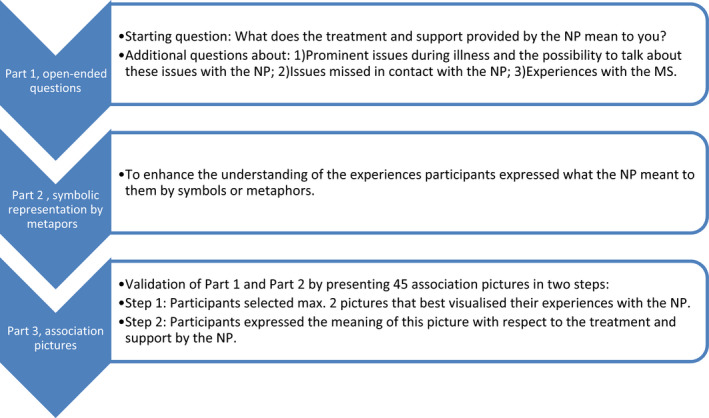
In 2017, seventeen outpatients aged 45-79 years, receiving oncological or palliative care, were interviewed in depth. Data were analysed by Colaizzi's seven-step method and by the Metaphor Identification Procedure.
Six fundamental themes emerged: the NP as a human (1) and as a professional (2), the NP providing care (3) and cure (4), NPs organising patient care (5) and the impact on patient's well-being (6). MIP analysis revealed six metaphors: NP means trust; is a travel aid; is a combat unit; is a chain; is a signpost; and is a technician.
NPs mean a lot to patients. NPs are valued as reliable, helpful and empathic. Patients feel empowered, at peace and in control as a result of the support, guidance and attention to them as a person as well as to aspects of the disease. Providing expert, integrated care makes patients feel safe and embraced in the NP's expertise.
This qualitative insight into patients' experiences will contribute to the body of knowledge on patients' perceptions of the treatment and support provided by NPs. It adds to the further development of the NPs' profession and education.
探讨患者在肿瘤学或姑息治疗中与护士从业者(NP)相关经历的意义。
NP 提供的护理会导致患者高度满意,这主要与保证护理的连续性以及获得有关应对疾病的信息和建议有关。研究表明,NP 提供的医疗保健与医生提供的医疗保健质量相当。患者甚至可能对 NP 提供的护理更满意。由于仅对患者的观点进行了定量检查,因此仍不清楚潜在的经验和意义。
来自现象学角度的定性研究。
2017 年,对 17 名年龄在 45-79 岁之间、接受肿瘤学或姑息治疗的门诊患者进行了深入访谈。使用 Colaizzi 的七步分析法和隐喻识别程序对数据进行分析。
出现了六个基本主题:NP 作为人(1)和专业人员(2),提供护理(3)和治疗(4),组织患者护理(5)以及对患者幸福感的影响(6)。MIP 分析揭示了六个隐喻:NP 意味着信任;是旅行援助;是战斗单位;是链条;是路标;是技术员。
NP 对患者意义重大。NP 被认为是可靠、有帮助和有同理心的。由于支持、指导和关注患者的个人以及疾病的各个方面,患者感到有力量、安心和掌控感。提供专业、综合的护理使患者感到安全,并在 NP 的专业知识中得到了包容。
对患者体验的这种定性洞察将有助于增加患者对 NP 提供的治疗和支持的认知。它为 NP 专业的进一步发展和教育做出了贡献。