1 Division of Nursing, Midwifery and Social Work, The University of Manchester, Manchester, UK.
2 Faculty of Biology, Medicine and Health, Division of Nursing, Midwifery and Social Work, The University of Manchester, Manchester, UK.
Palliat Med. 2018 Dec;32(10):1605-1614. doi: 10.1177/0269216318793286. Epub 2018 Aug 21.
Family carers provide vital support for patients towards end-of-life, but caregiving has considerable impact on carers' own health. The scale of this problem is unknown, as previous research has involved unrepresentative samples or failed to fully capture caregiving close to death.
To quantify level of psychological morbidity and general health among a census sample of carers of people with cancer at end-of-life, compared to population reference data.
National 4-month post-bereavement postal census survey of family carers of people who died from cancer, retrospectively measuring carers' psychological health (General Health Questionnaire-12) and general health (EuroQoL EQ-Visual Analogue Scale) during the patient's last 3 months of life.
N = 1504 (28.5%) of all 5271 people who registered the death of a relative from cancer in England during 2 weeks in 2015 compared with data from the Health Survey for England 2014 ( N = 6477-6790).
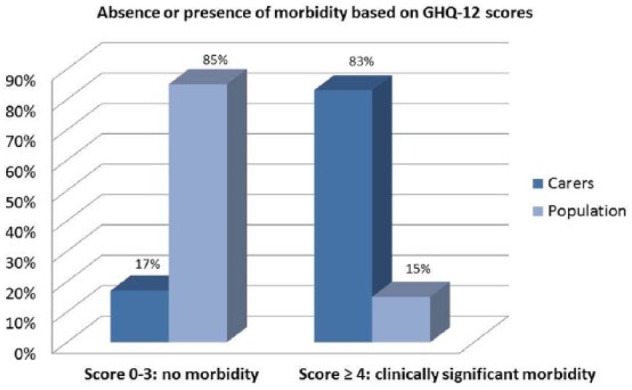
Psychological morbidity at clinically significant levels (General Health Questionnaire-12 ⩾4) was substantially higher among carers than the general population (83% vs 15%), with prevalence five to seven times higher across all age groups. Overall, carers' general health scores were lower than population scores, median 75 (interquartile range, 50-80) versus 80 (interquartile range, 70-90), but differences were more marked at younger ages. Female carers had worse psychological morbidity and general health than male carers.
Levels of psychological morbidity among family carers during end-of-life caregiving are far higher than indicated by previous research, indicating a substantial public health problem. Consistent assessment and support for carers to prevent breakdown in caregiving may produce cost savings in long term.
在患者临终之际,家属照顾者为其提供了至关重要的支持,但照顾者自身的健康也因此受到了极大的影响。由于之前的研究涉及的样本不具代表性,或者未能充分捕捉到接近死亡时的照顾情况,因此我们并不清楚这一问题的严重程度。
通过对临终期癌症患者家属进行全国性的 4 个月随访问卷调查,与人群参考数据相比,量化在该人群中处于代表性样本的照顾者的心理病态程度和一般健康状况。
对在英格兰,于 2015 年两周内登记有亲属因癌症死亡的所有 5271 人中的 1504 人(28.5%)进行回顾性调查,调查内容包括患者临终前 3 个月期间照顾者的心理健康(使用一般健康问卷-12 项)和一般健康状况(使用欧洲生命质量量表视觉模拟标尺)。
与 2014 年英格兰健康调查的 6477-6790 名数据相比,1504 名(28.5%)参与者登记了其亲属因癌症死亡。
在所有年龄组中,处于临床显著水平(一般健康问卷-12 ⩾4)的心理病态程度高的照顾者比例显著高于普通人群(83%比 15%),其流行率高出 5-7 倍。总体而言,照顾者的一般健康评分低于人群评分,中位数为 75(四分位间距,50-80)比 80(四分位间距,70-90),但在年龄较小的人群中差异更为显著。女性照顾者的心理病态程度和一般健康状况比男性照顾者差。
在临终关怀期间,家属照顾者的心理病态程度远远高于之前研究显示的程度,这表明存在严重的公共卫生问题。对照顾者进行持续评估和支持,以防止照顾崩溃,可能会在长期内节省成本。