Department of Sport, Exercise and Health, University of Basel, Basel, Switzerland.
Amsterdam Collaboration on Health and Safety in Sports, Amsterdam UMC, Vrije Universiteit Amsterdam, Department of Public and Occupational Health, Amsterdam Movement Sciences, Amsterdam, the Netherlands.
Br J Sports Med. 2019 Mar;53(5):309-314. doi: 10.1136/bjsports-2018-099395. Epub 2018 Aug 21.
To evaluate a potential reduction in injury related healthcare costs when using the '11+ Kids' injury prevention programme compared with a usual warmup in children's football.
This cost effectiveness analysis was based on data collected in a cluster randomised controlled trial over one season from football teams (under-9 to under-13 age groups) in Switzerland. The intervention group (INT) replaced their usual warmup with '11+ Kids', while the control group (CON) warmed up as usual. Injuries, healthcare resource use and football exposure (in hours) were collected prospectively. We calculated the mean injury related costs in Swiss Francs (CHF) per 1000 hours of football. We calculated the cost effectiveness (the direct net healthcare costs divided by the net health effects of the '11+ Kids' intervention) based on the actual data in our study (trial based) and for a countrywide implementation scenario (model based).
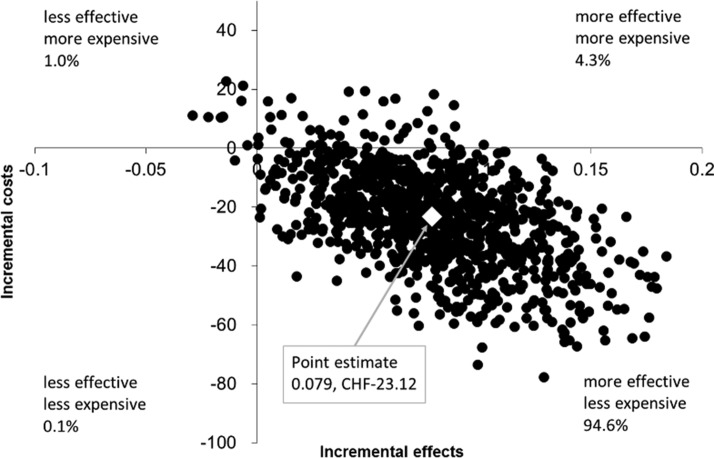
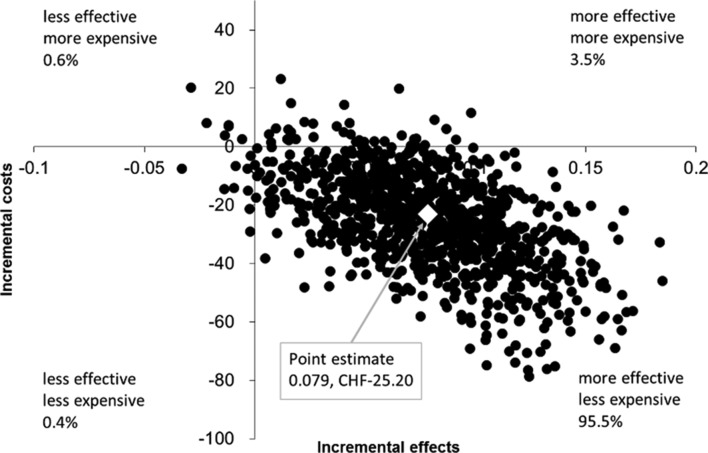
Costs per 1000 hours of exposure were CHF228.34 (95% CI 137.45, 335.77) in the INT group and CHF469.00 (95% CI 273.30, 691.11) in the CON group. The cost difference per 1000 hours of exposure was CHF-240.66 (95%CI -406.89, -74.32). A countrywide implementation would reduce healthcare costs in Switzerland by CHF1.48 million per year. 1002 players with a mean age of 10.9 (SD 1.2) years participated. During 76 373 hours of football, 99 injuries occurred.
The '11+ Kids' programme reduced the healthcare costs by 51% and was dominant (ie, the INT group had lower costs and a lower injury risk) compared with a usual warmup. This provides a compelling case for widespread implementation.
评估在儿童足球中使用“11+ Kids”预防伤害项目相对于常规热身时,在减少与伤害相关的医疗保健成本方面的潜在效果。
本成本效果分析基于在瑞士一个赛季中,从足球团队(9 岁以下至 13 岁以下年龄组)中收集的数据进行,采用集群随机对照试验设计。干预组(INT)用“11+ Kids”替代常规热身,而对照组(CON)则照常热身。前瞻性收集伤害、医疗资源使用和足球暴露(以小时计)的数据。我们以瑞士法郎(CHF)计算每 1000 小时足球相关伤害的平均成本。我们根据研究中的实际数据(基于试验)和全国范围内实施的情况(基于模型),计算了“11+ Kids”干预的直接净医疗成本与净健康效果的比值,即成本效果。
暴露于足球的每 1000 小时的成本分别为干预组 228.34 瑞士法郎(95%CI 137.45,335.77),对照组 469.00 瑞士法郎(95%CI 273.30,691.11)。暴露于足球的每 1000 小时的成本差异为-240.66 瑞士法郎(95%CI-406.89,-74.32)。在全国范围内实施该项目每年将减少瑞士的医疗保健成本 148 万瑞士法郎。共有 1002 名平均年龄为 10.9 岁(标准差 1.2 岁)的球员参与了研究。在 76373 小时的足球活动中,发生了 99 例伤害。
与常规热身相比,“11+ Kids”项目将医疗保健成本降低了 51%,且具有优势(即,干预组的成本更低,受伤风险也更低)。这为广泛实施该项目提供了有力的理由。