Riva Natalí S, Ruhlmann Claudio, Iaizzo Rocío S, Marcial López Carla A, Martínez Alejandro Gustavo
Fertilidad San Isidro, Buenos Aires, Argentina.
JBRA Assist Reprod. 2018 Nov 1;22(4):331-337. doi: 10.5935/1518-0557.20180060.
Cryopreservation of human spermatozoa is fundamental in assisted reproductive technology. At present, slow freezing techniques are widely used for sperm cryopreservation. Recently, sperm vitrification has been proposed as an alternative to slow freezing. This study aimed to compare the efficiency of slow versus ultra-rapid freezing after thawing and to determine the level of DNA fragmentation in post-thaw normal human semen samples processed through each of the cryopreservation techniques.
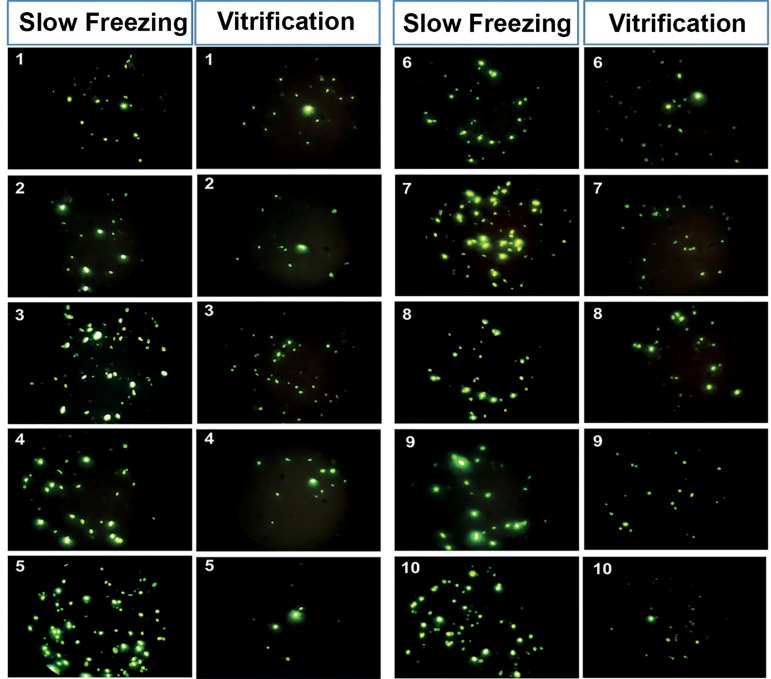
Ultra-rapid freezing is a method that only differs from conventional ultra-rapid freezing in the use of sucrose as a cryoprotectant. In experiment 1, 24 semen samples were used to compare sperm recovery rates after slow and ultra-rapid sperm freezing. In experiment 2, 18 semen samples were used to compare post-thaw sperm DNA fragmentation levels after each of the cryopreservation techniques.
In experiment 1, no significant differences were observed in sperm concentration recovery rates, although slow freezing showed a lower progressive motility rate than ultra-rapid freezing (16.6±7.4% vs. 34.7±10.2%), and higher non-progressive and immotile sperm counts (9.0±4.0% vs. 7.6±2.8%; and 74.4±10.1% vs. 57.8±10.3%, respectively). In experiment 2, sperm DNA fragmentation after thawing was significantly higher in slow freezing than in fresh post gradient processing and ultra-rapid freezing samples (47.3±13.4% vs. 9.1±3.7% vs. 14.6±4.6%, respectively).
Sperm ultra-rapid freezing may be an alternative to slow freezing with better recovery results and less apparent DNA damage.
人类精子的冷冻保存是辅助生殖技术的基础。目前,慢速冷冻技术广泛应用于精子冷冻保存。近来,精子玻璃化冷冻已被提出作为慢速冷冻的替代方法。本研究旨在比较慢速冷冻与超快速冷冻解冻后的效率,并确定通过每种冷冻保存技术处理的解冻后正常人精液样本中的DNA片段化水平。
超快速冷冻是一种仅在使用蔗糖作为冷冻保护剂方面与传统超快速冷冻不同的方法。在实验1中,使用24份精液样本比较慢速和超快速精子冷冻后的精子回收率。在实验2中,使用18份精液样本比较每种冷冻保存技术后的解冻后精子DNA片段化水平。
在实验1中,精子浓度回收率未观察到显著差异,尽管慢速冷冻显示出比超快速冷冻更低的前向运动率(16.6±7.4%对34.7±10.2%),以及更高的非前向运动和不动精子计数(分别为9.0±4.0%对7.6±2.8%;74.4±10.1%对57.8±10.3%)。在实验2中,解冻后精子DNA片段化在慢速冷冻中显著高于新鲜梯度处理后和超快速冷冻样本(分别为47.3±13.4%对9.1±3.7%对14.6±4.6%)。
精子超快速冷冻可能是慢速冷冻的一种替代方法,具有更好的恢复结果和较少明显的DNA损伤。