Departamento de Oncologia, Hospital Sirio Libanes, Sao Paulo, SP, BR.
Disciplina de Radiologia e Oncologia, Instituto do Cancer do Estado de Sao Paulo (ICESP), Hospital das Clinicas HCFMUSP, Faculdade de Medicina, Universidade de Sao Paulo, Sao Paulo, SP, BR.
Clinics (Sao Paulo). 2018 Aug 20;73(suppl 1):e490s. doi: 10.6061/clinics/2018/e490s.
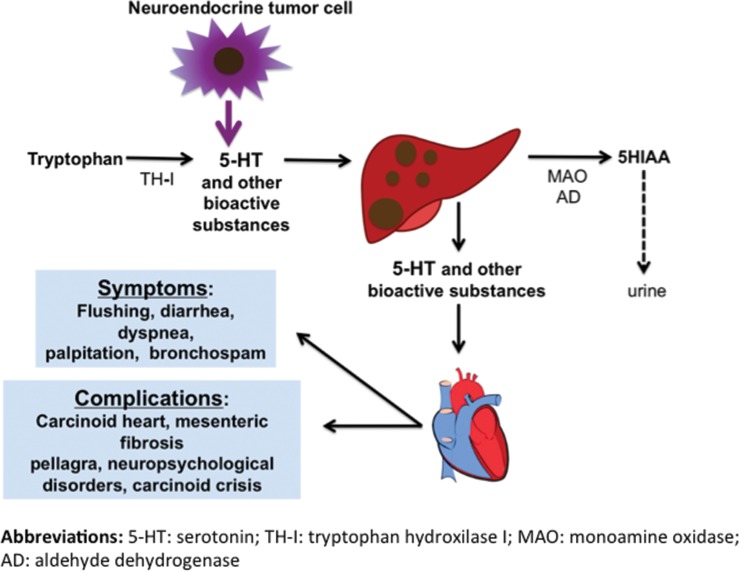
Approximately 30-40% of patients with well-differentiated neuroendocrine tumors present with carcinoid syndrome, which is a paraneoplastic syndrome associated with the secretion of several humoral factors. Carcinoid syndrome significantly and negatively affects patients' quality of life; increases costs compared with the costs of nonfunctioning neuroendocrine tumors; and results in changes in patients' lifestyle, such as diet, work, physical activity and social life. For several decades, patients with neuroendocrine tumors and carcinoid syndrome have been treated with somatostatin analogues as the first-line treatment. While these agents provide significant relief from carcinoid syndrome symptoms, there is inevitable clinical progression, and new therapeutic interventions are needed. More than 40 substances have been identified as being potentially related to carcinoid syndrome; however, their individual contributions in triggering different carcinoid symptoms or complications, such as carcinoid heart disease, remain unclear. These substances include serotonin (5-HT), which appears to be the primary marker associated with the syndrome, as well as histamine, kallikrein, prostaglandins, and tachykinins. Given the complexity involving the origin, diagnosis and management of patients with carcinoid syndrome, we have undertaken a comprehensive review to update information about the pathophysiology, diagnostic tools and treatment sequence of this syndrome, which currently comprises a multidisciplinary approach.
大约 30-40%的分化良好的神经内分泌肿瘤患者出现类癌综合征,这是一种与几种体液因子分泌有关的副肿瘤综合征。类癌综合征显著且负面地影响患者的生活质量;与无功能性神经内分泌肿瘤的成本相比,增加了成本;并导致患者生活方式的改变,如饮食、工作、体力活动和社会生活。几十年来,类癌综合征和神经内分泌肿瘤患者一直接受生长抑素类似物作为一线治疗。虽然这些药物能显著缓解类癌综合征症状,但不可避免地会出现临床进展,需要新的治疗干预措施。已经确定了 40 多种物质可能与类癌综合征有关;然而,它们在引发不同的类癌症状或并发症(如类癌心脏病)方面的单独作用仍不清楚。这些物质包括 5-羟色胺(5-HT),它似乎是与该综合征相关的主要标志物,以及组胺、激肽、前列腺素和速激肽。鉴于类癌综合征患者的起源、诊断和管理涉及到复杂性,我们进行了全面的回顾,以更新有关该综合征的病理生理学、诊断工具和治疗顺序的信息,目前该综合征包括多学科方法。