School of Integrative Engineering, Chung-Ang University, Seoul 06974, Korea.
Department of Chemical Engineering, Kwangwoon University, 20 Kwangwoon-Ro, Nowon-Gu, Seoul 0189, Korea.
Sensors (Basel). 2018 Aug 21;18(9):2755. doi: 10.3390/s18092755.
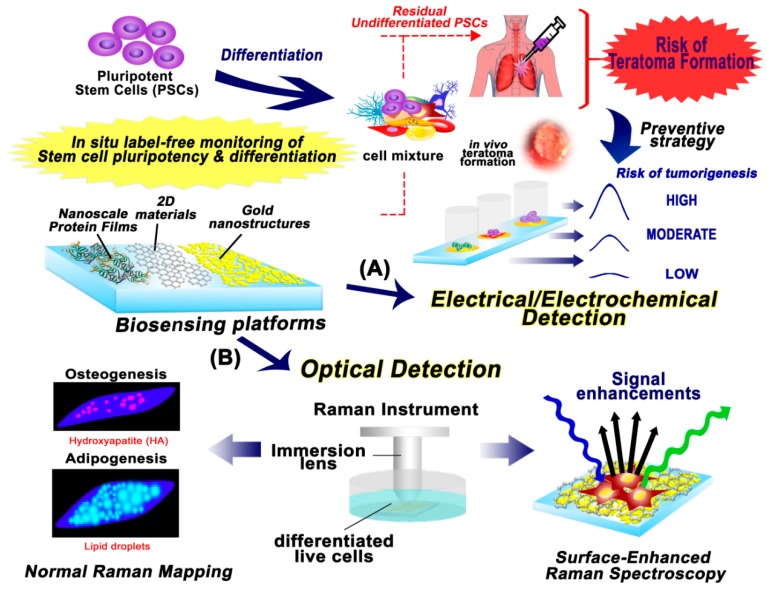
Breakthroughs in the biomedical and regenerative therapy fields have led to the influential ability of stem cells to differentiate into specific types of cells that enable the replacement of injured tissues/organs in the human body. Non-destructive identification of stem cell differentiation is highly necessary to avoid losses of differentiated cells, because most of the techniques generally used as confirmation tools for the successful differentiation of stem cells can result in valuable cells becoming irrecoverable. Regarding this issue, recent studies reported that both Raman spectroscopy and electrochemical sensing possess excellent characteristics for monitoring the behavior of stem cells, including differentiation. In this review, we focus on numerous studies that have investigated the detection of stem cell pluripotency and differentiation in non-invasive and non-destructive manner, mainly by using the Raman and electrochemical methods. Through this review, we present information that could provide scientific or technical motivation to employ or further develop these two techniques for stem cell research and its application.
生物医学和再生治疗领域的突破使得干细胞具有分化为特定类型细胞的影响力,从而能够替代人体受损的组织/器官。为了避免分化细胞的损失,对干细胞分化进行非破坏性鉴定是非常必要的,因为大多数通常用作干细胞成功分化确认工具的技术都会导致有价值的细胞变得不可恢复。关于这个问题,最近的研究报告表明,拉曼光谱和电化学传感都具有监测干细胞行为(包括分化)的优异特性。在这篇综述中,我们重点介绍了许多研究,这些研究主要通过拉曼和电化学方法,以非侵入性和非破坏性的方式来检测干细胞的多能性和分化。通过这篇综述,我们提供了一些信息,这些信息可能为这两种技术在干细胞研究及其应用中的应用或进一步发展提供科学或技术动力。