Center for Molecular Innovation, The Feinstein Institute for Medical Research, 350 Community Drive, Manhasset, New York, 11030, USA.
Chromatin Dynamics Unit, Division of Genetics and Cell Biology, San Raffaele University and San Raffaele Scientific Institute IRCCS, Via Olgettina 58, 20132, Milan, Italy.
Mol Med. 2018 May 10;24(1):21. doi: 10.1186/s10020-018-0023-8.
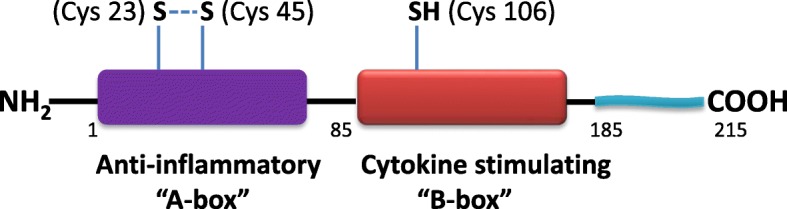
High Mobility Group Box 1 (HMGB1) was first identified as a nonhistone chromatin-binding protein that functions as a pro-inflammatory cytokine and a Damage-Associated Molecular Pattern molecule when released from necrotic cells or activated leukocytes. HMGB1 consists of two structurally similar HMG boxes that comprise the pro-inflammatory (B-box) and the anti-inflammatory (A-box) domains. Paradoxically, the A-box also contains the epitope for the well-characterized anti-HMGB1 monoclonal antibody "2G7", which also potently inhibits HMGB1-mediated inflammation in a wide variety of in vivo models. The molecular mechanisms through which the A-box domain inhibits the inflammatory activity of HMGB1 and 2G7 exerts anti-inflammatory activity after binding the A-box domain have been a mystery. Recently, we demonstrated that: 1) the TLR4/MD-2 receptor is required for HMGB1-mediated cytokine production and 2) the HMGB1-TLR4/MD-2 interaction is controlled by the redox state of HMGB1 isoforms.
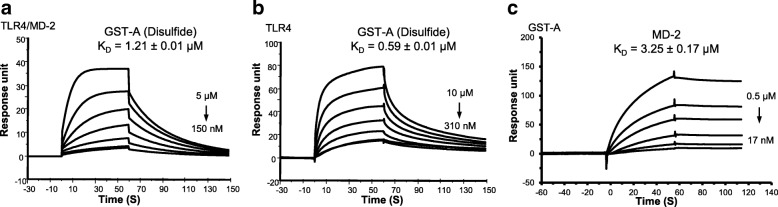
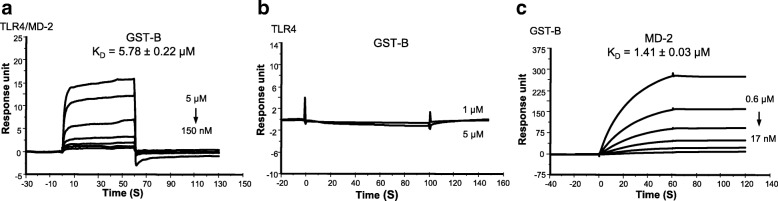
We investigated the interactions of HMGB1 isoforms (redox state) or HMGB1 fragments (A- and B-box) with TLR4/MD-2 complex using Surface Plasmon Resonance (SPR) studies.
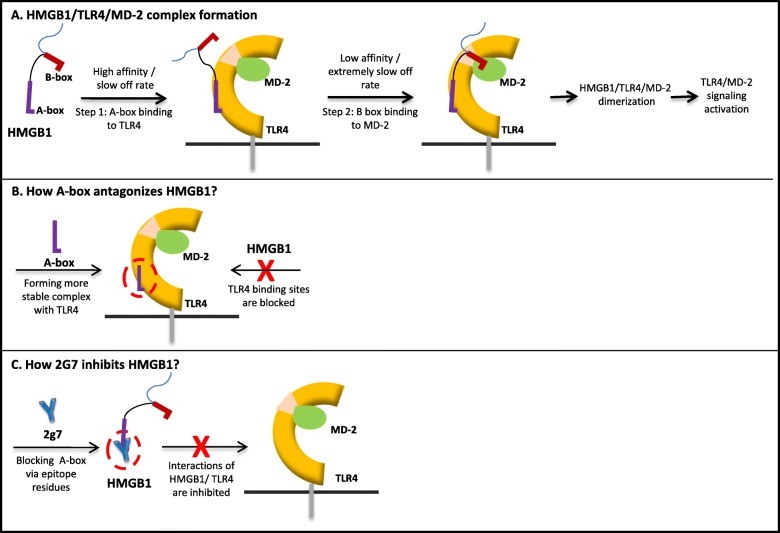
Our results demonstrate that: 1) intact HMGB1 binds to TLR4 via the A-box domain with high affinity but an appreciable dissociation rate; 2) intact HMGB1 binds to MD-2 via the B-box domain with low affinity but a very slow dissociation rate; and 3) HMGB1 A-box domain alone binds to TLR4 more stably than the intact protein and thereby antagonizes HMGB1 by blocking HMGB1 from interacting with the TLR4/MD-2 complex.
These findings not only suggest a model whereby HMGB1 interacts with TLR4/MD-2 in a two-stage process but also explain how the A-box domain and 2G7 inhibit HMGB1.
高迁移率族蛋白 B1(HMGB1)最初被鉴定为一种非组蛋白染色质结合蛋白,当从坏死细胞或活化的白细胞中释放时,它作为一种促炎细胞因子和损伤相关分子模式分子发挥作用。HMGB1 由两个结构相似的 HMG 盒组成,包括促炎(B 盒)和抗炎(A 盒)结构域。矛盾的是,A 盒还包含针对经过充分研究的抗 HMGB1 单克隆抗体“2G7”的表位,该抗体也能在多种体内模型中有效抑制 HMGB1 介导的炎症。A 盒结构域抑制 HMGB1 炎症活性的分子机制以及 2G7 结合 A 盒结构域后发挥抗炎活性的机制一直是个谜。最近,我们证明了:1)TLR4/MD-2 受体是 HMGB1 介导的细胞因子产生所必需的,2)HMGB1-TLR4/MD-2 相互作用受 HMGB1 同工型氧化还原状态的控制。
我们使用表面等离子体共振(SPR)研究调查了 HMGB1 同工型(氧化还原状态)或 HMGB1 片段(A 盒和 B 盒)与 TLR4/MD-2 复合物的相互作用。
我们的结果表明:1)完整的 HMGB1 通过 A 盒结构域与 TLR4 以高亲和力结合,但解离速率相当高;2)完整的 HMGB1 通过 B 盒结构域与 MD-2 以低亲和力结合,但解离速率非常慢;3)HMGB1 A 盒结构域本身与 TLR4 的结合比完整蛋白更稳定,从而通过阻止 HMGB1 与 TLR4/MD-2 复合物相互作用来拮抗 HMGB1。
这些发现不仅提出了一种模型,即 HMGB1 通过两步过程与 TLR4/MD-2 相互作用,还解释了 A 盒结构域和 2G7 如何抑制 HMGB1。