The Feinstein Institute for Medical Research, Manhasset, NY, USA; Division of Allergy and Immunology, Department of Pediatrics, Donald and Barbara Zucker School of Medicine at Hofstra/Northwell, Great Neck, NY, USA.
Department of Genomic Medicine, Otology and Neurotology Group CTS495, Centre for Genomics and Oncological Research, Pfizer/Universidad de Granada/Junta de Andalucía (GENYO), Granada, Spain.
Mol Med. 2018 May 16;24(1):23. doi: 10.1186/s10020-018-0022-9.
Stratified human keratinocytes (SHKs) are an essential part of mucosal innate immune response that modulates adaptive immunity to microbes encountered in the environment. The importance of these SHKs in mucosal integrity and development has been well characterized, however their regulatory immunologic role at different mucosal sites, has not. In this study we compared the immune gene expression of SHKs from five different anatomical sites before and after HPV16 transfection using microarray analyses.
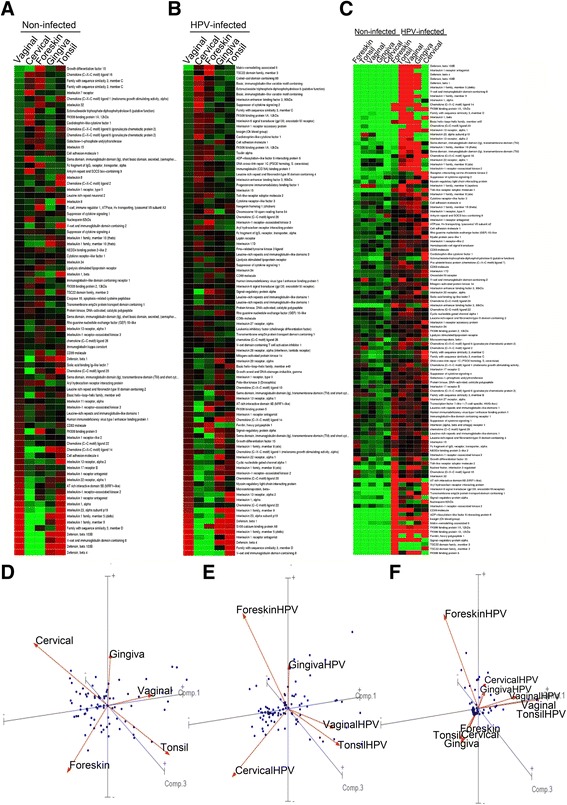
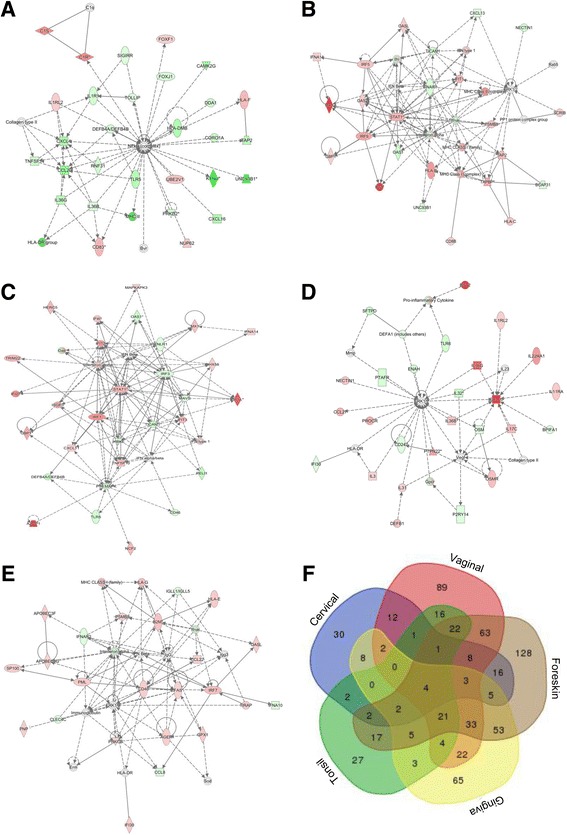
Individual pools of human keratinocytes from foreskin, cervix, vagina, gingiva, and tonsils (HFKs, HCKs, HVKs, HGKs and HTLKs) were prepared. Organotypic (raft) cultures were established for both normal and HPV16 immortalized HFKs, HCKs, HVKs, HGKs and HTLKs lines which stably maintained episomal HPV16 DNA. Microarray analysis was carried out using the HumanHT-12 V4 gene chip (Illumina). Immune gene expression profiles were obtained by global gene chip (GeneSifter) and Ingenuity pathway analysis (IPA) for each individual site, with or without HPV16 transfection.
We examined site specific innate immune response gene expression in SHKs from all five different anatomical sites before and after HPV16 transfection. We observed marked differences in SHK immune gene repertoires within and between mucosal tracts before HPV 16 infection. In addition, we observed additional changes in SHKs immune gene repertoire patterns when these SHKs were productively transfected with HPV16. Some immune response genes were similarly expressed by SHKs from different sites. However, there was also variable expression of non-immune response genes, such as keratin genes, by the different SHKs.
Our results suggest that keratinocytes from different anatomical sites are likely hard wired in their innate immune responses, and that these immune responses are unique depending on the anatomical site from which the SHKs were derived. These observations may help explain why select HPV types predominate at different mucosal sites, cause persistent infection at these sites, and on occasion, lead to HPV induced malignant and benign tumor development.
分层人角质形成细胞(SHK)是黏膜先天免疫反应的重要组成部分,调节对环境中遇到的微生物的适应性免疫。这些 SHK 在黏膜完整性和发育中的重要性已经得到很好的描述,但是它们在不同黏膜部位的调节免疫作用尚未得到描述。在这项研究中,我们使用微阵列分析比较了来自五个不同解剖部位的 SHK 在 HPV16 转染前后的免疫基因表达。
从包皮、宫颈、阴道、牙龈和扁桃体(HFKs、HCKs、HVKs、HGKs 和 HTLKs)中分别制备人角质形成细胞的个体池。建立了用于正常和 HPV16 永生化 HFKs、HCKs、HVKs、HGKs 和 HTLKs 系的器官型(筏)培养物,这些细胞系稳定地维持着 HPV16 的游离体 DNA。使用 HumanHT-12 V4 基因芯片(Illumina)进行微阵列分析。使用全局基因芯片(GeneSifter)和 Ingenuity 通路分析(IPA)对每个个体部位进行免疫基因表达谱分析,包括有无 HPV16 转染。
我们检查了来自所有五个不同解剖部位的 SHK 在 HPV16 转染前后的特定部位先天免疫反应基因表达。在 HPV16 感染之前,我们观察到 SHK 内和 SHK 之间黏膜途径的固有免疫基因库存在明显差异。此外,当这些 SHK 被 HPV16 有效转染时,我们观察到 SHK 免疫基因库模式的额外变化。一些免疫反应基因在不同部位的 SHK 中表达相似。然而,不同 SHK 中也存在非免疫反应基因(如角蛋白基因)的可变表达。
我们的结果表明,来自不同解剖部位的角质形成细胞在其先天免疫反应中可能已经被硬连线,并且这些免疫反应根据 SHK 来源的解剖部位而具有独特性。这些观察结果可能有助于解释为什么某些 HPV 类型在不同的黏膜部位占优势,导致这些部位的持续性感染,并在某些情况下导致 HPV 引起的良性和恶性肿瘤的发展。