Division of Public Health, Michigan State University, 200 East 1st St Room 366, Flint, MI, 48502, USA.
National Center for PTSD, Dissemination and Training Division and Stanford University Department of Psychiatry and Behavioral Sciences, 795 Willow Road (NC-PTSD 334), Menlo Park, CA, 94025, USA.
Implement Sci. 2018 Aug 22;13(1):115. doi: 10.1186/s13012-018-0807-9.
More research on sustainment of interventions is needed, especially return on investment (ROI) studies to determine cost-benefit trade-offs for effort required to sustain and how much is gained when effective programs are sustained. The ROSE sustainment (ROSES) study uses a sequential multiple assignment randomized (SMART) design to evaluate the effectiveness and cost-effectiveness of a stepwise approach to sustainment of the ROSE postpartum depression prevention program in 90 outpatient clinics providing prenatal care to pregnant women on public assistance. Postpartum depression (PPD) is common and can have lasting consequences. Outpatient clinics offering prenatal care are an opportune place to provide PPD prevention because most women visit while pregnant. The ROSE (Reach Out, Stay Strong, Essentials for mothers of newborns) program is a group educational intervention to prevent PPD, delivered during pregnancy. ROSE has been found to reduce cases of PPD in community prenatal settings serving low-income pregnant women.
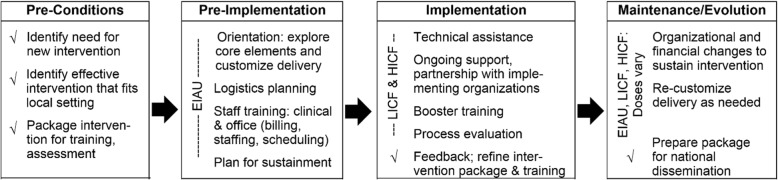
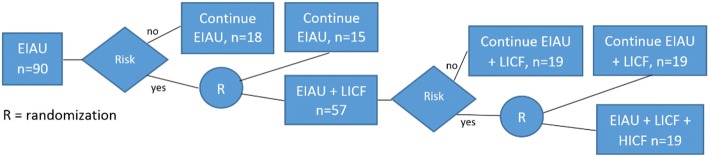
All 90 prenatal clinics will receive enhanced implementation as usual (EIAU; initial training + tools for sustainment). At the first time at which a clinic is determined to be at risk for failure to sustain (i.e., at 3, 6, 9, 12, and 15 months), that clinic will be randomized to receive either (1) no additional implementation support (i.e., EIAU only), or (2) low-intensity coaching and feedback (LICF). If clinics receiving LICF are still at risk at subsequent assessments, they will be randomized to either (1) EIAU + LICF only, or (2) high-intensity coaching and feedback (HICF). Additional follow-up interviews will occur at 18, 24, and 30 months, but no implementation intervention will occur after 18 months. Outcomes include (1) percent sustainment of core program elements at each time point, (2) health impact (PPD rates over time at each clinic) and reach, and (3) ROI (costs and cost-effectiveness) of each sustainment step. Hypothesized mechanisms include sustainment of capacity to deliver core elements and engagement/ownership.
This study is the first randomized trial evaluating the ROI of a stepped approach to sustainment, a critical unanswered question in implementation science. It will also advance knowledge of implementation mechanisms and clinical care for an at-risk population.
Clinicaltrials.gov, NCT03267563 . Registered June 14, 2018.
需要更多关于维持干预措施的研究,特别是投资回报率(ROI)研究,以确定维持所需的努力的成本效益权衡,以及当有效的项目得到维持时可以获得多少收益。ROSE 维持(ROSES)研究采用序贯多重分配随机(SMART)设计,评估逐步方法维持 ROSE 产后抑郁症预防计划的有效性和成本效益,该计划在 90 个为接受公共援助的孕妇提供产前护理的门诊诊所实施。产后抑郁症(PPD)很常见,并且可能会产生持久的影响。提供产前护理的门诊是提供 PPD 预防的一个合适场所,因为大多数女性在怀孕期间都会去看医生。ROSE(伸出援手,保持坚强,新生儿母亲必备)计划是一种小组教育干预措施,用于在怀孕期间预防 PPD。已经发现 ROSE 可以减少社区产前环境中为低收入孕妇提供的 PPD 病例。
所有 90 个产前诊所都将接受增强的常规实施(EIAU;初始培训+维持工具)。在首次确定诊所有无法维持的风险时(即 3、6、9、12 和 15 个月),该诊所将随机分配接受以下两种方案之一:(1)不提供额外的实施支持(即仅 EIAU),或(2)低强度辅导和反馈(LICF)。如果接受 LICF 的诊所仍有风险,将在随后的评估中随机分配给以下两种方案之一:(1)EIAU+LICF 仅,或(2)高强度辅导和反馈(HICF)。额外的随访访谈将在 18、24 和 30 个月进行,但在 18 个月后不再进行实施干预。结果包括:(1)每个时间点核心项目要素的维持率;(2)健康影响(每个诊所随时间推移的 PPD 率)和覆盖面;(3)每个维持步骤的投资回报率(成本和成本效益)。假设的机制包括维持提供核心要素的能力和参与度/所有权。
这是第一项评估逐步维持方法投资回报率的随机试验,这是实施科学中一个关键的未解决问题。它还将推进对高危人群实施机制和临床护理的认识。
Clinicaltrials.gov,NCT03267563。于 2018 年 6 月 14 日注册。