Tang Ming-Ming, Lin Wen-Juan, Pan Yu-Qin, Li Ying-Cong
CAS Key Laboratory of Mental Health, Institute of Psychology, Beijing, China.
Department of Psychology, University of Chinese Academy of Sciences, Beijing, China.
Front Cell Neurosci. 2018 Aug 8;12:255. doi: 10.3389/fncel.2018.00255. eCollection 2018.
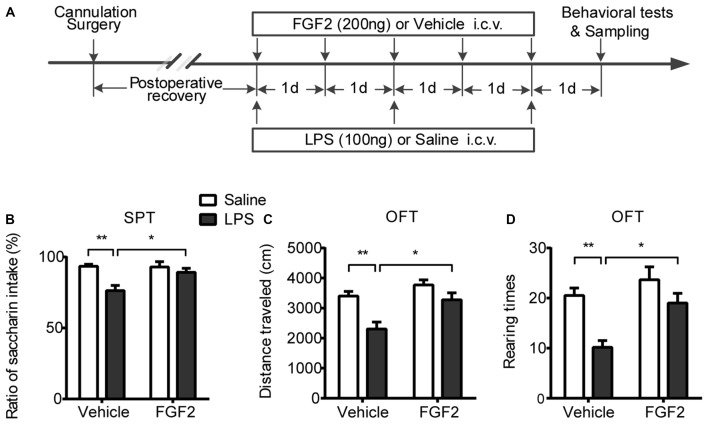
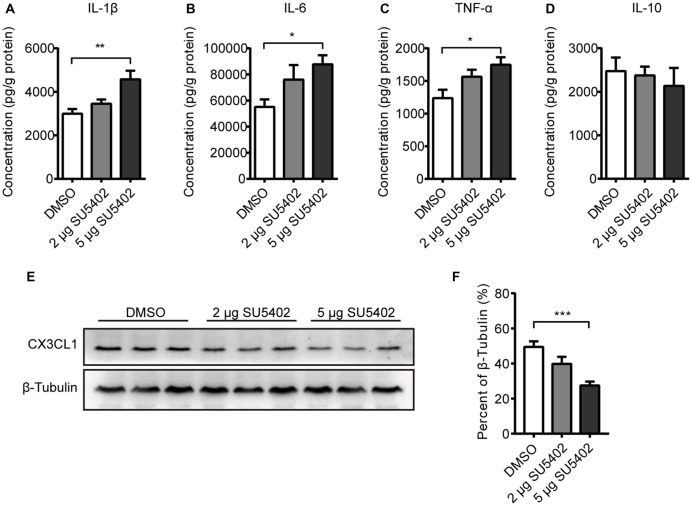
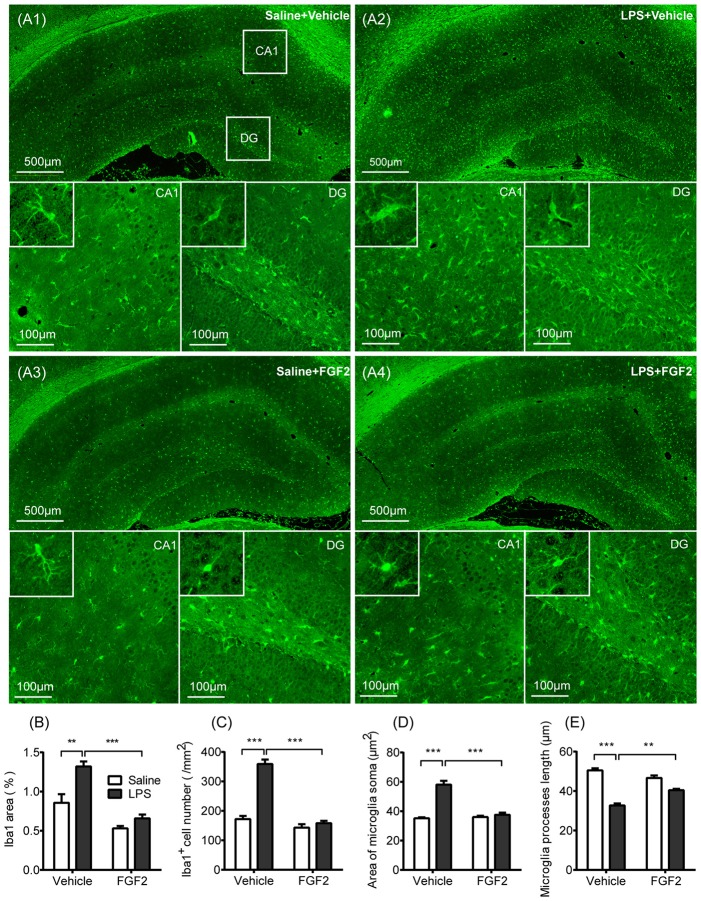
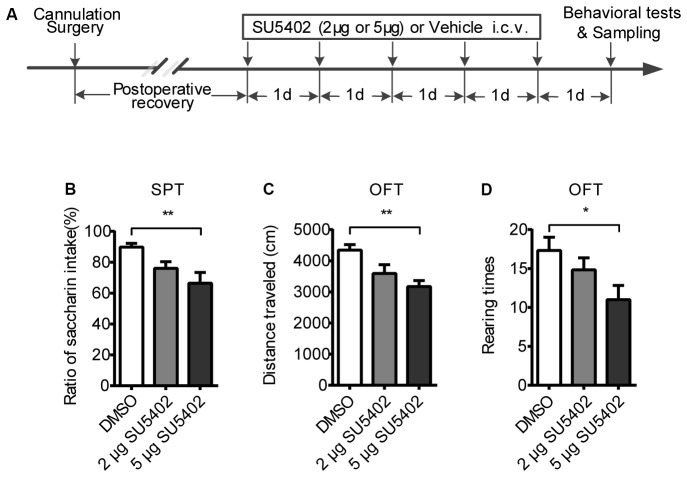
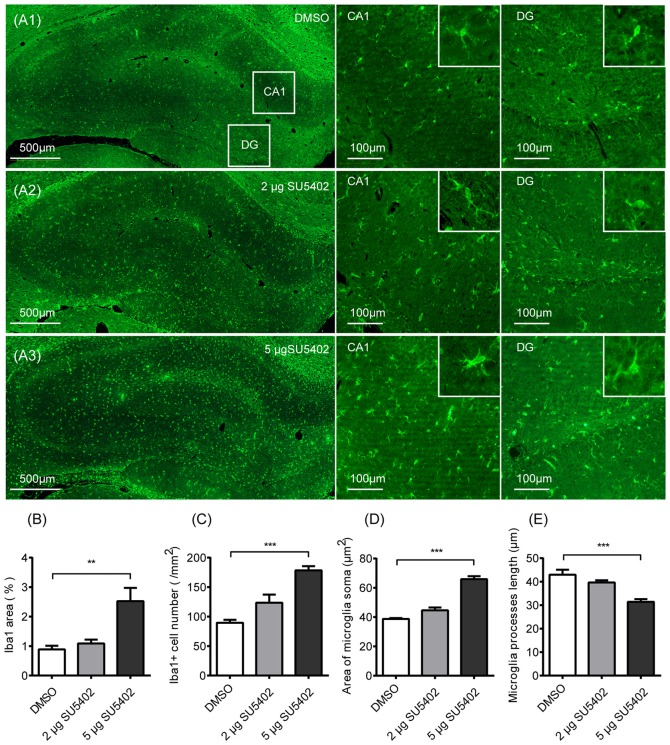
Recent studies indicate that disturbed structure and function of microglia can cause depression and associated neurogenesis impairments. Our previous work has demonstrated that exogenous fibroblast growth factor 2 (FGF2) reverses the depressive-like behaviors and the impaired hippocampal neurogenesis in a neuroinflammatory model of depression. However, whether and how the antidepressant effects of FGF2 involve the modulation of microglia activation has not been elucidated. In this study, to examine the effects of FGF2 on microglia activation, exogenous FGF2 was supplemented to the lateral ventricle of rats during the neuroinflammatory state induced by central lipopolysaccharides (LPS) administrations. It was found that FGF2 infusions reversed the LPS-induced depressive-like behaviors and inhibited the hippocampal microglia activation. In LPS-treated rats, FGF2 decreased the level of pro-inflammatory cytokines including interlukin-1β (IL-1β), IL-6 and tumor necrosis factor (TNF)-α, increased the level of IL-10, the anti-inflammatory cytokine and reversed the decreased expression of CX3CL1, a chemokine mainly expressed by neurons and keeping microglia in surveillance. Further, we examined the effects of inhibited FGF2 signaling by administration of SU5402, an FGFR inhibitor. It was found that SU5402 itself evoked depressive-like behaviors, induced microglia activation, increased production of pro-inflammatory cytokines including IL-1β, IL-6 and TNF-α, and decreased the expression of CX3CL1. Two lines of results that FGF2 signaling and FGFR inhibitor can effectively but oppositely modulate the regulation of microglia and the generation of depressive-like behavior, suggesting that microglia-regulated mechanisms may underlie the antidepressant role of FGF2. The present data provide novel insights into the understanding of mechanism of neuroinflammation-associated depression and may serve as a novel mechanism-based target for the treatment of inflammation-related depression.
最近的研究表明,小胶质细胞的结构和功能紊乱会导致抑郁症及相关的神经发生障碍。我们之前的研究表明,外源性成纤维细胞生长因子2(FGF2)可逆转抑郁症神经炎症模型中的抑郁样行为和受损的海马神经发生。然而,FGF2的抗抑郁作用是否以及如何涉及小胶质细胞激活的调节尚未阐明。在本研究中,为了检测FGF2对小胶质细胞激活的影响,在通过中枢给予脂多糖(LPS)诱导的神经炎症状态下,向大鼠侧脑室补充外源性FGF2。结果发现,FGF2输注可逆转LPS诱导的抑郁样行为,并抑制海马小胶质细胞激活。在LPS处理的大鼠中,FGF2降低了包括白细胞介素-1β(IL-1β)、IL-6和肿瘤坏死因子(TNF)-α在内的促炎细胞因子水平,提高了抗炎细胞因子IL-10的水平,并逆转了主要由神经元表达并维持小胶质细胞监测功能的趋化因子CX3CL1的表达降低。此外,我们通过给予FGFR抑制剂SU5402检测了抑制FGF2信号传导的影响。结果发现,SU5402本身可诱发抑郁样行为,诱导小胶质细胞激活,增加包括IL-1β、IL-6和TNF-α在内的促炎细胞因子的产生,并降低CX3CL1的表达。FGF²信号传导和FGFR抑制剂能够有效且相反地调节小胶质细胞的调控和抑郁样行为的产生,这两条结果表明,小胶质细胞调节机制可能是FGF²抗抑郁作用的基础。本研究数据为理解神经炎症相关性抑郁症的机制提供了新的见解,并可能成为治疗炎症相关性抑郁症的基于机制的新靶点。