Werner-Seidler Aliza, Johnston Lara, Christensen Helen
Black Dog Institute, University of New South Wales, Sydney, NSW, Australia.
Internet Interv. 2018 Feb 7;11:71-78. doi: 10.1016/j.invent.2018.01.007. eCollection 2018 Mar.
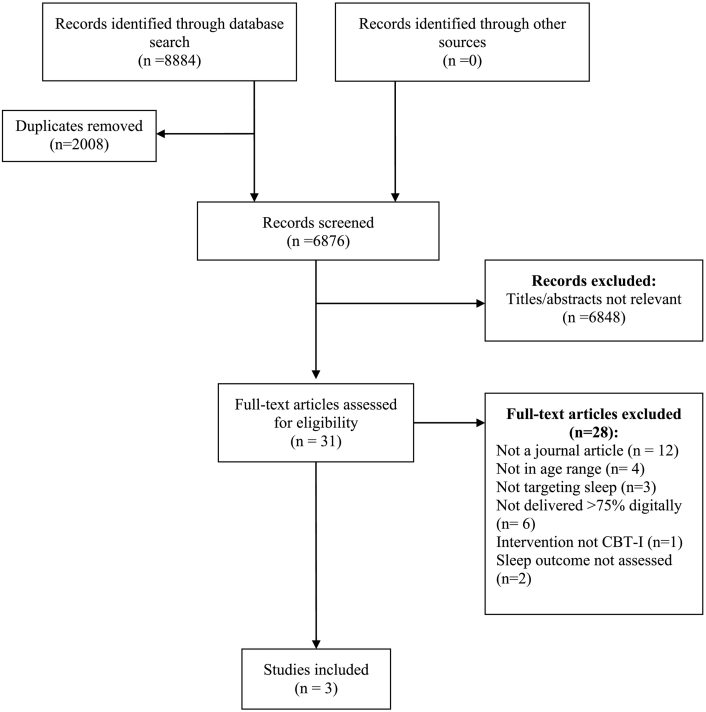
Sleep disturbance is common among young people, with consequences for academic, emotional and behavioural development. Cognitive-behavioural therapy for insomnia (CBT-I) is efficacious, yet it is costly and not available to many who need it. Digitally-delivered CBT-I (eCBT-I) has the potential to overcome these barriers. The purpose of this systematic review was to identify studies which report on the efficacy or effectiveness of eCBT-I for young people with sleep disturbance. Electronic databases were systematically searched and three studies met inclusion criteria. Two studies used the same online intervention for adolescents with insomnia symptoms, while the other was conducted in a college sample of individuals who opted into a stress-management study. Results showed that eCBT-I improved sleep efficiency, sleep quality, sleep-onset latency and total sleep time with effect sizes ranging from 0.17-1.30 (Cohen's ). This suggests that eCBT-I is a promising intervention for young people, but more studies are needed to verify the conditions under which it is most effective.
睡眠障碍在年轻人中很常见,会对学业、情绪和行为发展产生影响。失眠的认知行为疗法(CBT-I)是有效的,但成本高昂,许多有需要的人无法获得。数字化提供的CBT-I(eCBT-I)有潜力克服这些障碍。本系统评价的目的是确定报告eCBT-I对有睡眠障碍的年轻人的疗效或有效性的研究。对电子数据库进行了系统检索,有三项研究符合纳入标准。两项研究对有失眠症状的青少年使用了相同的在线干预措施,另一项研究是在一个选择参加压力管理研究的大学生样本中进行的。结果表明,eCBT-I提高了睡眠效率、睡眠质量、入睡潜伏期和总睡眠时间,效应大小在0.17至1.30之间(科恩氏d值)。这表明eCBT-I对年轻人是一种有前景的干预措施,但需要更多研究来验证其最有效的条件。