Batterham Philip J, Calear Alison L, Farrer Louise, McCallum Sonia M, Cheng Vanessa Wan Sze
Centre for Mental Health Research, Research School of Population Health, The Australian National University, Canberra, Australia.
Brain and Mind Centre, University of Sydney, Sydney, Australia.
Internet Interv. 2017 Aug 23;12:91-99. doi: 10.1016/j.invent.2017.08.002. eCollection 2018 Jun.
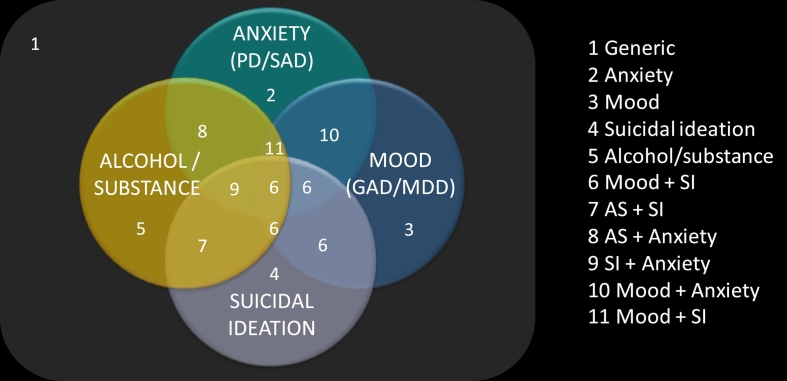
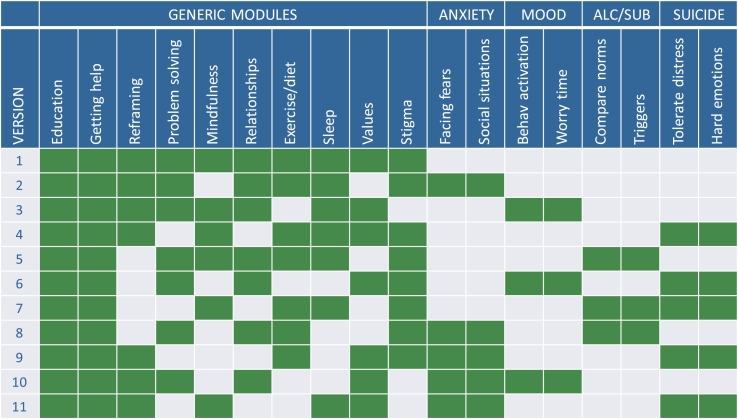
Online mental health programs can be effective in reducing symptoms of depression, anxiety disorders, substance use and suicidal ideation. However, most existing e-mental health programs focus on a single domain of mental health, neglecting comorbidity. Furthermore, few programs are tailored to the symptom patterns of the individual user. was designed to overcome the gaps of existing e-mental health programs, providing tailored, transdiagnostic therapeutic content to address a range of comorbid mental health symptoms. A trial was conducted to test the program's efficacy.
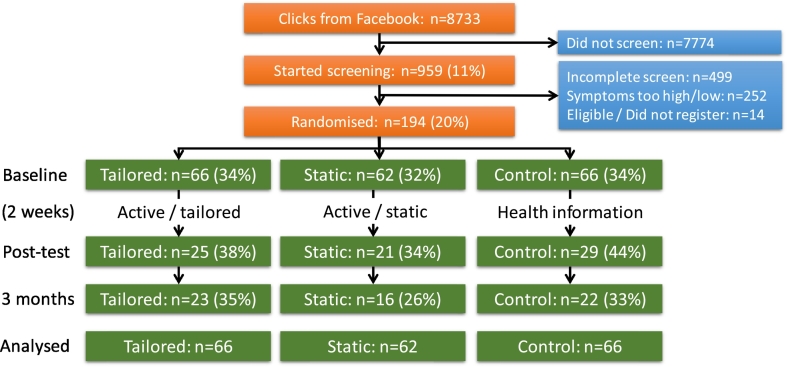
Australian adults with elevated symptoms of depression, anxiety, suicidal ideation and/or substance use were recruited through social media, with = 194 randomised into a fully-automated trial of a 10-day brief intervention. Participants were randomly allocated to receive tailored to their symptoms, an untailored generic version of , or an attention control.
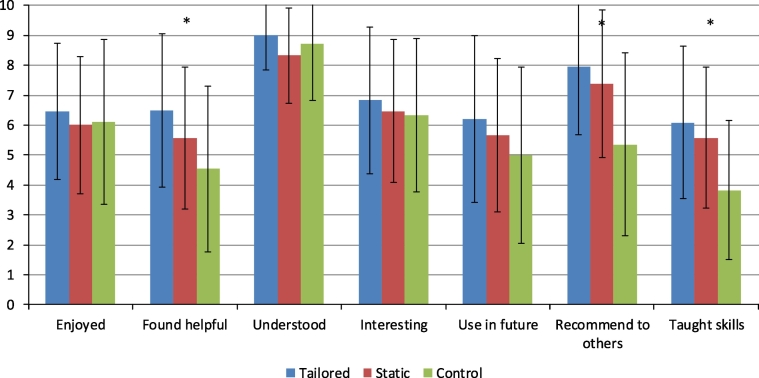
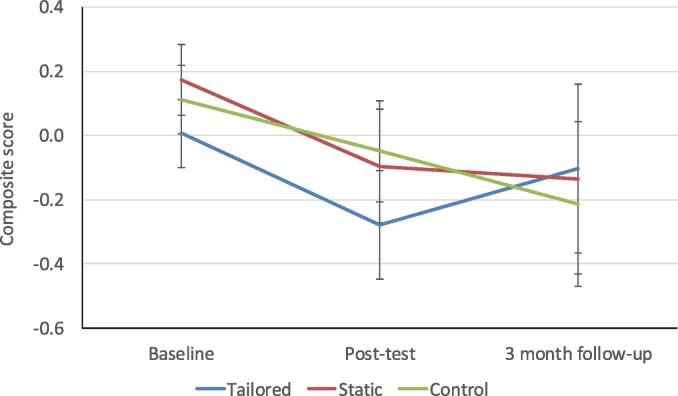
Mixed model repeated measures ANOVA indicated that participants in both and the attention control had significant reductions in symptom composite scores. Effects were not significantly greater in the program relative to control, either at post-test or 3-month follow-up. No effects were detected for specific decreases in depression, generalized anxiety, social anxiety, panic, suicidal ideation or alcohol/substance use. There were no significant differences between the tailored and static versions in effectiveness or adherence. Participants in the tailored and static conditions were more satisfied than in the control condition, with some evidence favouring the tailored condition. High attrition reduced power to find effects.
provides a model for addressing comorbid mental health symptoms in an online program, using automated tailoring to symptom patterns. Modifications to the program are recommended, along with the need for larger trials to test the effects of tailoring on mental health outcomes.
在线心理健康项目在减轻抑郁、焦虑症、物质使用和自杀意念症状方面可能有效。然而,大多数现有的电子心理健康项目都聚焦于心理健康的单一领域,忽视了共病情况。此外,很少有项目是根据个体用户的症状模式量身定制的。[该项目名称]旨在克服现有电子心理健康项目的不足,提供量身定制的、跨诊断的治疗内容,以解决一系列共病的心理健康症状。进行了一项试验以测试该项目的疗效。
通过社交媒体招募有抑郁、焦虑、自杀意念和/或物质使用症状加重的澳大利亚成年人,194人被随机分配到一个为期10天的简短干预的全自动试验中。参与者被随机分配接受根据其症状量身定制的[项目名称]、未量身定制的通用版本[项目名称]或注意力控制组。
混合模型重复测量方差分析表明,[项目名称]组和注意力控制组的参与者症状综合评分均有显著降低。在测试后或3个月随访时,[项目名称]组相对于对照组的效果并无显著更大。在抑郁、广泛性焦虑、社交焦虑、恐慌、自杀意念或酒精/物质使用的具体降低方面未检测到效果。量身定制版和静态版在有效性或依从性方面没有显著差异。量身定制组和静态组的参与者比对照组更满意,有一些证据支持量身定制组。高损耗降低了发现效果的效能。
[项目名称]提供了一个在在线项目中解决共病心理健康症状的模型,利用对症状模式的自动量身定制。建议对该项目进行修改,同时需要进行更大规模的试验来测试量身定制对心理健康结果的影响。