Schaeuffele Carmen, Zagorscak Pavle, Langerwisch Vladlena, Wilke Johanna, Medvedeva Yana, Knaevelsrud Christine
Freie Universität Berlin, Department of Education and Psychology, Clinical Psychological Intervention, Germany.
German Center for Mental Health (DZPG), partner site Berlin-Potsdam, Germany.
Internet Interv. 2025 Jun 14;41:100840. doi: 10.1016/j.invent.2025.100840. eCollection 2025 Sep.
Internet-based interventions (IBIs) offer the potential for personalization through various mechanisms and components.
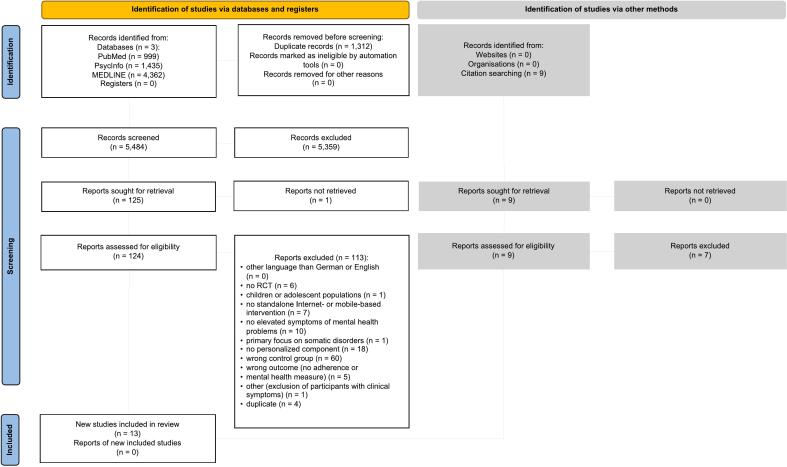
This systematic review aimed to synthesize evidence on the personalization of treatment components within IBIs targeting diverse mental health conditions. Specifically, we focused on studies that directly compared personalized components to standardized ones to isolate the impact of personalization on mental health outcomes and treatment adherence.
Thirteen studies were identified that compared personalized to non-personalized components, with the personalization of IBI content and personalized guidance investigated the most. Apart from one study that personalized more than one IBI component, studies did not find a significant positive effect of personalization on mental health outcomes. Two studies reported better adherence for human feedback personalized to user input than for the automated non-personalized guidance.
The results reveal a gap between the theoretical potential of personalization in IBIs and the current evidence supporting its impact on outcomes and adherence. The diversity in personalization strategies across studies complicates the ability to draw definitive conclusions. To address this, more detailed descriptions of how personalization is both implemented and communicated to patients are recommended.
基于互联网的干预措施(IBIs)通过各种机制和组件提供了个性化的潜力。
本系统评价旨在综合针对不同心理健康状况的IBIs中治疗组件个性化的证据。具体而言,我们关注那些直接将个性化组件与标准化组件进行比较的研究,以分离个性化对心理健康结果和治疗依从性的影响。
共确定了13项将个性化组件与非个性化组件进行比较的研究,其中对IBI内容的个性化和个性化指导的研究最多。除了一项对多个IBI组件进行个性化的研究外,其他研究未发现个性化对心理健康结果有显著的积极影响。两项研究报告称,针对用户输入进行个性化设置的人工反馈的依从性优于自动化非个性化指导。
结果揭示了IBIs中个性化的理论潜力与目前支持其对结果和依从性影响的证据之间的差距。各研究中个性化策略的多样性使得得出明确结论的能力变得复杂。为解决这一问题,建议更详细地描述个性化是如何实施以及如何传达给患者的。