Buhrman Monica, Gordh Torsten, Andersson Gerhard
Department of Psychology, Uppsala University, Uppsala, Sweden.
Department of Surgical Sciences, Pain Research, Uppsala University, Sweden.
Internet Interv. 2016 Jan 3;4:17-34. doi: 10.1016/j.invent.2015.12.001. eCollection 2016 May.
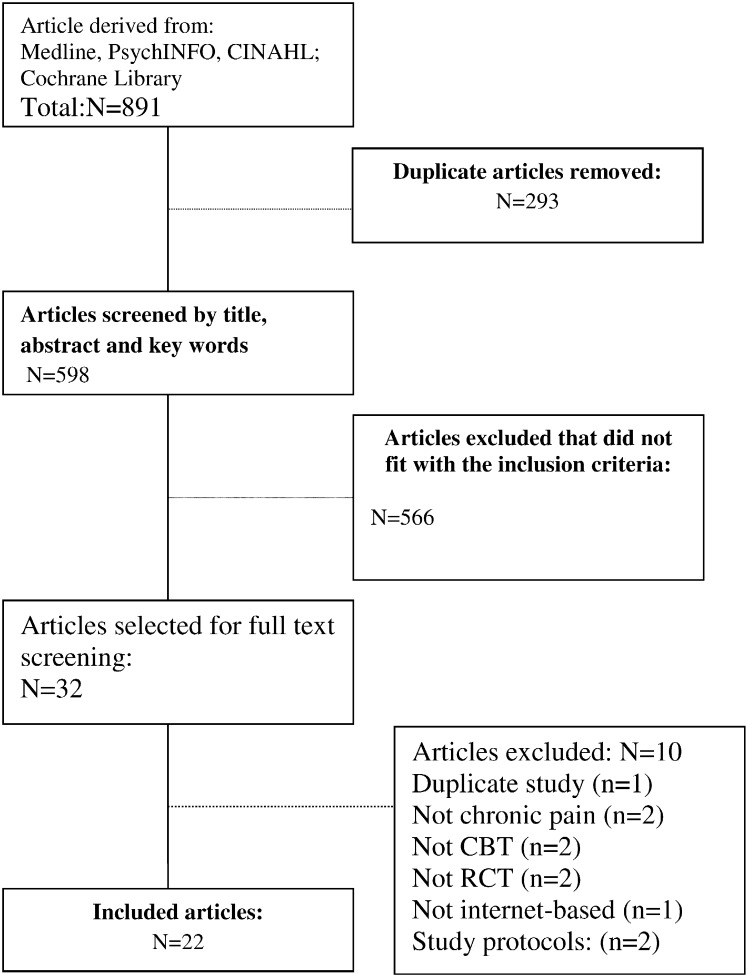
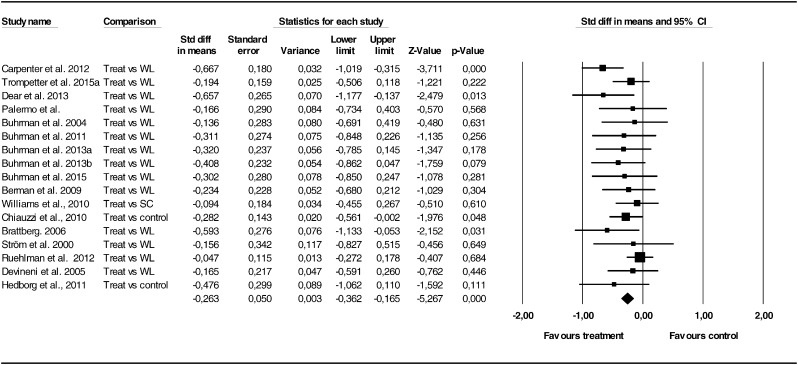
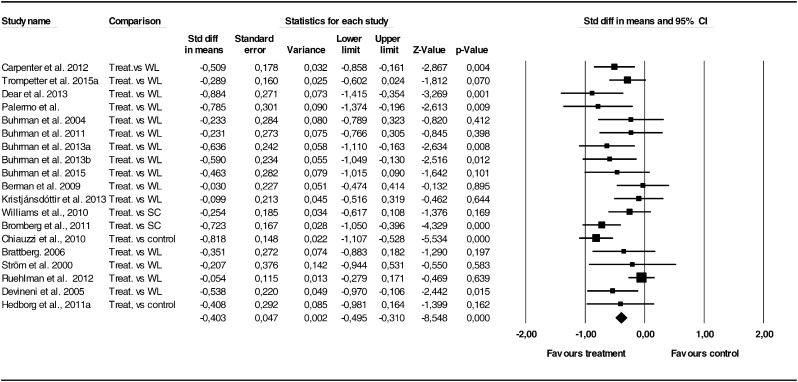
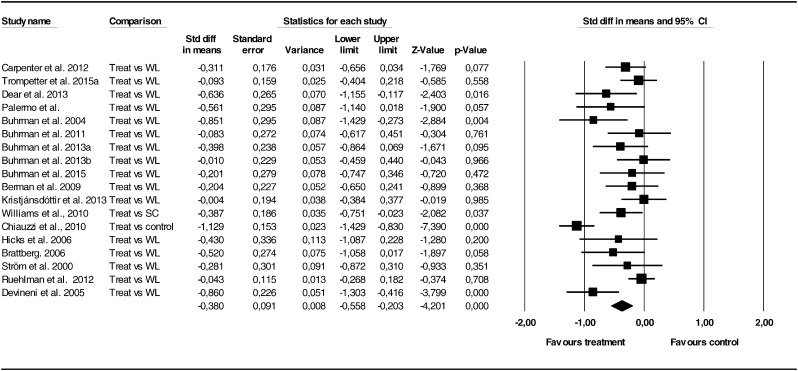
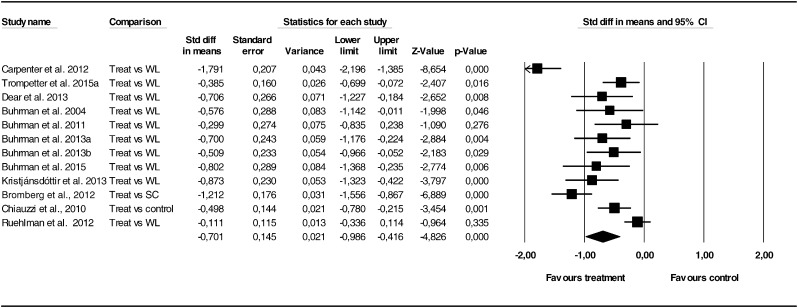
Chronic pain is a major health problem and behavioral based treatments have been shown to be effective. However, the availability of these kinds of treatments is scarce and internet-based treatments have been shown to be promising in this area. The objective of the present systematic review is to evaluate internet-based interventions for persons with chronic pain. The specific aims are to do an updated review with a broad inclusion of different chronic pain diagnoses and to assess disability and pain and also measures of catastrophizing, depression and anxiety. A systematic search identified 891 studies and 22 trials were selected as eligible for review. Two of the selected trials included children/youth and five included individuals with chronic headache and/or migraine. The most frequently measured domain reflected in the primary outcomes was interference/disability, followed by catastrophizing. Result across the studies showed a number of beneficial effects. Twelve trials reported significant effects on disability/interference outcomes and pain intensity. Positive effects were also found on psychological variable such as catastrophizing, depression and anxiety. Several studies (n = 12) were assessed to have an unclear level of risk bias. The attrition levels ranged from 4% to 54% where the headache trials had the highest drop-out levels. However, findings suggest that internet-based treatments based on cognitive behavioural therapy (CBT) are efficacious measured with different outcome variables. Results are in line with trials in clinical settings. Meta-analytic statistics were calculated for interference/disability, pain intensity, catastrophizing and mood ratings. Results showed that the effect size for interference/disability was Hedge's = - 0.39, for pain intensity Hedge's = - 0.33, for catastrophizing Hedge's = - 0.49 and for mood variables (depression) Hedge's = - 0.26.
慢性疼痛是一个主要的健康问题,基于行为的治疗方法已被证明是有效的。然而,这类治疗方法的可及性稀缺,而基于互联网的治疗方法在这一领域已显示出前景。本系统评价的目的是评估针对慢性疼痛患者的基于互联网的干预措施。具体目标是进行一次更新的综述,广泛纳入不同的慢性疼痛诊断,并评估残疾、疼痛以及灾难化思维、抑郁和焦虑的测量指标。一项系统检索确定了891项研究,22项试验被选为符合综述条件。所选试验中有两项纳入了儿童/青少年,五项纳入了患有慢性头痛和/或偏头痛的个体。主要结局中最常测量的领域是干扰/残疾,其次是灾难化思维。各项研究结果显示了一些有益效果。12项试验报告了对残疾/干扰结局和疼痛强度有显著影响。在灾难化思维、抑郁和焦虑等心理变量上也发现了积极效果。有12项研究被评估为风险偏倚水平不明确。失访率在4%至54%之间,其中头痛试验的退出率最高。然而,研究结果表明,基于认知行为疗法(CBT)的互联网治疗方法在不同结局变量的测量中是有效的。结果与临床环境中的试验一致。计算了干扰/残疾、疼痛强度、灾难化思维和情绪评分的荟萃分析统计数据。结果显示,干扰/残疾的效应量为Hedge's = -0.39,疼痛强度为Hedge's = -0.33,灾难化思维为Hedge's = -0.49,情绪变量(抑郁)为Hedge's = -0.26。