Law Emily F, Beals-Erickson Sarah E, Noel Melanie, Claar Robyn, Palermo Tonya M
Department of Anesthesiology and Pain Medicine, University of Washington School of Medicine, Seattle, USA.
Center for Child Health, Behavior and Development, Seattle Children's Research Institute, Seattle, USA.
Headache. 2015 Nov-Dec;55(10):1410-25. doi: 10.1111/head.12635. Epub 2015 Aug 28.
To evaluate the feasibility and preliminary effectiveness of an Internet-delivered cognitive-behavioral therapy (CBT) intervention for adolescents with chronic headache.
Headache is among the most common pain complaints of childhood. Cognitive-behavioral interventions are efficacious for improving pain among youth with headache. However, many youth do not receive psychological treatment for headache due to poor access, which has led to consideration of alternative delivery modalities such as the Internet.
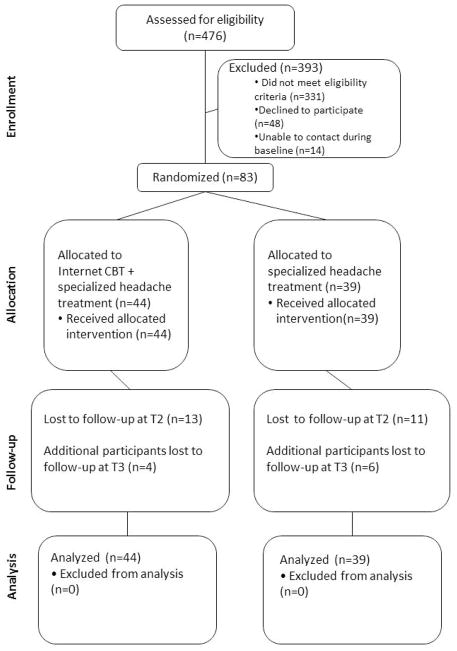
We used a parallel arm randomized controlled trial design to evaluate the feasibility and preliminary effectiveness of an Internet-delivered family-based CBT intervention, Web-based management of adolescent pain. Adolescents were eligible for the trial if they were a new patient being evaluated in a specialized headache clinic, between 11 and 17 years of age, and had recurrent headache for 3 months or more as diagnosed by a pediatric neurologist. Eighty-three youths were enrolled in the trial. An online random number generator was used to randomly assign participants to receive Internet CBT adjunctive to specialized headache treatment (n = 44) or specialized headache treatment alone (n = 39). The primary treatment outcome was headache days.
Youth and parents in the Internet CBT group demonstrated high levels of engagement with the web program and reported satisfaction with the intervention. Multilevel modelling (MLM) was used to conduct hypothesis testing for continuous outcomes. For our primary treatment outcome of headache days, adolescents reported a statistically significant reduction in headache days from baseline to post-treatment and baseline to 3-month follow-up in both treatment conditions (main effect for time F(2, 136) = 19.70, P < .001). However, there was no statistically significant difference between the Internet CBT group and the specialized headache treatment group at post-treatment or follow-up (group × time interaction F(2, 134) = 0.94, P = .395). For our secondary treatment outcomes, findings from MLM showed that adolescents in both groups demonstrated statistically significant improvement headache pain intensity, activity limitations, depressive symptoms, and parent protective behaviors from baseline to post-treatment and these gains were maintained at 3-month follow-up. Adolescent anxiety symptoms and sleep did not change during the study period for either group. There were no statistically significant group differences on any secondary outcomes at post-treatment or follow-up (P > .05 for all outcomes). No adverse events were reported.
Although adjunctive Internet CBT did not lead to additional benefit in this population, future research should evaluate whether it is an effective intervention for adolescents with headache who are unable to access specialized headache treatment.
评估通过互联网提供的认知行为疗法(CBT)干预对慢性头痛青少年的可行性和初步疗效。
头痛是儿童期最常见的疼痛主诉之一。认知行为干预对改善头痛青少年的疼痛有效。然而,由于难以获得治疗,许多青少年未接受头痛的心理治疗,这导致人们考虑诸如互联网等替代治疗方式。
我们采用平行组随机对照试验设计,评估通过互联网提供的基于家庭的CBT干预(青少年疼痛的网络管理)的可行性和初步疗效。如果青少年是在专门的头痛诊所接受评估的新患者,年龄在11至17岁之间,并且经儿科神经科医生诊断有复发性头痛3个月或更长时间,则符合试验条件。83名青少年参与了该试验。使用在线随机数生成器将参与者随机分配接受互联网CBT辅助专门的头痛治疗(n = 44)或仅接受专门的头痛治疗(n = 39)。主要治疗结局是头痛天数。
互联网CBT组的青少年和家长对网络程序的参与度很高,并报告对干预满意。使用多水平模型(MLM)对连续结局进行假设检验。对于我们的主要治疗结局头痛天数,在两种治疗条件下,青少年报告从基线到治疗后以及从基线到3个月随访时头痛天数有统计学显著减少(时间的主效应F(2, 136) = 19.70,P <.001)。然而,在治疗后或随访时,互联网CBT组和专门头痛治疗组之间没有统计学显著差异(组×时间交互作用F(2, 134) = 0.94,P = .395)。对于我们的次要治疗结局,MLM的结果表明,两组青少年从基线到治疗后在头痛疼痛强度、活动受限、抑郁症状和家长保护行为方面均有统计学显著改善,并且这些改善在3个月随访时得以维持。两组青少年的焦虑症状和睡眠在研究期间均未改变。在治疗后或随访时,任何次要结局在两组之间均无统计学显著差异(所有结局P >.05)。未报告不良事件。
尽管辅助性互联网CBT在该人群中未带来额外益处,但未来研究应评估它是否是无法获得专门头痛治疗的头痛青少年的有效干预措施。
