Martin Priya, Kumar Saravana, Lizarondo Lucylynn
Allied Health, Cunningham Centre, Darling Downs Hospital and Health Service, Toowoomba, Queensland 4350, Australia.
School of Health Sciences, Sansom Institute for Health Research, University of South Australia, Adelaide, South Australia 5001, Australia.
Internet Interv. 2017 Mar 22;8:35-39. doi: 10.1016/j.invent.2017.03.001. eCollection 2017 Jun.
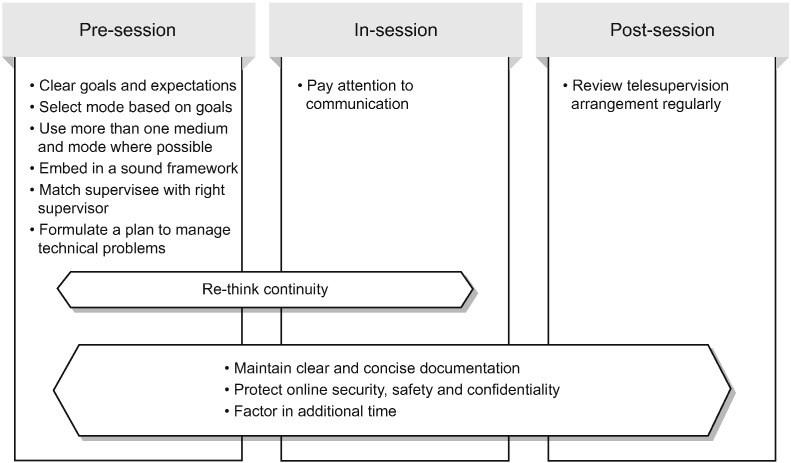
Clinical supervision is integral to continuing professional development of health professionals. With advances in technology, clinical supervision too can be undertaken using mediums such as videoconference, email and teleconference. This mode of clinical supervision is termed as telesupervision. While telesupervision could be useful in any context, its value is amplified for health professionals working in rural and remote areas where access to supervisors within the local work environment is often diminished. While telesupervision offers innovative means to undertake clinical supervision, there remain gaps in the literature in terms of its parameters of use in clinical practice. This article outlines ten evidence-informed, practical tips stemming from a review of the literature that will enable health care stakeholders to use technology effectively and efficiently while undertaking clinical supervision. By highlighting the "how to" aspect, telesupervision can be delivered in the right way, to the right health professional, at the right time.
临床督导是卫生专业人员持续专业发展不可或缺的一部分。随着技术的进步,临床督导也可以通过视频会议、电子邮件和电话会议等媒介来进行。这种临床督导模式被称为远程督导。虽然远程督导在任何情况下都可能有用,但对于在农村和偏远地区工作的卫生专业人员来说,其价值更为凸显,因为在这些地区,在当地工作环境中接触督导人员的机会往往较少。虽然远程督导提供了进行临床督导的创新手段,但在临床实践中其使用参数方面的文献仍存在空白。本文概述了通过文献综述得出的十条基于证据的实用建议,这些建议将使医疗保健利益相关者在进行临床督导时能够有效且高效地使用技术。通过突出“如何做”的方面,远程督导可以在正确的时间以正确的方式提供给正确的卫生专业人员。