Noordman Janneke, Driesenaar Jeanine A, van Bruinessen Inge R, van Dulmen Sandra
NIVEL, Netherlands Institute for Health Services Research, Utrecht, The Netherlands.
Department of Primary and Community Care, Radboud University Medical Center, Nijmegen, The Netherlands.
Internet Interv. 2017 Jun 1;9:51-56. doi: 10.1016/j.invent.2017.05.002. eCollection 2017 Sep.
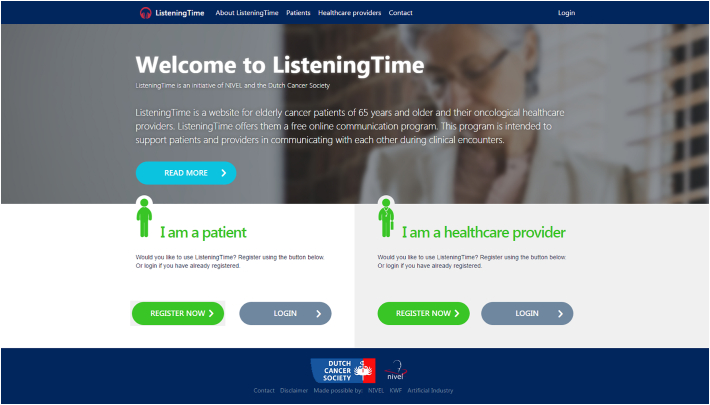
This paper outlines the participatory development process of a web-based preparatory communication tool for elderly cancer patients and their oncological healthcare providers (HCPs). This tool aims to support them to (better) prepare their encounters. An overarching aim of the project is to develop the tool in a participatory way to increase uptake and use.
Scrum, a participatory framework originated from software development, was applied to develop the tool. Using constant feedback loops, elderly (former) cancer patients, oncological HCPs and their representatives were, as end-users, involved.
During six 'sprints', the communication tool 'ListeningTime' was developed with input from end-users. The use of scrum in developing an innovative tool was challenging in this context, because of time constraints of seriously-ill patients and busy HCPs and the co-creation involving non-profit scientific researchers and a for-profit development company.
The collaboration with end-users facilitated the development process of ListeningTime. Early involvement of end-users and flexibility in terms of planning and setup appear to be preconditions for creating a bottom-up inspired development procedure. Several challenges emerged from using scrum as participatory framework. Nevertheless, the 'pressure cooking situation', using scrum, resulted in a quick development process and a product ready for implementation.
本文概述了一种基于网络的、供老年癌症患者及其肿瘤医疗服务提供者(HCPs)使用的预沟通工具的参与式开发过程。该工具旨在帮助他们(更好地)为医患会面做好准备。该项目的总体目标是以参与式方式开发该工具,以提高其使用率。
采用源自软件开发的参与式框架Scrum来开发该工具。通过持续的反馈循环,让老年( former)癌症患者、肿瘤HCPs及其代表作为最终用户参与进来。
在六个“冲刺”阶段中,在最终用户的参与下开发出了沟通工具“倾听时间”。在这种情况下,使用Scrum开发创新工具具有挑战性,原因包括重症患者和忙碌的HCPs的时间限制,以及涉及非营利性科研人员和营利性开发公司的共同创作。
与最终用户的合作促进了“倾听时间”的开发过程。最终用户的早期参与以及规划和设置方面的灵活性似乎是创建自下而上开发程序的先决条件。使用Scrum作为参与式框架出现了一些挑战。尽管如此,采用Scrum的“高压情况”带来了快速的开发过程和可供实施的产品。