Louw Adriaan, Zimney Kory, Landers Merrill R, Luttrell Mark, Clair Bob, Mills Joshua
International Spine & Pain Institute, United States.
Department of Physical Therapy, School of Allied Health Sciences, University of Nevada Las Vegas, United States.
S Afr J Physiother. 2016 Jul 28;72(1):306. doi: 10.4102/sajp.v72i1.306. eCollection 2016.
To examine how the choice of words explaining ultrasound (US) may influence the outcome of physiotherapy treatment for low back pain (LBP).
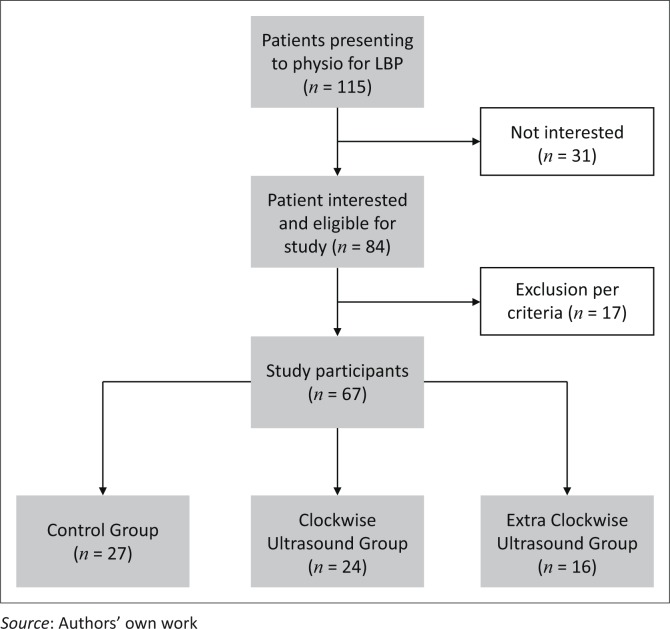
Sixty-seven patients with LBP < 3 months were randomly allocated to one of three groups - traditional education about US (control group [CG]), inflated education about US (experimental group [EG]) or extra-inflated education about US (extra-experimental group [EEG]). Each patient received the exact same application of US that has shown clinical efficacy for LBP (1.5 Watts/cm for 10 minutes at 1 Megahertz, pulsed 20% over a 20 cm area), but received different explanations (CG, EG or EEG). Before and immediately after US, measurements of LBP and leg pain (numeric rating scale), lumbar flexion (distance to floor) and straight leg raise (SLR) (inclinometer) were taken. Statistical analysis consisted of mixed-factorial analyses of variance and chi-square analyses to measure differences between the three groups, as well as meeting or exceeding minimal detectable changes (MDCs) for pain, lumbar flexion and SLR.
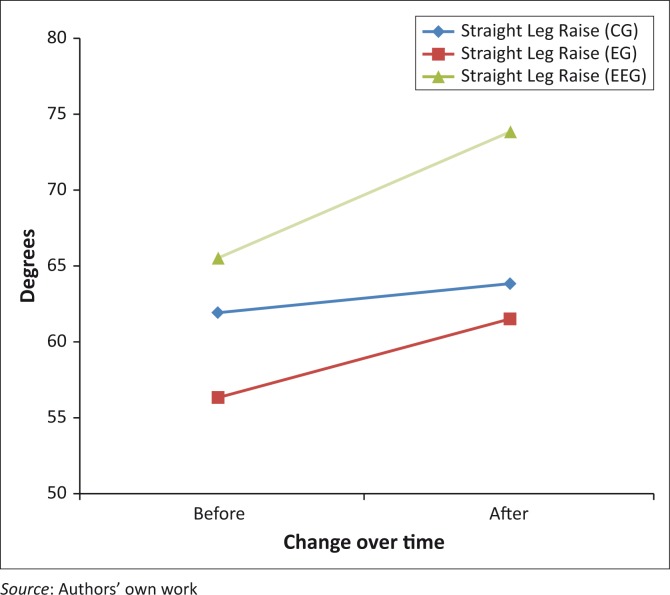
Both EG and EEG groups showed a statistically significant improvement for SLR ( < 0.0001), while the CG did not. The EEG group participants were 4.4 times (95% confidence interval: 1.1 to 17.5) more likely to improve beyond the MDC than the CG. No significant differences were found between the groups for LBP, leg pain or lumbar flexion.
The choice of words when applying a treatment in physiotherapy can alter the efficacy of the treatment.
探讨解释超声(US)的用词如何影响腰痛(LBP)物理治疗的效果。
67例病程小于3个月的腰痛患者被随机分为三组之一——关于超声的传统教育组(对照组[CG])、关于超声的夸大教育组(实验组[EG])或关于超声的过度夸大教育组(超实验组[EEG])。每位患者接受的超声应用完全相同,该应用已显示对腰痛具有临床疗效(1.5瓦/平方厘米,1兆赫兹,持续10分钟,在20厘米区域内脉冲占空比20%),但接受不同的解释(CG、EG或EEG)。在超声治疗前及治疗后即刻,测量腰痛和腿痛(数字评分量表)、腰椎前屈(距地面距离)和直腿抬高(SLR)(倾角仪)。统计分析包括混合因子方差分析和卡方分析,以测量三组之间的差异,以及疼痛、腰椎前屈和SLR达到或超过最小可检测变化(MDC)的情况。
EG组和EEG组的SLR均有统计学显著改善(<0.0001),而CG组没有。与CG组相比,EEG组参与者改善超过MDC的可能性高4.4倍(95%置信区间:1.1至17.5)。三组在腰痛、腿痛或腰椎前屈方面未发现显著差异。
物理治疗中应用治疗方法时的用词选择可改变治疗效果。