Li Tao, Zhou Xiaodong, Zhu Jie, Tang Xiaojing, Gu Xiaoyan
Department of Ophthalmology, Jinshan Hospital of Fudan University, Shanghai, China.
Clin Exp Optom. 2019 Mar;102(2):160-165. doi: 10.1111/cxo.12829. Epub 2018 Aug 22.
To compare the results of cycloplegic and non-cycloplegic refractive error measurement in Chinese children, and to assess the relationship between age and the difference in refractive error measured with and without cycloplegia.
This was a prospective study that recruited 224 healthy Chinese children at an ophthalmology clinic from November 2016 to February 2017. Refraction before and after cycloplegia were measured using an auto-refractor. Then spherical equivalent M, J , and J were calculated. The enrolled children were allocated into three groups according to M: myopia, emmetropia, and hyperopia. The distribution of the refraction was further analysed by stratifying by age: four to six years, seven to 11 years, and 12 to 16 years.
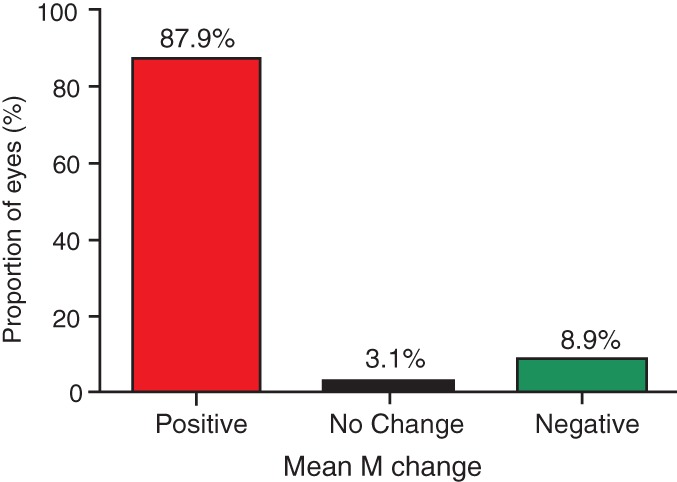
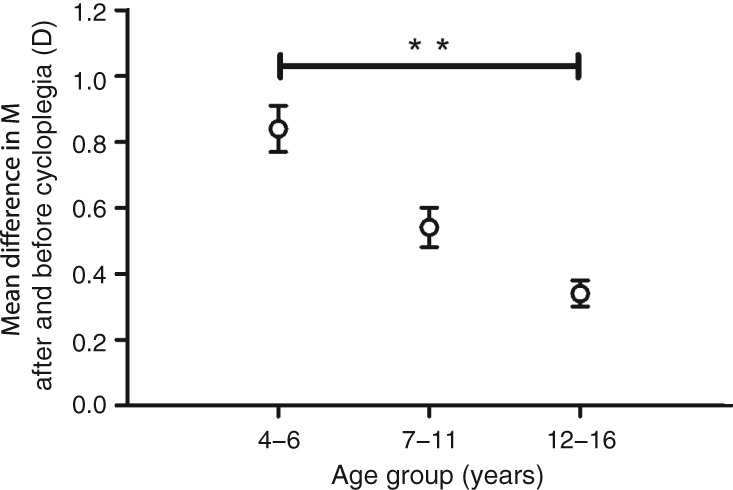
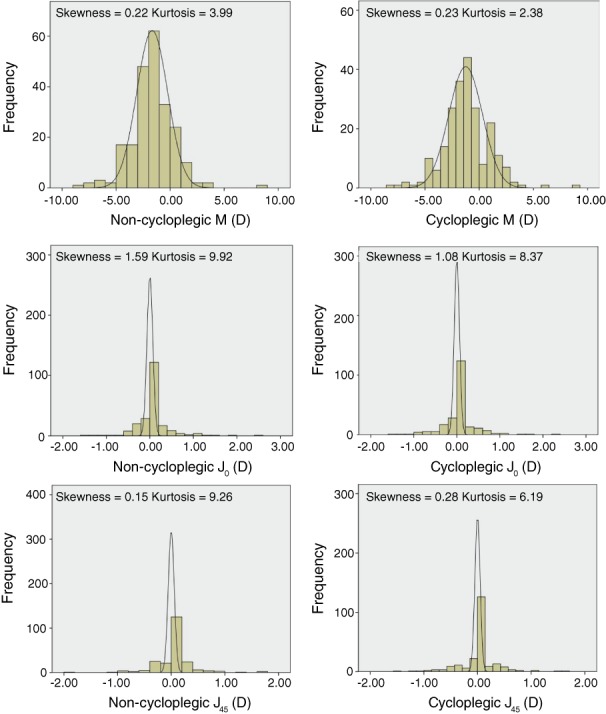
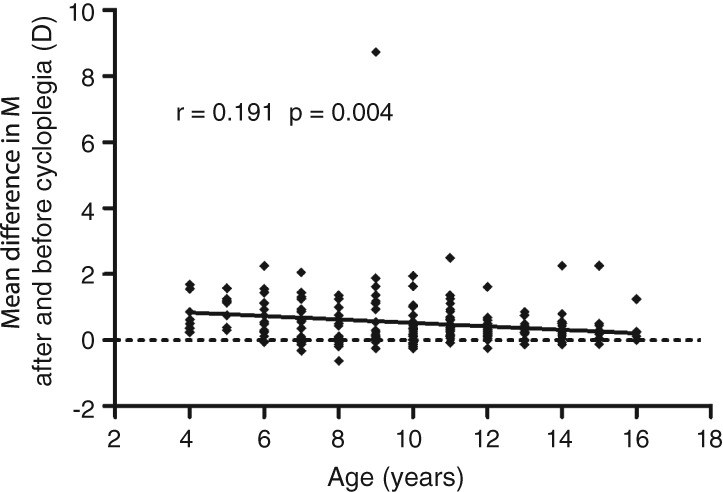
Mean non-cycloplegic M, J , and J were -1.68 ± 2.00 D, 0.05 ± 0.40 D, and 0.01 ± 0.35 D, while mean cycloplegic M, J , and J were -1.16 ± 2.17 D, 0.02 ± 0.40 D, and -0.01 ± 0.35 D. Significant differences were found between cycloplegic and non-cycloplegic M (p = 0.009), whereas there were no significant differences between cycloplegic and non-cycloplegic J and J (p = 0.486 and p = 0.594, respectively). The differences between cycloplegic and non-cycloplegic M were statistically significant in the four to six years group (p = 0.002) and seven to 11 years group (p = 0.023), whereas there was no significant difference between cycloplegic and non-cycloplegic M in the 12 to 16 years group (p = 0.151). The proportion of myopia decreased from 78.1 per cent before cycloplegia to 71.4 per cent after cycloplegia, while the proportion of hyperopia increased from 12.1 per cent before cycloplegia to 21.4 per cent after cycloplegia.
Non-cycloplegic auto-refraction is found to be inaccurate and not suitable for studies of refractive error in Chinese children.
比较中国儿童睫状肌麻痹验光与非睫状肌麻痹验光的屈光不正测量结果,并评估年龄与睫状肌麻痹验光和非睫状肌麻痹验光测量的屈光不正差异之间的关系。
这是一项前瞻性研究,于2016年11月至2017年2月在一家眼科诊所招募了224名健康的中国儿童。使用自动验光仪测量睫状肌麻痹前后的屈光度数。然后计算等效球镜度M、散光轴向J0和J90。根据等效球镜度M将纳入的儿童分为三组:近视、正视和远视。通过按年龄分层进一步分析屈光分布情况:4至6岁、7至11岁和12至16岁。
非睫状肌麻痹状态下的平均等效球镜度M、散光轴向J0和J90分别为-1.68±2.00D、0.05±0.40D和0.01±0.35D,而睫状肌麻痹状态下的平均等效球镜度M、散光轴向J0和J90分别为-1.16±2.17D、0.02±0.40D和-0.01±0.35D。睫状肌麻痹验光与非睫状肌麻痹验光的等效球镜度M之间存在显著差异(p = 0.009),而睫状肌麻痹验光与非睫状肌麻痹验光的散光轴向J0和J90之间无显著差异(分别为p = 0.486和p = 0.594)。睫状肌麻痹验光与非睫状肌麻痹验光的等效球镜度M差异在4至6岁组(p = 0.002)和7至11岁组(p = 0.023)具有统计学意义,而在12至16岁组中睫状肌麻痹验光与非睫状肌麻痹验光的等效球镜度M无显著差异(p = 0.151)。近视比例从睫状肌麻痹前的78.1%降至睫状肌麻痹后的71.4%,而远视比例从睫状肌麻痹前的12.1%增至睫状肌麻痹后的21.4%。
发现非睫状肌麻痹自动验光不准确,不适用于中国儿童屈光不正的研究。