Swiss Tropical and Public Health Institute, P.O. Box, CH-4002, Basel, Switzerland.
University of Basel, P.O. Box, CH-4003, Basel, Switzerland.
Global Health. 2018 Aug 23;14(1):88. doi: 10.1186/s12992-018-0406-1.
The research productivity of countries commonly grouped within sub-Saharan Africa is as diverse as their cultural, economic, linguistic, political, and social profiles. While South Africa has been the science hub on the subcontinent for decades, publishing original research articles in the thousands, Mauritania struggles to have a single publication in international indexed journals in any given year. Detailed country-specific accounts on the co-evolution of research productivity and demographic and economic indicators from sub-Saharan Africa are lacking and render an accurate evaluation and cross-country comparison of internal research progress challenging.
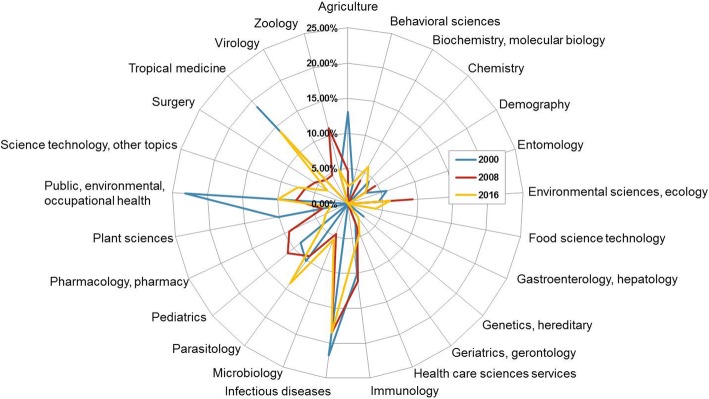
We assessed the research productivity of Côte d'Ivoire, a francophone West African country that has gone through considerable socio-political unrest, for the period 2000-2016, and determined the main publishing institutions. We considered original research articles extracted from PubMed and Web of Science Core Collection, emphasizing life sciences and biomedical sciences.
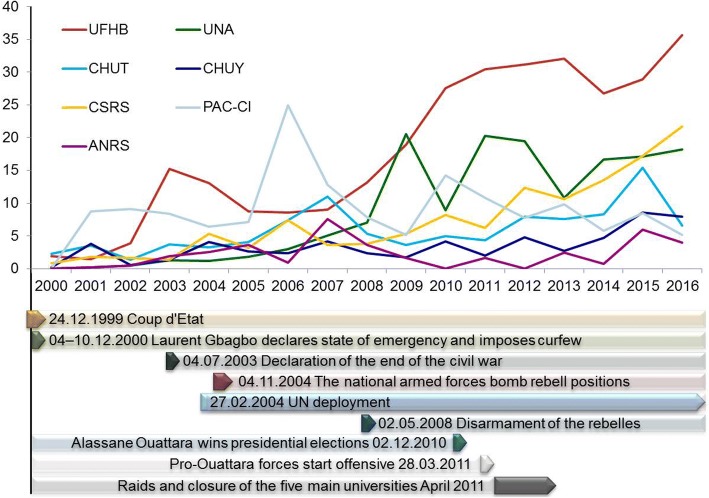
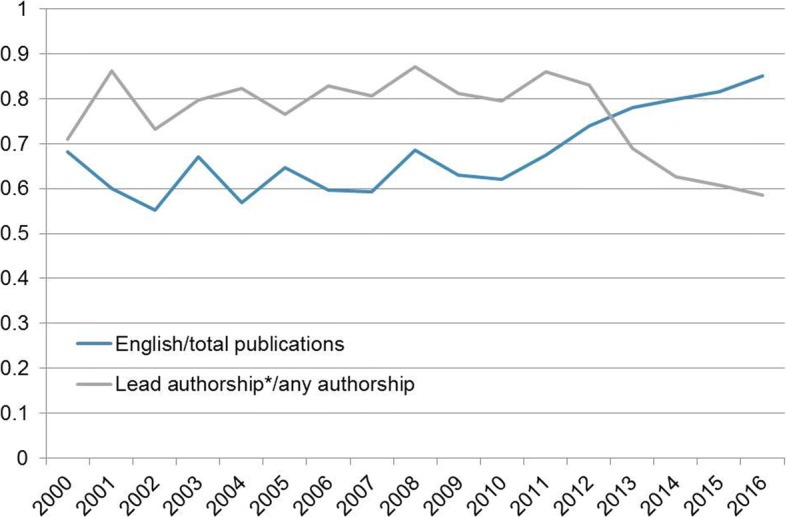
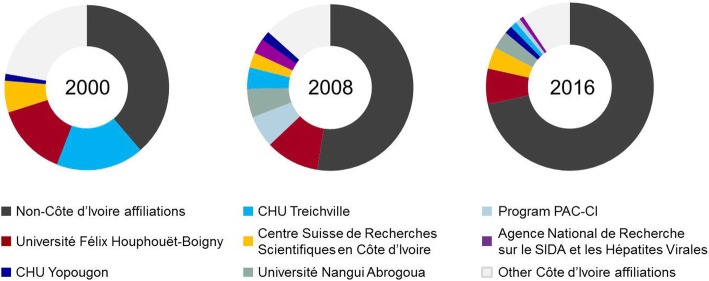
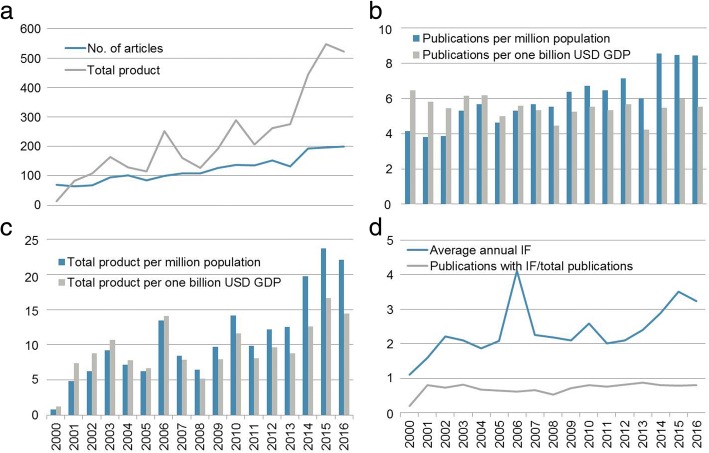
We found the quantity of publications doubling from 4.1 to 8.5 per million population and the 'total product' - a measure for quantity and quality of published articles - rising from 0.8 to 22.1 per million population between 2000 and 2016. Since 2010 there was a marked increase in the proportion of English publications and a concomitant drop in the proportion of articles with Ivorian first and last authors. The percentage of foreign author contribution increased from 38.7% in 2000 to 71.6% in 2016, suggesting an 'internationalization' of the country's research production and output. Mixed authorship compared with 'Ivorian only' showed higher representation in journals with an official impact factor by Web of Science with proportions of 73% versus 28% for 2008 and 91% versus 45% for 2016. Two universities and university hospitals and three autonomous research institutions were consistently among the top 10 institutions publishing peer-reviewed material in three selected years (2000, 2008, and 2016). The main features of the most successful publishing institutions were research staff size, diversification of research portfolio and funding, multiple research bases across the country, and established and productive partnerships with foreign institutions.
Since the turn of the millennium, research productivity in Côte d'Ivoire has steadily grown at an above regional and global rate despite recurring economic pressures and sociopolitical unrest. We have observed benefits of internationalization throughout this current analysis reaching from improved publishing standards to increasing resilience of research institutions in times of crisis.
通常被归为撒哈拉以南非洲地区的国家,其科研产出与其文化、经济、语言、政治和社会状况一样多样化。尽管南非几十年来一直是该次区域的科学中心,每年发表数千篇原创研究文章,但毛里塔尼亚每年在国际索引期刊上发表的论文却仅有一篇。缺乏撒哈拉以南非洲国家科研产出与人口和经济指标协同演变的详细国别报告,使得对内部科研进展进行准确评估和跨国比较具有挑战性。
我们评估了科特迪瓦的科研产出,科特迪瓦是一个讲法语的西非国家,经历了相当大的社会政治动荡,研究期间为 2000-2016 年,并确定了主要的出版机构。我们从 PubMed 和 Web of Science Core Collection 中提取了原始研究文章,重点是生命科学和生物医学科学。
我们发现出版物的数量从每百万人口 4.1 篇增加到 8.5 篇,而“总产量”——衡量发表文章的数量和质量的指标——从 2000 年到 2016 年从每百万人口 0.8 增加到 22.1。自 2010 年以来,英文出版物的比例显著增加,而科特迪瓦第一和最后作者的文章比例相应下降。外国作者的贡献比例从 2000 年的 38.7%增加到 2016 年的 71.6%,表明该国的研究生产和产出正在“国际化”。混合作者与“仅科特迪瓦作者”相比,在具有官方影响因子的期刊中的代表性更高,2008 年为 73%,2016 年为 91%,而 2016 年为 45%。在三个选定年份(2000 年、2008 年和 2016 年),两所大学及其附属医院和三个自治研究机构始终跻身发表同行评议材料的前 10 名机构之列。最成功的出版机构的主要特征是研究人员规模、研究组合和资金的多样化、全国多个研究基地以及与外国机构建立和富有成效的伙伴关系。
自千禧年之交以来,尽管经济压力和社会政治动荡持续存在,但科特迪瓦的科研产出一直在以高于区域和全球的速度稳步增长。我们在当前的分析中观察到了国际化的好处,从提高出版标准到在危机时期提高研究机构的韧性。