UK Centre for Tobacco and Alcohol Studies and Department of Psychology, University of Bath, Bath, UK.
Utrecht Institute for Pharmaceutical Sciences, Department of Psychopharmacology, Utrecht University, Utrecht, the Netherlands.
Addiction. 2018 Dec;113(12):2182-2193. doi: 10.1111/add.14404. Epub 2018 Aug 30.
Studies examining the next-day cognitive effects of heavy alcohol consumption have produced mixed findings, which may reflect inconsistencies in definitions of 'hangover'. Recent consensus has defined hangover as 'mental and physical symptoms, experienced the day after a single episode of heavy drinking, starting when blood alcohol concentration (BAC) approaches zero'. In light of this, we aimed to review the literature systematically to evaluate and estimate mean effect sizes of the next-day effects of heavy alcohol consumption on cognition.
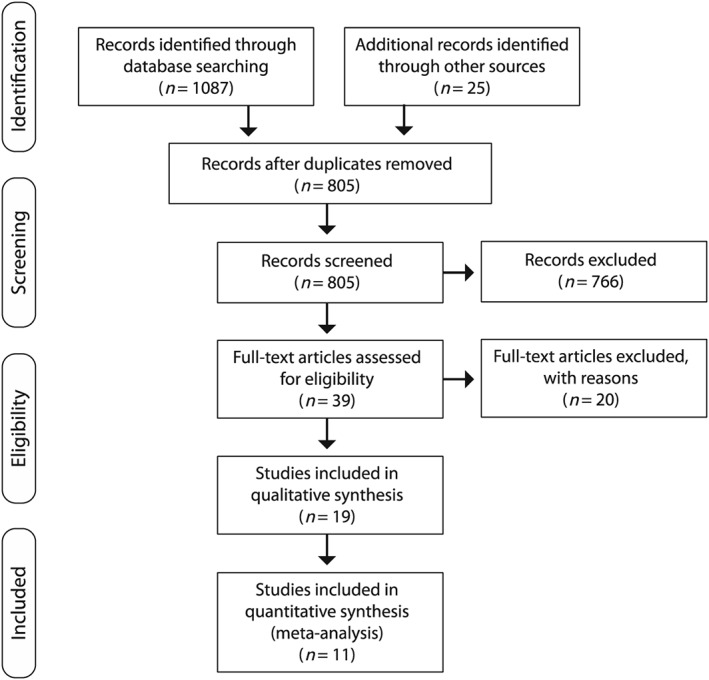
Embase, PubMed and PsycNET databases were searched between December 2016 and May 2018 using terms based on 'alcohol' and 'hangover'. Studies of experimental designs which reported the next-day cognitive effects of heavy alcohol consumption in a 'hangover' group with BAC < 0.02% were reviewed. A total of 805 articles were identified. Thirty-nine full-text articles were screened by two independent reviewers and 19 included in the systematic review; 11 articles provided sufficient data to be included in the meta-analysis; 1163 participants across 19 studies conducted since 1970 were included in the analysis. Data for study design, hangover severity, BAC at testing and cognitive performance were extracted and effect estimates calculated.
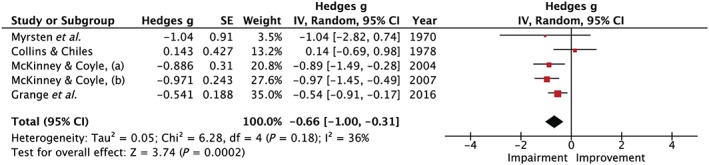
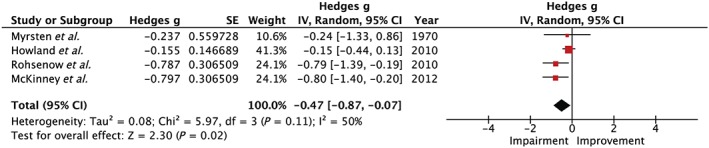
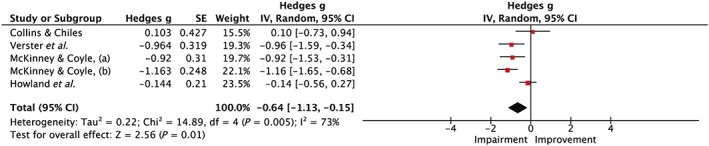
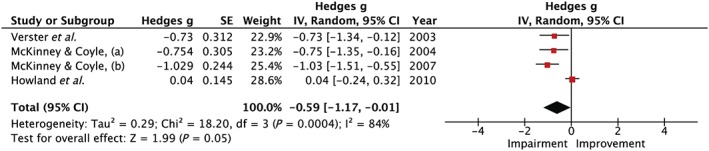
The systematic review suggested that sustained attention and driving abilities were impaired during hangover. Mixed results were observed for: psychomotor skills, short- (STM) and long-term memory (LTM) and divided attention. The meta-analysis revealed evidence of impairments in STM [g = 0.64, 95% confidence interval (CI) = 0.15-1.13], LTM (Hedges' g = 0.59, 95% CI = 0.01-1.17) sustained attention (g = 0.47, 95% CI = 0.07-0.87) and psychomotor speed (Hedges' g = 0.66, 95% CI = 0.31-1.00) during alcohol hangover.
The research literature suggests that alcohol hangovers may involve impaired cognitive functions and performance of everyday tasks such as driving.
研究考察了大量饮酒后次日的认知影响,结果喜忧参半,这可能反映了“宿醉”定义的不一致。最近的共识将宿醉定义为“在血液酒精浓度(BAC)接近零时,单次大量饮酒后次日出现的精神和身体症状”。有鉴于此,我们旨在系统地回顾文献,评估和估计大量饮酒后次日对认知的影响的平均效应大小。
2016 年 12 月至 2018 年 5 月期间,我们使用基于“酒精”和“宿醉”的术语,在 Embase、PubMed 和 PsycNET 数据库中进行了搜索。我们对报告 BAC<0.02%的“宿醉”组大量饮酒后次日认知影响的实验设计研究进行了审查。共确定了 805 篇文章。两名独立评审员筛选了 39 篇全文文章,19 篇纳入系统综述;11 篇文章提供了足够的数据纳入荟萃分析;分析中纳入了自 1970 年以来进行的 19 项研究的 1163 名参与者。提取了研究设计、宿醉严重程度、测试时的 BAC 和认知表现的数据,并计算了效应估计值。
系统综述表明,在宿醉期间,持续注意力和驾驶能力受损。对于以下方面的结果存在差异:运动技能、短期记忆(STM)和长期记忆(LTM)以及注意力分散。荟萃分析显示 STM 受损的证据[g=0.64,95%置信区间(CI)=0.15-1.13]、LTM(Hedges' g=0.59,95% CI=0.01-1.17)持续注意力(g=0.47,95% CI=0.07-0.87)和运动速度(Hedges' g=0.66,95% CI=0.31-1.00)在酒精宿醉期间。
研究文献表明,酒精宿醉可能涉及认知功能受损和日常任务(如驾驶)的表现受损。