Department of Psychiatry, Washington University School of Medicine, Mailstop 8134-29-2100, 660 S. Euclid Ave., St. Louis, MO 63110, USA.
Department of Pediatrics, University of California, San Diego, 8950 Villa La Jolla Dr., Suite C-203, San Diego, CA 92037, USA.
Contemp Clin Trials. 2018 Sep;72:117-125. doi: 10.1016/j.cct.2018.07.002. Epub 2018 Jul 6.
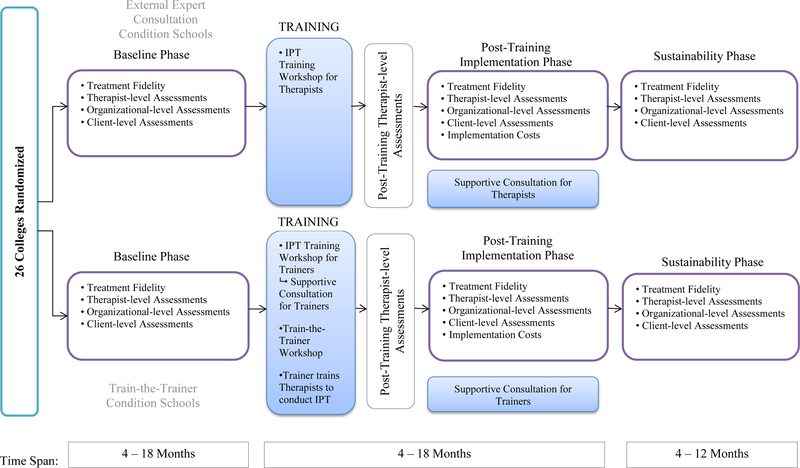
Mental disorders often emerge in adolescence and young adulthood, and these disorders can have lasting effects on students' health, social functioning, and education. Although evidence-based treatments have been established for many mental disorders, few community therapists use such treatments. What is needed is a practical, economically feasible means of training clinicians to implement evidence-based treatments suitable for widespread use. This cluster randomized trial will randomize 26 college counseling centers to one of two implementation strategies for training counselors to use interpersonal psychotherapy (IPT), an evidence-based treatment for depression and eating disorders: 1) an external expert consultation model comprising a workshop, therapy manual, and expert follow-up consultation (n = 13); or 2) a train-the-trainer model in which a staff member from the counseling center is coached to train other staff members to implement IPT (n = 13). The primary outcome is therapist adherence to IPT, with secondary outcomes of therapist competence in IPT and client outcomes for depression and eating disorders. Therapist and organizational characteristics will be explored as potential moderators and mediators of implementation outcomes. Implementation costs for each of the training methods will also be assessed. The present study involves partnering with college counseling centers to determine the most effective method to implement IPT for depression and eating disorders in these settings. The results of this study will inform future large-scale dissemination of clinical interventions to mental health service providers by providing evidence for the selection of training methods when an agency chooses to adopt new interventions.
精神障碍通常在青少年和青年时期出现,这些障碍会对学生的健康、社交功能和教育产生持久影响。尽管已经有许多针对精神障碍的循证治疗方法,但很少有社区治疗师使用这些治疗方法。我们需要一种实用且经济可行的方法来培训临床医生,以实施适合广泛使用的循证治疗方法。本项集群随机试验将随机分配 26 个大学咨询中心,采用两种实施策略之一对咨询师进行培训,以使用人际心理治疗(IPT):1)外部专家咨询模式,包括讲习班、治疗手册和专家后续咨询(n=13);或 2)培训员模式,由咨询中心的一名工作人员接受培训,以培训其他工作人员实施 IPT(n=13)。主要结局是治疗师对 IPT 的依从性,次要结局是治疗师在 IPT 方面的胜任力和抑郁及饮食障碍患者的结局。将探讨治疗师和组织特征作为实施结果的潜在调节因素和中介因素。还将评估每种培训方法的实施成本。本研究通过与大学咨询中心合作,确定在这些环境中实施 IPT 治疗抑郁和饮食障碍的最有效方法,从而为未来向心理健康服务提供者大规模推广临床干预措施提供依据,为机构选择采用新干预措施时选择培训方法提供证据。