de Visser Ewart J, Beatty Paul J, Estepp Justin R, Kohn Spencer, Abubshait Abdulaziz, Fedota John R, McDonald Craig G
Human Factors and Applied Cognition, Department of Psychology, George Mason University, Fairfax, VA, United States.
Warfighter Effectiveness Research Center, Department of Behavioral Sciences and Leadership, United States Air Force Academy, Colorado Springs, CO, United States.
Front Hum Neurosci. 2018 Aug 10;12:309. doi: 10.3389/fnhum.2018.00309. eCollection 2018.
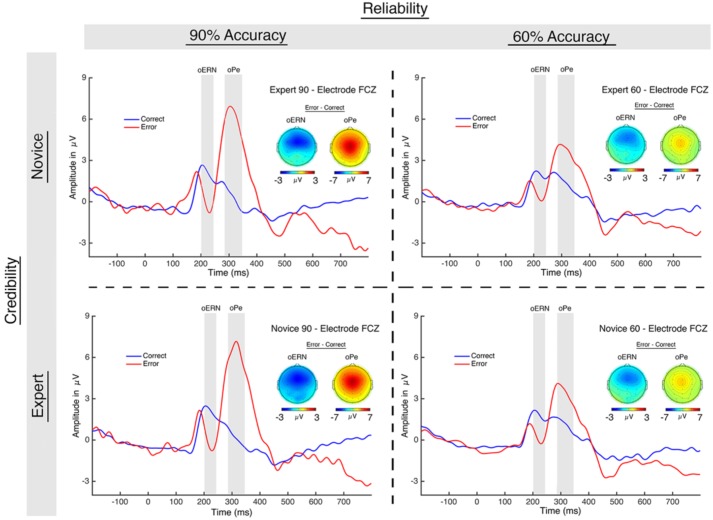
With the rise of increasingly complex artificial intelligence (AI), there is a need to design new methods to monitor AI in a transparent, human-aware manner. Decades of research have demonstrated that people, who are not aware of the exact performance levels of automated algorithms, often experience a mismatch in expectations. Consequently, they will often provide either too little or too much trust in an algorithm. Detecting such a mismatch in expectations, or , remains a fundamental challenge in research investigating the use of automation. Due to the context-dependent nature of trust, universal measures of trust have not been established. Trust is a difficult construct to investigate because even the act of reflecting on how much a person trusts a certain agent can change the perception of that agent. We hypothesized that electroencephalograms (EEGs) would be able to provide such a universal index of trust without the need of self-report. In this work, EEGs were recorded for 21 participants (mean age = 22.1; 13 females) while they observed a series of algorithms perform a modified version of a flanker task. Each algorithm's degree of credibility and reliability were manipulated. We hypothesized that neural markers of action monitoring, such as the observational error-related negativity (oERN) and observational error positivity (oPe), are potential candidates for monitoring computer algorithm performance. Our findings demonstrate that (1) it is possible to reliably elicit both the oERN and oPe while participants monitored these computer algorithms, (2) the oPe, as opposed to the oERN, significantly distinguished between high and low reliability algorithms, and (3) the oPe significantly correlated with subjective measures of trust. This work provides the first evidence for the utility of neural correlates of error monitoring for examining trust in computer algorithms.
随着日益复杂的人工智能(AI)的兴起,需要设计新的方法以透明、可感知人类的方式来监控AI。数十年的研究表明,那些不了解自动化算法确切性能水平的人,其期望往往会出现偏差。因此,他们对算法的信任往往要么过少,要么过多。在研究自动化应用时,检测这种期望偏差仍然是一项基本挑战。由于信任具有情境依赖性,尚未建立通用的信任度量标准。信任是一个难以研究的概念,因为即使是思考一个人对某个主体的信任程度这一行为,也可能改变对该主体的认知。我们假设脑电图(EEG)能够提供这样一种无需自我报告的通用信任指标。在这项研究中,对21名参与者(平均年龄 = 22.1岁;13名女性)进行了脑电图记录,他们观察一系列算法执行侧翼任务的修改版本。对每个算法的可信度和可靠性程度进行了操控。我们假设动作监测的神经标记,如观察错误相关负波(oERN)和观察错误正波(oPe),是监测计算机算法性能的潜在候选指标。我们的研究结果表明:(1)在参与者监测这些计算机算法时,能够可靠地诱发oERN和oPe;(2)与oERN不同,oPe能够显著区分高可靠性算法和低可靠性算法;(3)oPe与信任的主观度量显著相关。这项工作首次证明了错误监测的神经关联在检验对计算机算法的信任方面的效用。